
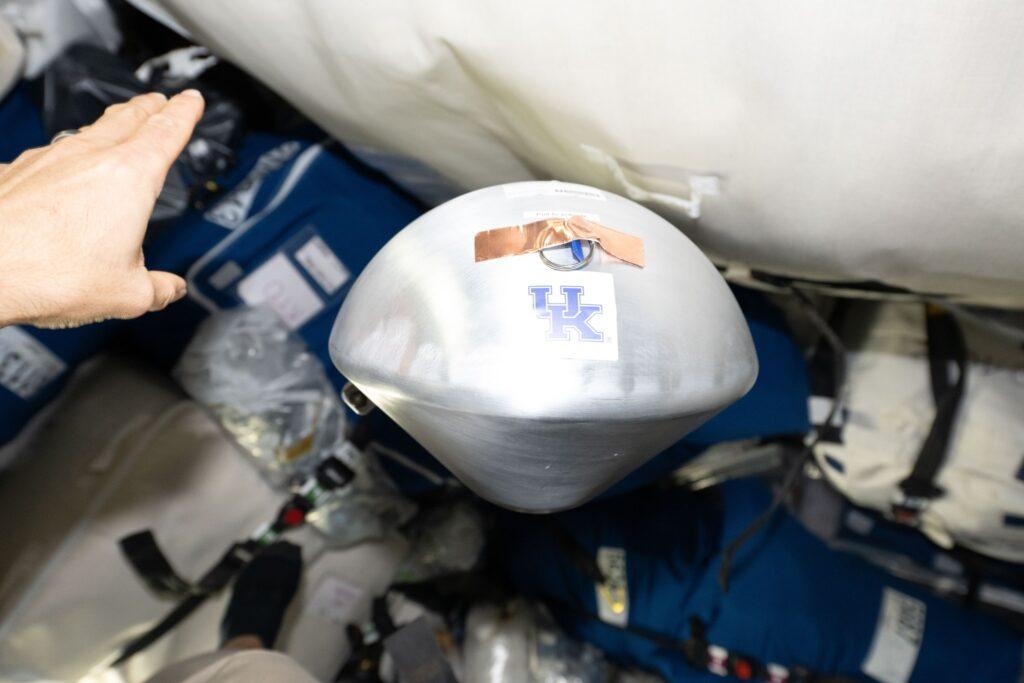
A KREPE-3 capsule is currently floating within the Northrop Grumman Cygnus XL 24 cargo spacecraft, as of 7th October. Inside this capsule lies a 3D-printed heat shield, a product of research conducted by scientists at NASA’s Johnson Space Center in Houston.
Innovative Testing of Heat Shields
NASA is exploring novel methods of heat shield testing to ensure astronaut safety during their return from missions to the Moon and Mars, employing an unconventional approach: utilising waste disposal missions. During the 24th cargo resupply mission to the International Space Station, a fleet of 12 small, experimental capsules was dispatched, designed specifically to evaluate the next generation of thermal protection materials that may form the basis of future heat shields.
This initiative, known as the Kentucky Reentry Probe Experiment (KREPE-3), represents the third in a series of cost-effective, high-impact missions aimed at collecting valuable data during the concluding phase of the cargo spacecraft’s operational life. This experiment is a collaborative effort involving the University of Kentucky, the state of Kentucky, NASA’s Established Program to Stimulate Competitive Research (EPSCoR), several NASA centres, along with various federal and commercial partners.
“KREPE-3 exemplifies the objectives of NASA’s EPSCoR programme,” remarked David Berger, EPSCoR programme manager at NASA Headquarters in Washington. “We are nurturing the next generation of scientists and engineers as they embark on unique projects that serve both their educational needs and NASA’s mission objectives.”
Transforming Waste into Valuable Data
Prior to the departure of the Cygnus XL from the station, astronauts loaded it with refuse and activated the 12 small capsules contained within. Developed by students at the University of Kentucky, these capsules are equipped with sensors that will monitor temperature, pressure, motion, magnetic fields, and light during the re-entry phase. As the spacecraft safely disintegrates upon re-entry into Earth’s atmosphere, the capsules will be released to gather data regarding the performance of each experimental heat shield material. Live data will be transmitted via satellite signals, providing insights into how larger heat shields might safeguard future cargo or crew missions.
“This strategy allows us to obtain flight data on materials that are still under development,” stated Keith Peterson, a materials engineer at NASA’s Ames Research Center in California’s Silicon Valley. “We are effectively leveraging a vehicle that is already returning to Earth.”
Advancements in Thermal Protection Technology
The capsules will feature a diverse array of thermal protective components, incorporating established technologies such as the ceramic tile material employed on the space shuttle. Additionally, some will evaluate innovative options, including a 3D-printed heat shield developed under NASA’s Additive Manufacturing of Thermal Protective Systems project in collaboration with Oak Ridge National Laboratory.
Researchers at NASA Ames are contributing various materials to KREPE-3, including two capsules designed to test a next-generation family of protective coverings termed Materials Engineered for Re-entry using Innovative Needling Operations (MERINO). Constructed from layers of carbon and phenolic fibres stitched together, these materials are more adaptable, quicker to manufacture, and more cost-effective than traditional protective materials, making them promising candidates for Mars-bound missions. The thinner atmosphere of Mars allows for reduced heat loads and facilitates lighter protective measures during landings.
Exploring Diverse Designs for Future Missions
A third capsule will combine these protective coverings with additional elements. The Kentucky Instrumented Conical Hypersonic Experiment will feature a dual-cone design, integrating a tungsten tip with a cone layered in carbon and heat-resistant plastic fibres, alongside an aft cone wrapped in MERINO. This distinctive configuration is expected to validate computer models against real-world data.
Another capsule mimics the protective aeroshell intended for NASA’s forthcoming Dragonfly mission, which will explore Saturn’s moon, Titan. This capsule is designed to test the dynamic stability of its design and is coated with Phenolic Impregnated Carbon Ablator, a material developed at NASA Ames that has seen applications in commercial vehicles and has previously been utilised in NASA’s Stardust, Mars Science Laboratory, and Mars 2020 missions.
Additionally, one capsule will examine a deployable heat shield known as Adaptable Deployable Entry and Placement Technology, which resembles an umbrella to increase surface area and decelerate descent. In its full-scale iteration, this design could be folded, making it ideal for deploying payloads larger than the rockets that launch them.
While some capsules are focused on testing new materials for Mars missions, others are investigating new shapes and designs that will enhance research and understanding of computer modelling and sensor technology—advancements that could pave the way for a new generation of re-entry design innovation.
Additional capsules, developed by both domestic and international collaborators, will assess a variety of established and innovative materials, including a heat flux sensor from the University of Stuttgart in Germany, which will assist researchers in measuring heat transfer across surfaces during re-entry.
“We are pushing the limits of heat shield technology,” Peterson concluded. “Our testing methods are rapid, cost-efficient, and remarkably effective.”




More Stories
NASA Appoints Christina Koch as Acting Deputy Chief Engineer in Groundbreaking Move
NASA JPL Prepares Voyager Technologies Lander for Upcoming Lunar Mission Testing
Exploring Complex Modes in Lightly Damped Structural Systems: Insights from a Two-Mode Interaction Approach