
Each day, enthusiasts of the cosmos are invited to explore a new image or photograph showcasing the wonders of our universe, accompanied by a succinct explanation crafted by a professional astronomer. This initiative, known as Astronomy Picture of the Day (APOD), serves as a gateway to the vastness of space.
Unveiling the Remnants of Cosmic Explosions
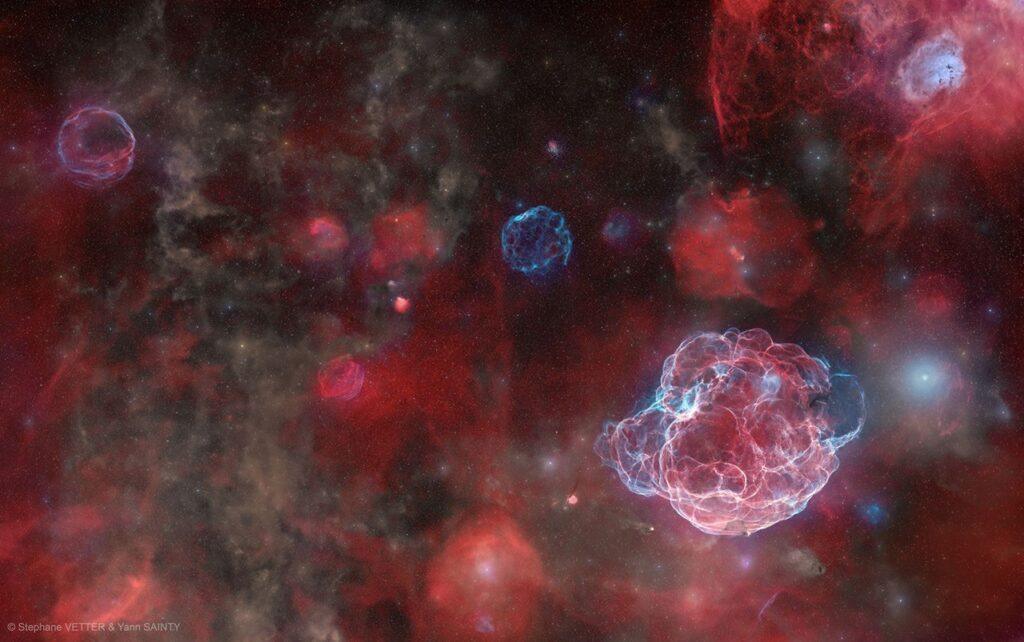
The image featured today captures the ethereal remnants of five supernovae, a ghostly testament to powerful stellar explosions. Taken at Oukaïmeden Observatory in Morocco, this extraordinary photograph represents approximately 200 hours of meticulous observation. It encompasses a vast region of the night sky, an area comparable to one thousand full moons laid side by side, situated within the constellation of Auriga, also known as the Charioteer.
From left to right, the five visible supernova remnants include G181.1+9.5, G182.4+4.3, G179.0+2.6, G180.0−1.7 (specifically known as Sh2-240 or the Spaghetti Nebula), and G178.2−4.2. These remnants are illuminated in the annotated image, which also features the open cluster M37 and the stunning Tadpole Nebula. As these supernovae exploded, they propelled a shell of shocked gas into the cosmos, forming intricate filamentary structures. The red hues represent hydrogen, while the blue indicates oxygen, providing a striking visual representation of these ancient events.
A Glimpse into Cosmic History
These supernova explosions occurred independently and are scattered across various distances from Earth, ranging up to several thousand light-years. Their ages span tens of thousands of years, suggesting that early humans may have witnessed them as brilliant new stars, their brightness waning over weeks or months. Such celestial phenomena not only enrich our understanding of the universe but also connect us to our ancestors, who gazed upon the same stars.
For those interested in contributing images to APOD, please note that the submission email has changed. Further details can be found on the APOD Submissions page. Additionally, the main NASA site for APOD is transitioning from apod.nasa.gov to science.nasa.gov/apod.
Anticipating Tomorrow’s Cosmic Display
As we look forward to tomorrow’s feature, be sure to check back for another captivating glimpse into the universe. The next image will be revealed on September 24, 2026, providing yet another opportunity to marvel at the wonders of space.
Today’s image credit goes to Stephane Vetter and Yann Sainty, with contributions from authors and editors Cecilia Chirenti, Robert Nemiroff, Jerry Bonnell, and Keighley Rockcliffe. This initiative is proudly supported by the ASD at NASA/GSFC, NASA Science Activation, and Michigan Technological University.
For those who missed it, yesterday’s image showcased the newly discovered lunar crater, McGetchin, further highlighting the ever-evolving nature of astronomical exploration.



More Stories
Shannon Lucid’s Historic Space Mission: Breaking Records on the Mir Space Station
Explore the Newly Discovered McGetchin Crater on the Moon – September 23, 2026
NASA’s Chandra Discovers Bizarre Objects in the Pinwheel Galaxy