
For further inquiries, please reach out to Joel W. Sills at the Langley Research Center via email at joel.w.sills@nasa.gov.
To obtain the PDF version, please click on the appropriate link.
Advancements in NASA’s Chemical Equilibrium Analysis
NASA’s Chemical Equilibrium with Applications (CEA) code serves as a vital tool for analysing propulsion systems. This programme facilitates equilibrium chemistry assessments, rocket performance evaluations, and calculations involving shock and detonation, thereby proving essential for NASA and the broader aerospace sector. The NASA Engineering and Safety Centre (NESC) undertook an initiative, labelled TI-22-01730, to modernise the longstanding CEA2 Fortran code. The result is CEA v3, an advanced Fortran 2008 object-oriented software package that boasts enhanced interface support, updated thermochemical data, improved maintainability, and significantly better workflow integration.
The newly modernised code retains backward compatibility with legacy CEA input workflows while allowing seamless integration with contemporary analysis environments, including Python, C, MATLAB, and automated design studies. This ensures that users can benefit from the latest advancements without losing access to established methodologies.
Understanding Complex Modes in Lightly Damped Structures
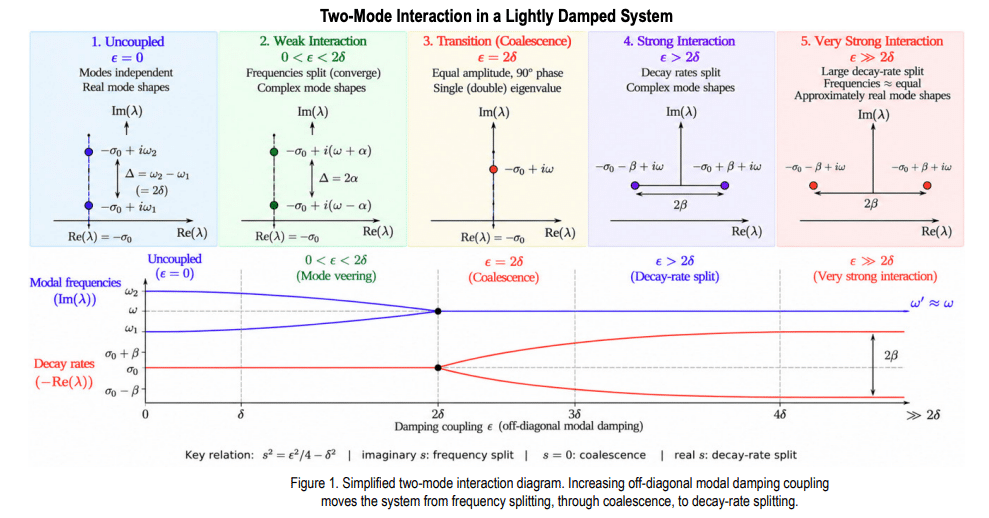
In classical modal analysis, lightly damped structures are frequently regarded as nearly proportional systems characterised by real mode shapes. However, this interpretation can be misleading when two modes are closely spaced. In the context of modal coordinates, nonproportional damping introduces an off-diagonal coupling term, denoted as ε. Consequently, the pertinent inquiry shifts from merely assessing whether damping is minimal to evaluating whether the coupling is substantial in relation to the baseline half-frequency separation, represented as δ = (ω2 – ω1)/2.
Exploring the Reduced Perturbation Framework
For a pair of closely spaced eigenvalues, one can define the central eigenvalue as λ0 ≈ -ζω + iω and express the coupled eigenvalues as λ1,2 = λ0 ± s. Under assumptions of light damping and closely spaced modes, the local quartic eigenvalue problem simplifies to s² = ε²/4 – δ². This singular relationship is crucial as it dictates the direction of eigenvalue separation within the complex plane, as illustrated in the accompanying figure.
In summary, this sophisticated approach underscores the importance of considering both damping and coupling effects in the analysis of closely spaced modes, thereby enhancing the accuracy of predictions in engineering applications.




More Stories
NASA Appoints Christina Koch as Acting Deputy Chief Engineer in Groundbreaking Move
NASA JPL Prepares Voyager Technologies Lander for Upcoming Lunar Mission Testing
Explore the Enchanting Dance of Jupiter and Its Moons: October 12, 2026 Astronomy Highlights