
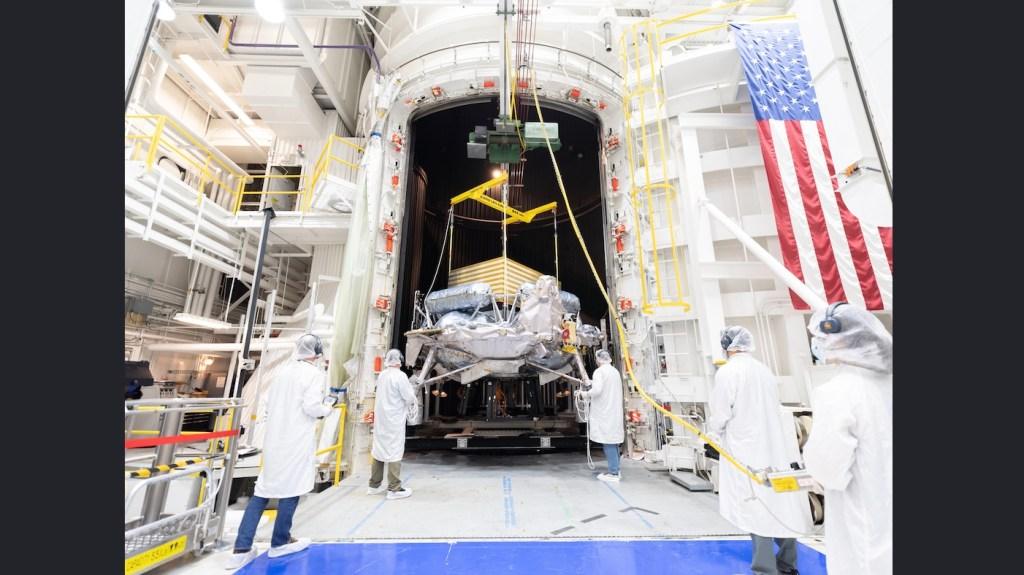
Specialised engineers clad in pristine clean-room attire and hairnets oversee the manoeuvring of a spacecraft, which is delicately suspended from a crane, into an expansive thermal vacuum chamber located within a high-bay facility. An American flag prominently adorns the wall, symbolising the national pride in this ambitious endeavour.
Advancements in Lunar Exploration
This commercial lander is set to play a pivotal role in NASA’s mission to create a permanent human presence on the Moon, marking a significant milestone in lunar exploration. Following a rigorous sequence of essential evaluations, the lander has successfully met critical benchmarks that are integral to its operational readiness.
The spacecraft’s design and functionality have been meticulously tested to ensure that it can withstand the harsh conditions of space and the Moon’s environment. These tests are crucial for validating the lander’s systems, which include navigation, communication, and power management, thereby ensuring that it can perform its intended functions effectively once deployed.
A New Era of Space Collaboration
The project represents a collaborative effort between government and private industry, exemplifying a new era in space exploration. By partnering with commercial entities, NASA aims to leverage innovative technologies and reduce costs, thereby accelerating the timeline for establishing a lunar base.
As part of this initiative, the commercial lander will be instrumental in transporting cargo, equipment, and scientific instruments to the Moon’s surface. This will not only facilitate the construction of infrastructure for human habitation but also support ongoing research aimed at understanding the Moon’s resources and potential for future exploration.
Future Implications for Human Spaceflight
The successful deployment of this lander is expected to have far-reaching implications for future human spaceflight missions beyond the Moon, including aspirations for Mars exploration. By refining the technologies and processes involved in lunar landings, engineers are laying the groundwork for more complex missions in the solar system.
In addition to its technical achievements, this venture embodies a spirit of exploration that resonates with humanity’s enduring quest to push the boundaries of what is possible. As preparations continue, anticipation builds around the lander’s eventual launch and its role in a historic chapter of space exploration.




More Stories
NASA Appoints Christina Koch as Acting Deputy Chief Engineer in Groundbreaking Move
Exploring Complex Modes in Lightly Damped Structural Systems: Insights from a Two-Mode Interaction Approach
Explore the Enchanting Dance of Jupiter and Its Moons: October 12, 2026 Astronomy Highlights