
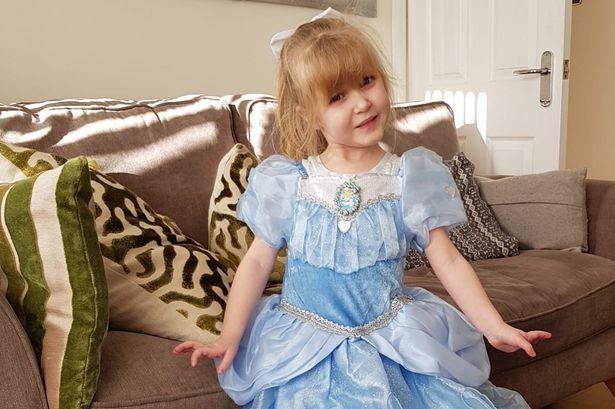
A young girl, Faye Condon, aged 12, endured six rounds of chemotherapy unnecessarily due to a misdiagnosis of an autoimmune condition. Faye was first diagnosed with Juvenile Dermatomyositis (JDM) at the tender age of five, after her mother, Christina Condon, observed that Faye was not as active as her peers. Despite the diagnosis, Christina, 36, remained sceptical and advocated for further testing to explore alternative conditions.
After seven long years, encompassing six cycles of chemotherapy, home injections, and a muscle biopsy, Faye was finally referred to Great Ormond Street Hospital (GOSH), where she received a correct diagnosis of de novo Emery-Dreifuss muscular dystrophy (EDMD) type 2. Unfortunately, there is currently no treatment available for this condition. Christina, hailing from Plymouth, expressed her anguish: “We have spent her entire childhood in and out of hospital. We haven’t had holidays and our home is not wheelchair accessible because we were led to believe she would get better.”
Frustration with Medical Professionals
Reflecting on the years lost, Christina lamented that had Faye been correctly diagnosed when she was still able to walk, they could have enjoyed holidays and created lasting memories before her condition worsened. “We put our lives on hold because we were consistently told she would improve,” she added. In March 2019, Christina took Faye to the hospital, concerned about her developmental progress. Initially referred to Bristol Children’s Hospital (BCH), doctors conducted preliminary tests. Christina recounted her experience: “I first took her in for hip pain and difficulty bearing weight. I knew something was amiss, but the doctors couldn’t see what I observed as a mother.”
“Faye couldn’t walk 200 yards to school and would unexpectedly fall. I had to document her struggles to provide evidence. It was subtle yet evident to me. The doctor seemed dismissive, merely prescribing medication that yielded no improvement.” In October 2019, Christina was assured that it was not muscular dystrophy, yet she felt the doctor assumed Faye fit into a rheumatological condition before even assessing her properly. “Everyone noticed something was wrong, but no one wanted to take responsibility for further tests due to financial concerns,” she added. “We shouldn’t have to hear about budget disputes when seeking medical care.”
The Struggles with Diagnosis and Treatment
Despite undergoing numerous tests for the autoimmune disease, all results returned negative, and a muscle biopsy indicated a congenital muscle condition, not an autoimmune disorder. Nevertheless, the diagnosis of JDM was made in November 2019. Consequently, Faye’s first chemotherapy session commenced in January 2021, leaving her severely ill. Christina described the experience as “horrific” as Faye, then merely seven years old, became gravely unwell and contracted viral meningitis as a complication from a blood product administered during treatment.
“There is no cure for muscular dystrophy, so none of this would have been necessary had there been a timely and accurate diagnosis,” Christina lamented. A 2023 study published in the British Medical Journal indicated that approximately one in 18 patients in primary and secondary care experience misdiagnosis. Following her persistent advocacy, Christina sought a second opinion at Derriford Hospital, where a doctor concurred that the JDM diagnosis was incorrect and facilitated a referral to GOSH.
A Journey Towards the Correct Diagnosis
“Without the support of the doctors at Derriford Hospital, we may never have received the correct diagnosis,” Christina acknowledged. “From the outset, they listened to us as parents and advocated for Faye.” The doctor conducted genetic blood tests, leading to a conclusive diagnosis at GOSH. Christina recounted how the specialist there promptly identified the type of muscular dystrophy after reviewing Faye’s case. “It only required a specific genetic blood test, yet the doctors at BCH were so convinced it was JDM that they never pursued it. Those doctors have irrevocably impacted my daughter’s childhood. I feel utterly let down.”
Currently, there is no available treatment for muscular dystrophy, requiring a focus on maintaining Faye’s comfort and minimising pain. Christina lamented, “She is rapidly losing the use of her legs and has even been refused entry into a school due to her changing needs. Our home is unsuitable for wheelchair access, rendering it unsafe. Faye is in a precarious situation; her heart could fail at any moment, and she relies on a ventilator at night, which precludes her from participating in sleepovers like her classmates.”
The Impact on Family Life and Ongoing Complaints
“Had we been informed accurately at the age of five, we could have made essential preparations and not found ourselves in such a desperate predicament now,” Christina reflected. “Every appointment seems to bring more distressing news, and Faye is struggling to cope with her new diagnosis. Her independence is slipping away. If I were in her position, I would have given up by now, but she depends on my support.”
Christina is currently in the process of filing a formal complaint against BCH. In response to the family’s concerns, Professor Steve Hams, chief nursing and improvement officer at Bristol NHS Foundation Trust, expressed his regret over the situation. “We are deeply sorry to hear about the issues raised by Faye’s family, and our thoughts are with them. We aim to reach out to her mother to understand and address their experience comprehensively, prioritising care and compassion as we proceed.”




More Stories
The Reset Rooms puts Pilates, yoga and recovery under one roof in Crouch End
Yoga studios in London
Weddings by Anita: documentary-style wedding photography in London