
Unprecedented Summer Heat in the UK
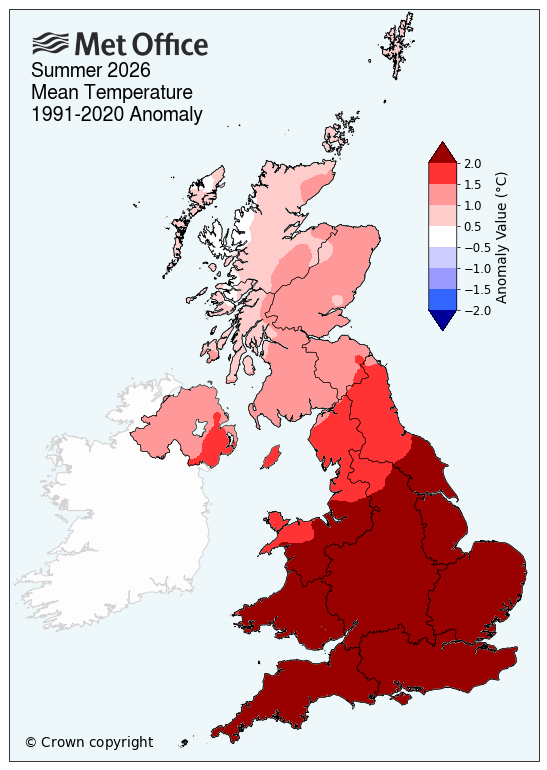
The summer of 2026 has been provisionally marked as the hottest on record in the United Kingdom, with an average mean temperature of 16.5°C, surpassing all previous seasons since records began in 1884. This remarkable increase in temperature has been attributed to human-induced climate change, which has made such extremes approximately 130 times more likely.
Alongside the soaring temperatures, this summer also stands out as one of the sunniest on record for numerous regions, dating back to 1910. While many areas experienced significantly dry conditions throughout the season, late rains played a crucial role in averting a complete drought and steering clear of breaking seasonal rainfall records.
Dr Amy Doherty, who heads the National Climate Information Centre at the Met Office, commented on the unprecedented conditions, stating, “The climate records we have encountered this summer highlight the increasing frequency of such events, underscoring the impact of human-induced climate change on UK temperatures. Notably, we have significantly surpassed the previous summer mean temperature record, set just the year before, and the once infamous summer of 1976 has now been relegated to seventh place in the rankings of average summer mean temperatures.”
Breaking Historical Temperature Records
The warm weather was a persistent theme throughout the summer, following a notable heatwave in late spring. The UK commenced meteorological summer with its second warmest June on record, closely followed by an equally warm July. Although late August brought some unsettled weather that slightly tempered the month’s temperature figures, the overall consistency of warmth throughout the season resulted in the establishment of a new provisional record for the UK’s summer mean temperature.
All four nations of the UK reported broken mean temperature records for the summer season, with Scotland recording its joint sixth warmest summer. The updated list of the five warmest summers on record now includes:
- 2026: 16.5°C
- 2025: 16.1°C
- 2018: 15.7°C
- 2006: 15.7°C
- 2003: 15.7°C
The summer of 1976, once notorious for its heat, now ranks seventh. Furthermore, the average daytime maximum temperatures for 2026 also set a new record, eclipsing the previous high established in 1976, with daily temperatures peaking at 38.1°C at Kew Gardens on 13 August. Lingwood in Norfolk achieved a new daily temperature record for June, reaching 38.0°C. Overall, 54 weather stations operated by the Met Office broke their all-time daily maximum temperature records this summer.
The Impact of Climate Change on Extreme Weather
A rapid climate attribution study conducted by scientists at the Met Office has determined that the record-breaking summer was made approximately 130 times more likely due to human-induced climate change. This assessment was based on peer-reviewed methodologies outlined in a technical report.
By analysing computer simulations, one of which factored out human influence on greenhouse gas levels, researchers were able to evaluate the effects of anthropogenic climate change on the event. Dr Mark McCarthy, the head of Climate Attribution at the Met Office, remarked, “The summer of 2026 is a remarkable example of the extremes we can expect to witness more frequently due to human-induced climate change. Our findings reveal that summers like this one are now around 130 times more probable, whereas, in a climate that was not impacted by human greenhouse gas emissions, such an event would have been exceptionally unlikely—about once in over 1,000 years.”
Dr McCarthy further noted that a summer as extreme as this one is expected to occur roughly once every nine years in the current climate scenario. The attribution study conducted after the summer of 2025, which was already record-breaking, indicated that even hotter summers could be anticipated. Just a year later, the average temperature for summer 2026 was found to be 0.40°C higher than that of 2025, a significant margin for a seasonal temperature.
Projections for Future Summers and Climate Trends
The analysis concluded that the estimated return period for a summer like that of 2026 in a natural climate would be around 1,148 years, although this estimate carries substantial uncertainty due to the extreme nature of the event. Climate projections suggest that UK summers will continue to grow hotter, a trend already evident in observational data.
Dr James Pope, a climate scientist at the Met Office, explained that when comparing summer 2026 to global climate change projections, it would align with the average conditions expected in a world that is 2.5 to 3°C warmer than pre-industrial times. He noted, “If greenhouse gas emissions are curtailed and global warming is limited to 2°C, this summer would still be classified as notably hot. However, in a scenario where emissions continue to rise and the world warms by 4°C, summer 2026 would likely be perceived as cool or below average.”
Dry Conditions and Sunshine Records
Despite some late-season rain and thunderstorms, the overall dryness of the summer remained pronounced. July was recorded as the UK’s third driest on record, with England experiencing its driest July ever. Although late August rainfall helped to moderate summer totals, they still fell short of average levels.
High pressure systems contributed to the warmth of recent months, yielding abundant sunshine across many regions. The summer of 2026 saw the UK experience its sixth sunniest summer on record, accumulating 621.9 hours of sunshine. Both England and Wales recorded their second sunniest summers ever, while Scotland saw sunshine levels closer to its historical average. Notably, Preston Cove House became the first UK weather station to log more than 400 hours of sunshine in a single month, recording 409.2 hours in July 2026, while St Athan in South Glamorgan set a new Welsh monthly sunshine record with 360.6 hours.
Statistical Overview of Summer 2026
The following provisional statistics summarise the weather conditions across the UK for summer 2026:
| Region | Mean Temp (°C) | Rainfall (mm) | Sunshine (hours) |
|---|---|---|---|
| UK | 16.5 | 195.4 | 621.9 |
| England | 18.2 | 132.9 | 752.2 |
| Wales | 16.9 | 179.5 | 699.4 |
| Scotland | 13.8 | 295.0 | 418.5 |
| Northern Ireland | 15.4 | 246.8 | 424.0 |
Monthly Recap: August 2026
August, much like the preceding summer, displayed a split between the northern and southern regions of the UK. All nations recorded above-average mean temperatures for the month, with England showing the most significant increase of 1.9°C above the long-term average, while Scotland was closest to average at 0.5°C. The south of England witnessed particularly high mean temperatures, with seven counties breaking their August temperature records.
While large areas of the UK remained drier than average throughout August, intense downpours toward the end of the month brought some regions closer to average rainfall levels. Nonetheless, certain areas, especially in Wales and southern England, continued to experience below-average rainfall despite the late-month precipitation.
Sunshine hours were unevenly distributed across the country, with the south enjoying above-average sunshine, while northern England and Wales saw levels around average, and Northern Ireland and Scotland recorded below-average sunshine hours.
Provisional Statistics for August 2026
The following provisional statistics summarise the weather conditions across the UK for August 2026:
| Region | Mean Temp (°C) | Rainfall (mm) | Sunshine (hours) |
|---|---|---|---|
| UK | 16.5 | 75.8 | 184.8 |




More Stories
Calm Weekend Ahead Before Rainy Weather Moves In
Unpredictable Weather Ahead: Expect Wind, Rain, and Sunshine This Week
UK’s Early Spring: Discover How Nature Is Adapting to Rising Temperatures