
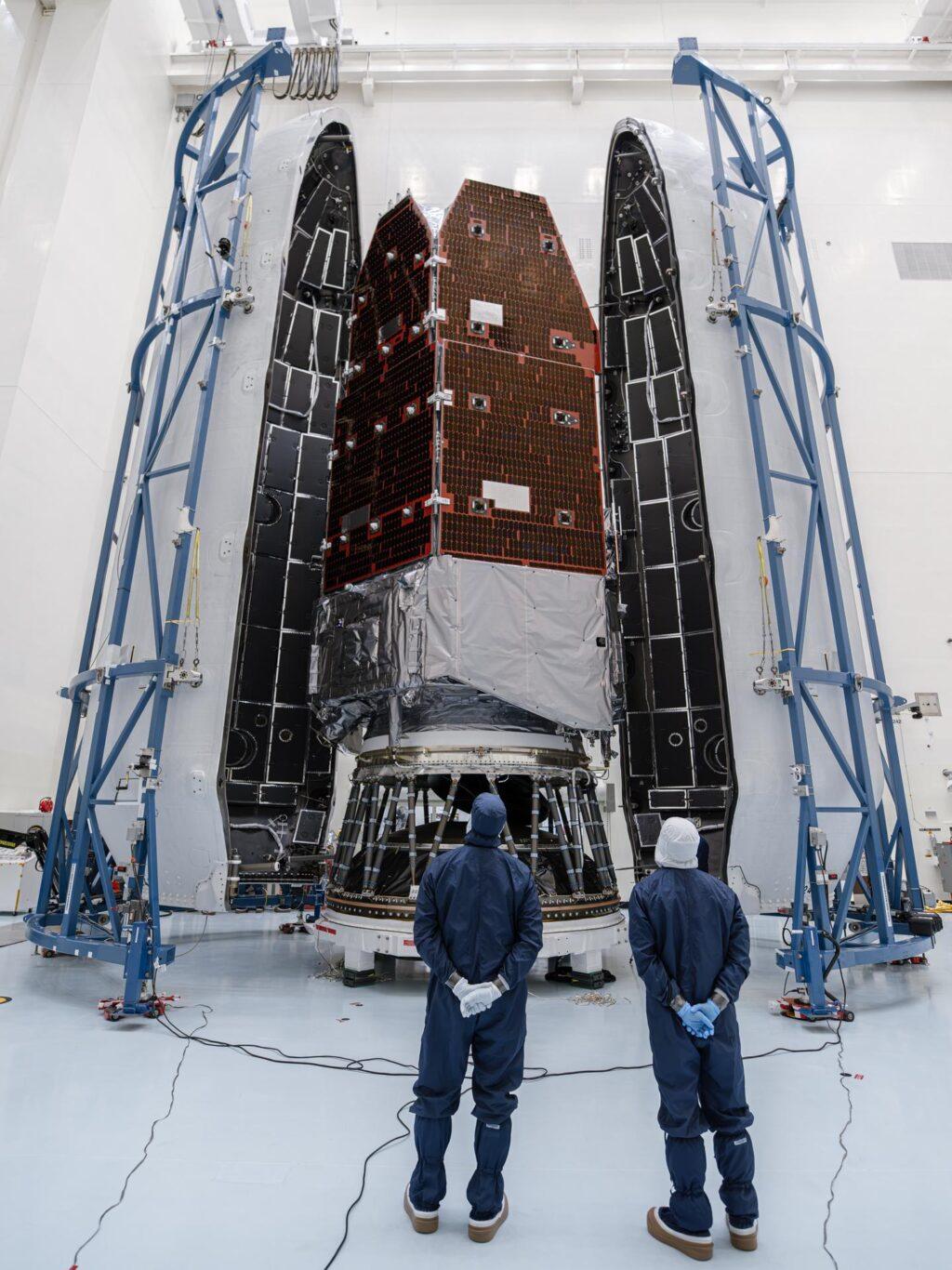
The Nancy Grace Roman Space Telescope has been successfully encapsulated within its payload fairing at NASA’s Kennedy Space Center in Florida, in preparation for its upcoming launch. This innovative observatory is designed to delve into some of the universe’s most profound enigmas, including the nature of dark energy.
Launch Schedule and Coverage Details
NASA, in collaboration with SpaceX, has set a target launch window for Roman at no earlier than 7:26 a.m. EDT on Sunday, 30th August, aboard a Falcon Heavy rocket from Launch Complex 39A at Kennedy Space Center. Coverage of the launch will commence at 6:20 a.m.
Live streaming of the prelaunch and launch activities will be available across various platforms. For those interested in viewing the events online, further details can be found at the NASA website.
The Nancy Grace Roman Space Telescope, named after NASA’s first chief astronomer, boasts cutting-edge infrared capabilities and a field of view more than 100 times that of the Hubble Space Telescope. Its wide-ranging surveys are expected to significantly advance our understanding of dark energy and dark matter, facilitate the discovery and characterisation of exoplanets, map billions of galaxies, investigate black holes, and examine objects within our solar system as well as those at the very edge of the observable universe.
Mission Timeline and Key Events
Following its launch and subsequent separation from the rocket, the Roman telescope will embark on a journey to the second Sun-Earth Lagrange point (L2), situated approximately one million miles from Earth. The mission is designed with a primary operational period of five years, although there are ambitions for it to function for up to ten years. Once processed, the scientific data collected by Roman will be made publicly accessible.
The mission’s coverage will unfold as follows (all times are listed in Eastern Time and may be subject to adjustments based on real-time developments):
On Saturday, 29th August:
9:00 a.m.: A mission science briefing will be held at the NASA Kennedy Press Site auditorium, featuring prominent scientists including Shawn Domagal-Goldman from NASA Headquarters and Julie McEnery, senior project scientist at NASA Goddard Space Flight Center. Media representatives can pose questions either in person or via phone, with limited seating available.
10:30 a.m.: A prelaunch news conference will follow, with key participants such as Nicky Fox, associate administrator for NASA’s Science Mission Directorate, and Lucas Paganini, program executive for the Roman telescope. As with the earlier briefing, media can participate in person or by phone.
11:45 a.m.: NASA Administrator Jared Isaacman is anticipated to conduct a flyover of the launch pad in his jet, which will be broadcast live alongside the prelaunch news conference.
12:00 p.m.: In-person interviews will be available at the NASA Kennedy Press News Centre, featuring various project leaders and scientists involved in the Roman mission.
On Sunday, 30th August:
6:20 a.m.: Launch coverage will commence.
7:26 a.m.: The anticipated launch will take place.
9:30 a.m.: A postlaunch news conference will occur, featuring NASA Administrator Jared Isaacman and project leaders from the Roman mission.
Audio Coverage and Public Engagement
For those interested in audio-only coverage, the launch will be available via NASA’s “V” circuits, which can be accessed by calling specific numbers. Additional audio will be provided on the Launch Information Service as well as local amateur radio frequencies.
Members of the public are invited to register for virtual attendance at the launch through NASA’s Virtual Guest Program, which includes access to curated resources and notifications about launch-related opportunities.
Social media users are encouraged to share their excitement about the mission by engaging with NASA’s accounts on various platforms, including X, Facebook, and Instagram. The Roman telescope project is managed at NASA Goddard, with significant contributions from the Jet Propulsion Laboratory, Caltech/IPAC, and various research institutions globally, alongside key industrial partners.
For further information about the Nancy Grace Roman Space Telescope, please visit the NASA website.




More Stories
NASA Appoints Christina Koch as Acting Deputy Chief Engineer in Groundbreaking Move
NASA JPL Prepares Voyager Technologies Lander for Upcoming Lunar Mission Testing
Exploring Complex Modes in Lightly Damped Structural Systems: Insights from a Two-Mode Interaction Approach