
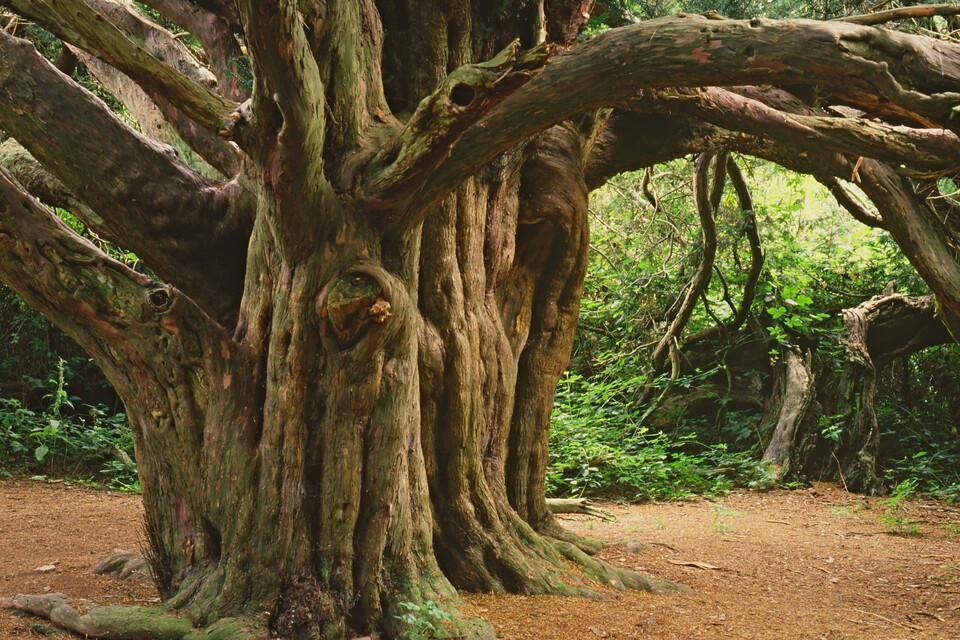
Kingley Vale National Nature Reserve (NNR), located near Chichester in West Sussex, is a designated Site of Special Scientific Interest (SSSI) and a special area of conservation, primarily celebrated for its ancient yew woodlands. Covering an expansive 147.9 hectares, of which approximately 99.1 hectares is wooded, the reserve features significant chalk grassland as well.
The yew woodlands dominate the steep southern slopes of the reserve, with notable features including a ‘yew grove’ at the site’s base, which is home to at least 30 ancient yews, some of which measure over five metres in circumference. These venerable trees, estimated to be between 500 and 2,000 years old, rank among the oldest yews in Europe. In addition to yews, the woodland is home to a variety of other tree species including oak, birch, ash, holly, whitebeam, and hawthorn, with remnants of ancient wood pasture indicating a historical grazing landscape that has evolved into closed-canopy woodland.
Impact of Ash Dieback on the Woodland Ecosystem
Over the past decade, the reserve has faced significant challenges due to ash dieback, a chronic fungal disease affecting a large portion of the South Downs since 2012. This has resulted in the felling of numerous ash trees, leading to the creation of open canopy areas within the woodland.
The flora at Kingley Vale NNR is under constant threat from local deer populations, which include roe deer, fallow deer, and increasingly, Reeve’s muntjac. The broader deer management area surrounding the reserve is estimated to host 17 deer per square kilometre. While yew seedlings have been observed in the understory of mature woodlands, heavy browsing pressure has hindered their establishment. Fallow deer, being the most prevalent species, are particularly concerning due to their significant impact on the regeneration of the woodland.
Evidence of deer activity is widespread, with young trees and new growth suffering noticeable damage. The yew trees display a phenomenon known as ‘deer topiary,’ where repeated browsing shapes new shoots into hedge-like forms. Bark damage from fallow deer rubbing their antlers against trees is prevalent, particularly following the autumn rutting season.
Conservation Efforts and Deer Management Strategies
In response to the challenges posed by deer browsing, Kingley Vale NNR employs various deer management strategies, primarily through contract stalking conducted in a careful and sustainable manner. Since 2023, the reserve has been included in a Protected Site Strategies (PSS) initiative led by Natural England, which aims to enhance collaboration among landowners, share knowledge, and coordinate deer surveys and management.
This project not only bolsters conservation efforts but also supports the rural economy by providing training, connecting with game dealers, and developing local supply chains for venison. Following the Covid-19 pandemic, visitor numbers have more than doubled, resulting in increased human activity that has created a ‘landscape of fear’ for the deer, thereby altering their movement patterns.
Innovative methods such as thermal drone surveys are now being employed to assess deer density and distribution. Findings reveal that fallow deer tend to congregate in the SSSI woodland areas during the day, venturing into surrounding arable lands at night to feed. Population control measures aim to maintain sustainable levels, supported by annual woodland impact surveys to gauge browsing pressure.
Innovative Approaches to Tree Protection
To combat browsing pressures, Natural England has trialled various physical tree protection methods, including small-scale exclosures. Structures made from Timber and Clipex® have been established to foster regeneration, while miniature weld mesh exclosures allow for annual monitoring of growth. These exclosures are designed to be easily relocated every six to ten years, ensuring ongoing regeneration across the site.
Past initiatives have included protecting individual seedlings with flexi-netting tubes, achieving mixed results in supporting sapling growth. The sustainability and durability of tree guards are critical considerations in effective management.
In addition to deer management, Kingley Vale NNR is grazed by both sheep and Belted Galloway cattle. Sheep are typically confined to grassland areas through temporary electric fencing, while drop gates and deer leaps have been incorporated into traditional stock fencing to facilitate deer movement through the woodland.
Integrating Livestock Grazing with Woodland Conservation
This integration of livestock grazing and deer management is essential for maintaining the health of the woodland ecosystem. The addition of plain wire above barbed wire, along with high-visibility electric fencing tape and strategically placed deer leaps, has significantly reduced deer injuries caused by fencing.
Historical management practices may have involved delimbing or crown-lifting yew trees to prevent livestock access to the toxic foliage or to enhance light penetration to the forest floor. The cattle, accustomed to grazing among yews, also browse on these trees.
To optimise cattle movement, the reserve has experimented with Nofence GPS-enabled collars, which create virtual boundaries to regulate grazing. While these collars facilitate a more extensive grazing regime, challenges remain, particularly when cattle are motivated to access restricted areas.
Kingley Vale NNR exemplifies effective management practices aimed at balancing deer populations, livestock grazing, and woodland regeneration. Through targeted monitoring, coordinated control efforts, and innovative protection strategies, the reserve continues to address the browsing pressures that threaten the young trees within its bounds.
Resources for Further Information
For those interested in learning more, the following resources provide valuable insights:
- Farm Animal Welfare Committee – An independent report on the welfare implications of virtual fencing for livestock.
- Natural England – Information on PSS projects and conservation efforts.
- Forest Research – A checklist for planning and maintaining fencing.
- National Animal Disease Information Service – Information on plant toxicity to livestock.
- Visual Guide to Deer Damage – Guidance on identifying damage caused by deer.
- Visual Guide to Grazing Damage – Identifying damage from grazing species.




More Stories
Graham Bell Announces Retirement: A Farewell to an Iconic Career
Welfare System Reforms Expected to Generate £1.9 Billion in Savings by 2030/31
Neil Sachdev’s Tenure as Chair of HM Land Registry Extended: What It Means for the Future