
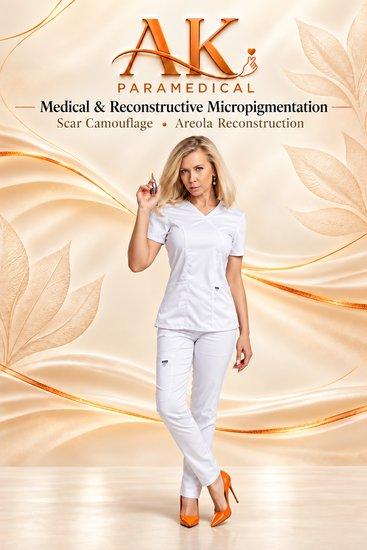
The Battersea specialist focuses on reconstructive and paramedical micropigmentation, including scar and pigmentation camouflage and areola reconstruction
Anna Kovalchuk runs AK Paramedical Studio, a private studio in Battersea, south-west London, dedicated to paramedical micropigmentation. She holds a VTCT Level 4 qualification in the discipline, has worked in London and St Petersburg, and has trained more than 70 practitioners across five countries.
Her practice focuses on reconstructive and paramedical micropigmentation: scar camouflage following surgery, trauma and burns; camouflage of vitiligo and pigmentation irregularities; and areola and 3D nipple tattooing after breast surgery. She describes her approach as "a highly specialised discipline where technical knowledge of skin, scar tissue and pigment meets artistic judgement".

The cases others turn away
With more than a decade in paramedical pigmentation, Anna has built her practice around complex cases. "I have become known as the specialist you come to when every other practitioner has said no," she says. Complex corrections, layered scar tissue and unpredictable skin are, in her words, not obstacles but invitations.
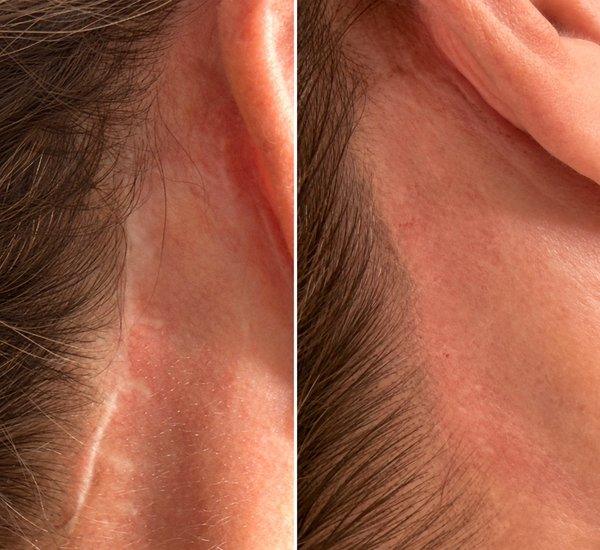
Scar camouflage
Scar camouflage uses micropigmentation to blend a scar into the surrounding skin. Anna works with surgical scars, such as those left by caesarean sections, tummy tucks or breast surgery, with scars from accidents and healed burns, mature stretch marks, cleft lip scars and skin grafts, and she offers pigment camouflage for vitiligo. Self-harm scars are treated "with complete discretion and without judgement".
She is clear about the limits of the technique. Camouflage reduces the visibility of a scar but does not erase it, results vary from person to person, and not every scar can be treated: raised, red or very recent scars, for example, usually aren't suitable. She usually recommends a small patch test first and, if camouflage is not right for a particular scar, she says she will tell the client.
Anna also highlights the growing role of reconstructive micropigmentation following modern cosmetic and plastic surgery. Aesthetic surgery is now much more common, and people are increasingly attentive not only to the surgical result itself, but also to the visible traces that may remain afterwards. Once the surgeon's work is complete and the tissues have fully healed, her work can become the final aesthetic stage, helping to soften and camouflage visible scars and restore greater visual harmony to the skin.
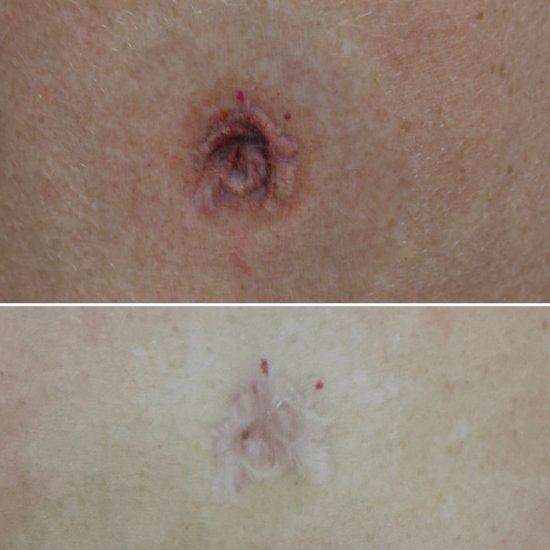
Areola and 3D nipple tattooing
For people who have had a mastectomy or breast reconstruction, Anna recreates the appearance of the areola and nipple with 3D tattooing once the skin has healed. She also works on asymmetric or faded areolas, after top surgery, and on corrections of areola tattoos done elsewhere. "I treat the areola not as just a procedure, but as the completion of a long journey," she says.
Another very important part of her practice is supporting women who have undergone treatment for breast cancer. Anna provides complimentary reconstructive areola and 3D nipple micropigmentation procedures for women following mastectomy and breast reconstruction. For her, this is more than an aesthetic procedure: it can help restore visual harmony, femininity and confidence after a very difficult period in a woman's life.

A calm start
The first step is a calm, no-pressure consultation in which Anna assesses the skin and the client's goals, and she recommends that clients who have had surgery confirm the timing with their surgeon. She sums up the purpose of her work in one sentence: "The aim is simple: to help you feel more at home in your own skin."
Address: 226 York Rd, London SW11 3SD



More Stories
Weddings by Anita: documentary-style wedding photography in London
Wedding photographers in London
Meet Britain’s Strongest Schoolgirl: The Edgware Weightlifter Breaking Stereotypes