
The Artemis II mission, a significant milestone in NASA’s lunar exploration programme, has successfully completed its objective of transporting four astronauts around the Moon and returning them safely to Earth. This mission not only marks a major achievement in space exploration but also paves the way for future crewed landings on the lunar surface.
Heat Shield Performance Analysis
Following the mission, extensive engineering data analysis was conducted on the heat shield of the Orion spacecraft. The findings corroborated initial assessments, demonstrating that the heat shield functioned as anticipated during its journey. This crucial component is designed to protect the spacecraft from the extreme temperatures encountered during re-entry into Earth’s atmosphere, and the analysis confirmed its reliability under these demanding conditions.
The heat shield’s performance is critical for the safety of future Artemis missions, particularly as NASA prepares for more complex operations, including lunar landings. The successful results from Artemis II provide valuable insights that will inform ongoing developments in spacecraft design and engineering.
Visual Comparison of Heat Shields
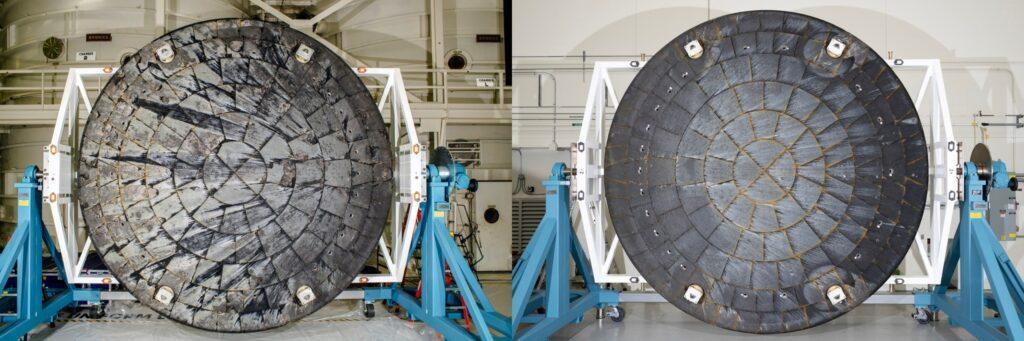
A visual juxtaposition of the heat shield backshell panels from both the Artemis I and Artemis II missions highlights the evolution in design and technology. The heat shield from Artemis I, which is displayed on the left, features a circular design adorned with dark, irregularly weathered tiles, indicative of the mission’s exposure to the harsh conditions of space.
In contrast, the heat shield from Artemis II, presented on the right, showcases a more contemporary design with newer, uniformly coloured tiles, reflecting advancements in materials and engineering techniques. Both heat shields are mounted on blue support stands within a clean, industrial environment, emphasising the meticulous standards upheld in NASA’s facilities.
Future Implications for Lunar Exploration
The success of Artemis II not only validates the technology used in the Orion spacecraft but also strengthens NASA’s commitment to advancing human exploration of the Moon. With the groundwork laid by this mission, the agency is now poised to undertake even more ambitious projects, including the eventual establishment of a sustainable human presence on the Moon.
As NASA continues to refine its systems and gather data from each mission, the insights gained will be instrumental in ensuring the safety and success of future crewed flights, contributing to the broader goals of exploration beyond our planet.




More Stories
NASA to Announce Exciting Details for Upcoming US Spacewalks 100 and 101 in Live News Conference
NASA Unveils Advanced Batteries to Fuel Humanity’s Lunar Comeback
NASA Appoints Christina Koch as Acting Deputy Chief Engineer in Groundbreaking Move