
Every day, the Astronomy Picture of the Day (APOD) presents a captivating image or photograph from our vast universe, complemented by a concise explanation from a professional astronomer. This initiative aims to ignite curiosity and appreciation for the cosmos, showcasing the beauty and complexity of celestial phenomena.
Exploring Andromeda’s True Appearance
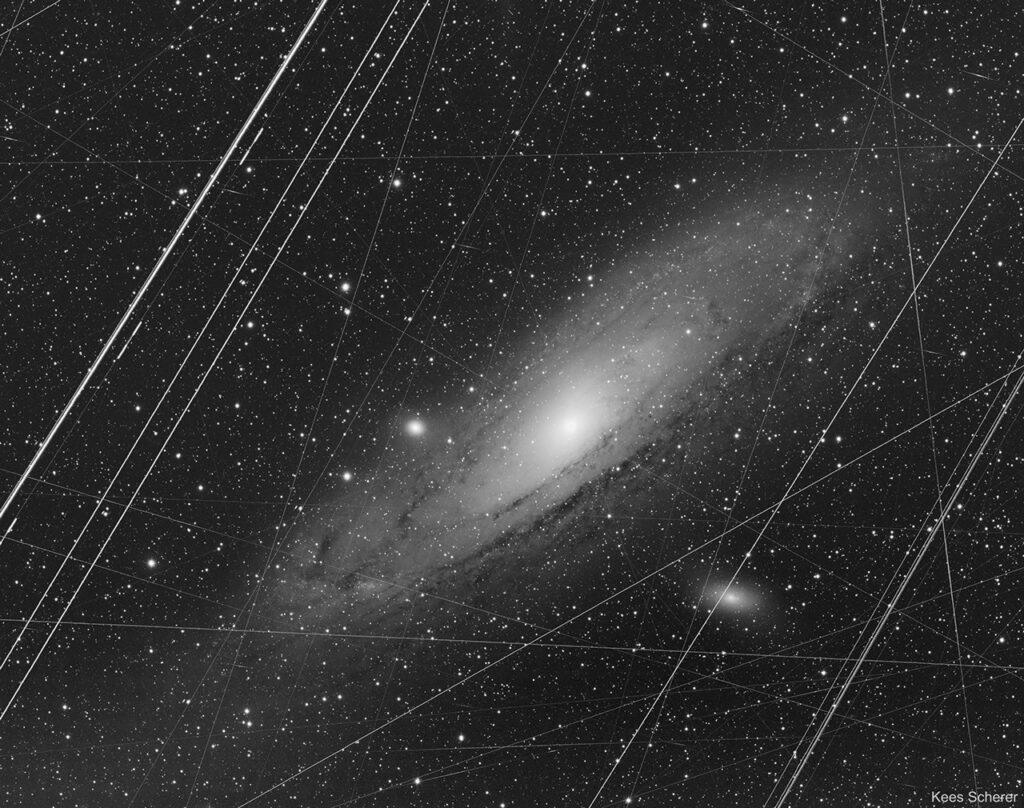
What does the Andromeda galaxy truly look like? The featured ‘before’ image reveals how our nearest major galactic neighbour appears when captured through Earth’s busy atmosphere, utilising a digital camera that inevitably introduces certain imperfections. This particular photograph is a composite of 223 images, each with a 300-second exposure, taken from a garden observatory in Portugal during 2019. The image displays a range of noticeable deficiencies, such as bright, parallel trails from aircraft, continuous streaks from satellites, brief flashes from cosmic rays, and faulty pixels.
In the ‘after’ image, these imperfections were not merely erased using Photoshop; rather, they were significantly mitigated through a series of advanced software tools, including Astro Pixel Processor, DeepSkyStacker, and PixInsight. The objective behind this meticulous processing was not to create a misleading digital fantasy but to reduce terrestrial artefacts that bore no relation to the distant galaxy. This approach allows for a more authentic representation of Andromeda (M31) and enhances our understanding of its true nature.
Updates and News from APOD
The email address for image submissions to APOD has recently changed, and interested individuals can find the new information under the APOD Submissions section.
Looking ahead, tomorrow’s image will feature the intriguing concept of ‘cosmic latte,’ promising another fascinating glimpse into the wonders of the universe.
Image Credits and Contributors
The featured image of the Andromeda galaxy is credited to Kees Scherer. The project is managed by a dedicated team of authors and editors, including Robert Nemiroff, Jerry Bonnell, Cecilia Chirenti, and Keighley Rockcliffe. This initiative is a collaborative effort supported by the Astrophysics Science Division at NASA’s Goddard Space Flight Center, NASA Science Activation, and Michigan Technological University.
Yesterday’s image was titled “Mirrored Meteor and Milky Way,” showcasing the stunning interplay between terrestrial and celestial elements in the night sky.




More Stories
Discover the Stunning Dark Nebula Lynds 1251: A Cosmic Marvel Unveiled on 23 November 2026
Stunning Swirls and Vibrant Colours of Jupiter Captured by Juno – 22 November 2026
Voyager’s Stunning Neptune Encounter: A Deep Dive into the Cosmos on 21 November 2026