
Waste crime extends far beyond the act of fly-tipping; it represents a vast criminal enterprise worth billions. Organised crime syndicates exploit the waste industry not only to launder money but also to evade taxes, undermine legitimate businesses, and pollute both communities and the environment, all while masquerading as lawful operators.
As these criminals continuously adapt their strategies, our response evolves in tandem. We develop innovative tools, utilise advanced technology, and collaborate with an expanding network of partners to thwart their activities—before, during, and after the crime has occurred.
Achievements in Tackling Waste Crime
The Joint Unit for Waste Crime (JUWC) summarises its accomplishments for the year 2025–26, showcasing a proactive approach to dismantling criminal networks rather than merely processing individual cases.
Our dedicated team of 14 full-time crime officers spearheaded 23 operations and provided support for an additional 38. They were actively involved in 59 days of coordinated action around the nation, resulting in 111 disruptions and supporting 13 arrests by partner agencies. In total, 17 interviews were conducted under caution, and 8 vehicles were seized. Each statistic reflects a disrupted criminal network, a community safeguarded, and a legitimate business afforded a fairer chance to thrive.
Dismantling a Family Empire
A particular case involved a family that had operated what appeared to be a legitimate waste business for over a decade. In reality, they ran an illegal landfill, scrap metal operation, and waste transfer station—a deeply entrenched and hostile site that had consistently flouted the regulations set by the Environment Agency.
Rather than simply impose fines, we aimed to make their criminal business model unviable. Collaborating with police, HMRC, the Insolvency Service, local councils, and the DVSA, we constructed a comprehensive case that extended beyond waste offences alone. This culminated in the seizure and destruction of 23 heavy goods vehicles, the eviction of the family from their site, and the recovery of assets, including land that had been transferred among family members to evade accountability. We are also in the process of recovering a £50,000 Bounce Back Loan that was fraudulently obtained, with ongoing proceedings under the Proceeds of Crime Act.
Active Interventions on the Roads
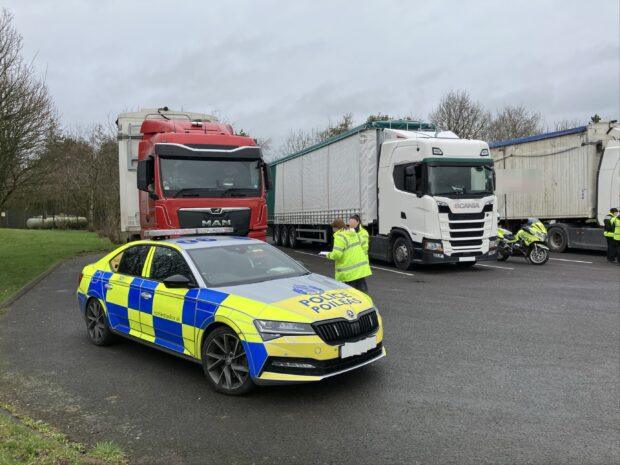
A significant portion of our efforts takes place in real-time on roads across the country. In Kent, a multi-agency day of action successfully halted 14 vehicles, leading to one arrest and multiple driver investigations. In the Scottish borders, our officers teamed up with Highways England, SEPA, and Police Scotland to inspect waste-carrying vehicles crossing the border.
In Lancashire, in collaboration with the National Crime Agency, we were instrumental in the arrest of an individual connected to several sites of extensive illegal dumping, resulting in the seizure of his vehicle. A prosecution is currently pending.
These operations are vital; they are visible, disrupt established criminal behaviours, and send a clear message: the roads are not a safe haven for waste criminals.
The Power of Disruption
Prosecution processes can take years, allowing organised crime groups to continue their operations and generate profits in the meantime. Hence, disruption is fundamental to our strategy. Operation ‘B’ targeted an organised crime group involved in running illegal waste sites and large-scale dumping. We deregistered their waste carrier licenses, seized vehicles, and collaborated with law enforcement to pursue individuals for additional offences, ultimately crippling the group’s operations.
Operation ‘C’ focused on an individual managing permitted waste sites across England while committing fraud and money laundering. We successfully secured an account freezing order for £600,000, suspended permits, and revoked waste exemptions across several sites, effectively rendering that individual inactive in the waste industry.
Consistently applying financial pressure, regulatory measures, and genuine partnerships can yield results that straightforward criminal prosecution may not achieve.
Adapting to a Growing Threat
Organised crime groups are becoming increasingly sophisticated, often mimicking legitimate waste businesses, which complicates detection and exacerbates harm. Each year, the demand to target high-risk groups intensifies.
In response, the JUWC has expanded its team from 10 to 18 full-time staff, with all positions filled by March 2026. Additionally, two officers have qualified as drone pilots, enhancing our capacity to identify illegal sites and gather evidence from the air, thus uncovering locations that previously remained hidden.
This September, we provided evidence to the House of Lords Environment and Climate Change Committee regarding serious and organised waste crime, and the Committee’s findings are currently under review at the highest levels of government.
A Call to Action
This year has underscored a crucial truth: waste crime is serious and causes significant harm, warranting a robust and serious response. The environment deserves protection, communities burdened by illegal dumping deserve better, and legitimate businesses undermined by criminal activities deserve a level playing field.
The JUWC is dedicated to these principles.
For further insights, read our end-of-year report: JUWC End of Year Report 2025 to 2026.
If you possess information regarding illegal activities within the waste sector, please report it anonymously to Crimestoppers. In England or Scotland, you can also reach out to the Environment Agency or SEPA incident hotline at 0800 80 70 60, available 24 hours a day.


More Stories
Transforming Flood Defences: Building Resilience and Confidence in a Changing Climate
Optimal Meat Consumption: How Much Should You Really Be Eating?
Understanding the New Five-Day Limit: How Long Should You Safely Use a Decongestant Nasal Spray?