
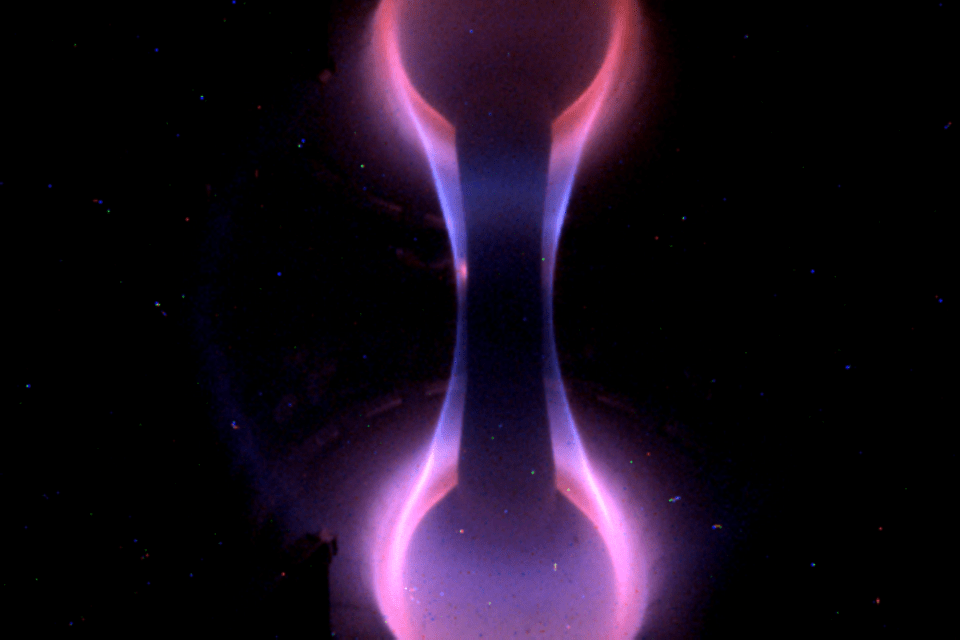
MAST Upgrade’s fifth series of experiments has successfully addressed plasma instability issues, which are crucial prerequisites for the development of commercial fusion energy power plants. The research team has introduced an innovative technique that leverages light measurements to detect and manage minute imbalances within the plasma.
Groundbreaking Experiments at UKAEA
The United Kingdom Atomic Energy Authority (UKAEA) has recently concluded its most ambitious series of experiments on its leading fusion device. This latest phase has resulted in the highest plasma pressure recorded by the MAST Upgrade machine, overcoming control challenges that are vital for the future of commercial fusion energy.
Conducted at the UKAEA’s Culham Campus in Oxfordshire, the fifth series of experiments ran throughout 2025 and 2026, generating over 1,100 fusion plasmas. The scientific outcomes are a key element of UKAEA’s newly published 2026-2030 Strategy, aimed at establishing the scientific groundwork necessary to transform fusion into a viable, low-carbon energy source.
Achieving High Plasma Pressure
Creating a plasma in a fusion facility requires hydrogen isotopes to be heated, compressed, and confined under extreme conditions of temperature and pressure. The rate of fusion reactions escalates with increasing density and temperature. A high-pressure plasma is capable of producing greater fusion power per unit volume, thus closely mimicking the conditions required in a commercial power plant.
The experiments demonstrated the highest pressure ever achieved in the MAST Upgrade machine while maintaining plasma stability, an impressive feat given the complexity of the task.
Addressing Edge Localised Modes
A significant challenge faced during the MAST Upgrade experiments was the suppression of instabilities known as Edge Localised Modes (ELMs). These instabilities can lead to sudden pressure drops in the plasma, causing the loss of up to ten per cent of its stored energy and potentially damaging the machine’s inner wall and exhaust components over time.
If left unresolved, ELMs pose a serious threat to the commercial viability of fusion energy, as frequent wall damage would result in increased maintenance costs.
Innovative ELM Suppression Techniques
Building on previous findings regarding ELM suppression, the MAST Upgrade team implemented Quasi-Continuous Exhaust mode (QCE-mode) and Resonant Magnetic Perturbations (RMP) to manage plasma pressure at the edge effectively. This approach utilises coils that generate three-dimensional magnetic fields to stabilise the plasma.
The team also successfully accessed two additional stable operating regimes: Quiescent H-mode (QH-mode) and I-mode. These advanced plasma confinement regimes improve energy retention while alleviating issues associated with large ELMs, enabling better management of edge pressure without triggering damaging bursts.
Real-Time Plasma Control Innovations
In a groundbreaking achievement, the MAST Upgrade team developed a world-first technique for controlling the plasma’s position. By measuring the visible light emitted by deuterium from the machine’s upper and lower outer divertors, the team can detect minute positional imbalances in real-time.
This advancement paves the way for automated, real-time control systems necessary for the operation of future power plants without the need for constant manual adjustments. These breakthroughs stem from exploring advanced techniques for ELM suppression combined with innovative plasma control and heat-exhaust strategies, such as the MAST Upgrade’s Super-X divertor, which effectively manages and distributes intense heat and particle exhaust loads.
Managing Excess Heat
The team discovered that introducing small quantities of nitrogen into the plasma edge results in a significant portion of the exhaust power being emitted as light. This process dissipates excess heat throughout the plasma before it reaches the inner walls and divertor of the machine, thereby reducing peak heat flux and minimising wear on internal surfaces.
This impurity-assisted method is anticipated to play a crucial role in future fusion power plants, as even the Super-X geometry alone would generate heat loads that are excessively high.
Exploring New Plasma Shapes
The experiments also investigated “negative triangularity” plasma shapes, which could enable high-power operations without ELMs. This approach is garnering significant attention from the international fusion research community.
James Harrison, Head of MAST Upgrade Science at UKAEA, expressed that the findings are instrumental in shaping the design of future fusion power plants. “Accessing four stable high-performance plasma regimes, including QH-mode, QCE, and I-mode, along with our world-first plasma position control technique, showcases that MAST Upgrade is at the forefront of scientific advancements in fusion energy,” he stated. “The level of international interest in our data underscores the UK’s pivotal role in global fusion research, bringing us closer to practical fusion energy.”
Future Developments and International Collaboration
The results from the experiments were showcased at the European Physical Society’s Plasma Physics Conference 2026, hosted by UKAEA in Edinburgh. They are now being shared with the international fusion community to aid in the design and operation of future projects such as STEP and ITER.
This year, MAST Upgrade is set to undergo further enhancements, including the installation of two new neutral beam injectors to double the machine’s neutral beam heating capacity and the introduction of an Electron Bernstein Wave (EBW) system, which will contribute an additional 1.6 MW of heating power. The EBW technology is planned for integration into STEP, the UK’s prototype fusion power plant located in West Burton, Nottinghamshire.
The enhancement programme is anticipated to conclude in 2027, with a sixth series of experiments focusing on STEP-relevant research scheduled for 2028.




More Stories
Government Launches Ambitious Initiative to Restore Churches and Revitalise Heritage Buildings Across England
UK Government Allocates Funds for Vital Repairs to Chornobyl Nuclear Power Plant Following Russian Drone Strike
Great British Railways Unveils New Headquarters and Apprenticeship Programme