
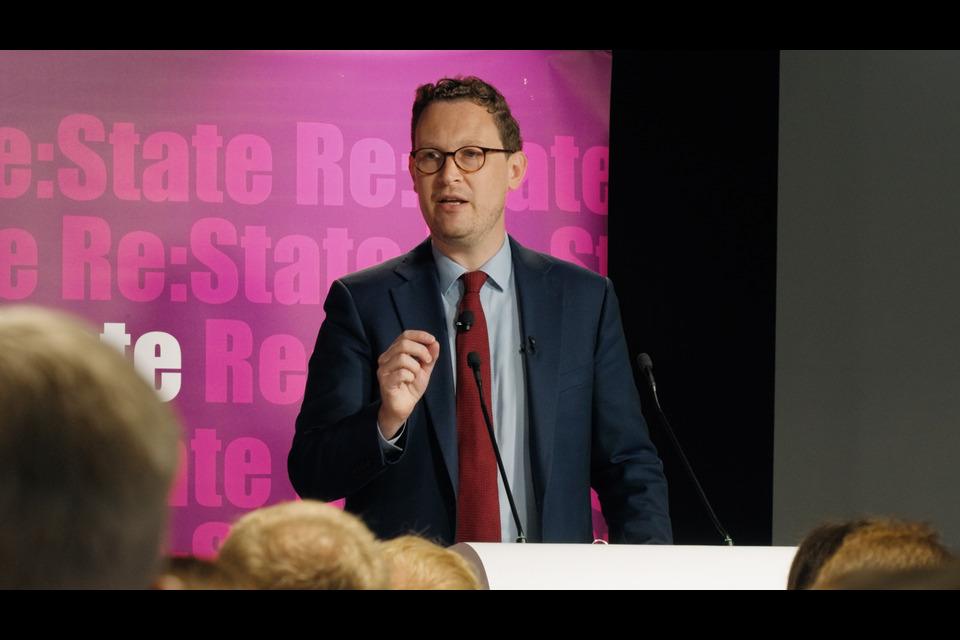
It is a pleasure to be here today.
The last occasion I visited the BT headquarters was in 2017, during my tenure as a lawyer within the consumer division. At that time, I informed my superior and general counsel of my intention to stand for election for a second time in Theresa May’s snap general election. I recall expressing my confidence in the data, which suggested there was absolutely no chance of success.
Yet, a few weeks later, I found myself needing to make an apologetic phone call to say, “I’m truly sorry, but I have won and can’t fulfil my notice period.” They were exceedingly understanding about the situation.
The silver lining is that the company managed quite well in my absence.
It is wonderful to return to them in this remarkable new building, especially considering that, back then, we operated out of the BT Centre in St. Paul’s. This new head office is a splendid improvement for the team here.
Reflections on Remaking the State
As mentioned, I have been invited to discuss the remodelling of the state. This is a topic I have pondered considerably during my time as Chief Secretary to the Treasury and Chief Secretary to the Prime Minister. While I had several policy announcements prepared for today, I have been informed that, given my impending redundancy in a few weeks, I am unable to present them.
Therefore, I would like to take this opportunity to share some insights I have gained over the past two years, what I have accomplished, and aspects my successors may want to consider moving forward.
I recognise that each of you dedicates significant time to contemplating these crucial issues in your daily work, from the impact of technology on the transformation of the state to a more profound reimagining of its functions. Re:state has published invaluable insights on these subjects, and I’m pleased to affirm that we share much common ground.
From diagnosing the challenges to proposing solutions, I take pride in some of the accomplishments I have achieved or the groundwork I have laid for my successors. There are, of course, areas where we may disagree, but I will take this opportunity to explain why I still believe I am correct in my views.
Understanding the Challenges
Upon entering government as Chief Secretary to the Treasury and later as Chief Secretary to the Prime Minister, I was struck by the sluggishness of operations. There was an alarming amount of inertia within the system. Processes were burdened with excessive layers of approval, with numerous individuals given the right to express opinions, yet not enough who had the authority to make decisions.
Additionally, there were too many priorities and insufficient focus, alongside a lack of comprehension regarding the real-world supply chain. I often questioned how specific policy documents could translate into tangible change and how we could ascertain their effectiveness. Too frequently, there was an assumption that Whitehall was best positioned to resolve issues, which was not always the case.
Streamlining Government Operations
In response to these challenges, I advocated for promoting action-oriented individuals rather than mere talkers, coupled with a clearer set of government priorities. I initiated a streamlining of priorities across Whitehall, establishing a concise set of Prime Ministerial objectives that each department was to focus on, limited to just two or three key areas.
This was underpinned by an agreed set of data and metrics, collaboratively determined by the departments and the central government, to accurately assess performance alongside defined lines of accountability through both ministerial and civil service teams.
All of this culminated in what we refer to as our integrated delivery dashboard, which aligned departments around a singular set of data, incorporating criteria that tracked their performance. This sparked significant discussions around metrics, such as “why is it amber-green rather than green?” and “what steps do I need to take to shift it from amber-green to green?”
Introducing Key Performance Indicators
While this may seem straightforward, it has begun to incentivise performance through clear accountability, which is vital. I introduced key performance indicators (KPIs) within departments. This might sound surprising to those in the private sector, but when I arrived at the Cabinet Office, several departments did not have KPIs for the preceding year, making it impossible to measure their performance.
Consequently, I mandated that senior civil servants establish KPIs. Alarmingly, many of these had previously been set by Permanent Secretaries rather than Secretaries of State. We needed to ensure that the political priorities of Secretaries of State, which inherently included delivering on the Prime Minister’s priorities, were reflected in those KPIs. This adjustment made it easier to evaluate performance against appropriate metrics.
It is somewhat astonishing that this was a novel concept for the civil service, but I am relieved to report that it is now firmly in place.
Enhancing Civil Service Performance
I also raised the bar for senior civil servants to qualify for cash bonuses, awarding higher, yet fewer, bonuses to those exceptional civil servants who genuinely excelled. Last month, I announced that for the first time, performance-based pay progression has been implemented for the entire Senior Civil Service. This marks a significant shift in how pay rises are determined, moving towards meritocracy and performance-based assessments.
Furthermore, I emphasised the importance of prioritising delivery over the incessant development of new policies. It is a shared sentiment that excessive bureaucracy within government has undermined the capacity of both Ministers and Civil Servants to execute their duties effectively. My teams have affectionately referred to this challenge as “sludge”.
Reducing Bureaucracy in Government Projects
This sludge can cause substantial infrastructure projects, such as HS2, as well as smaller initiatives, to become mired in reviews, approvals, and cross-Whitehall checks, where everyone has input but no one can act. This leads to soaring costs, extended timelines, and ultimately, minimal results.
In response, I established the National Infrastructure and Service Transformation Authority, placing it specifically within the Treasury, albeit with accountability to the Cabinet Office. Additionally, I initiated a project known as “Project RESET”, aimed at reducing the bureaucratic hurdles civil servants face in executing their responsibilities. This included raising departmental delegated authority limits, allowing them to progress without needing to seek my approval constantly.
This initiative came into effect at the start of the financial year and has already demonstrated its efficacy in expediting the delivery of government programmes. I was particularly interested to see if the Civil Service would embrace this opportunity for greater freedom and autonomy in exchange for heightened accountability to accelerate their work.
Innovations in Technology and Delivery
One area I am particularly proud of is the expansion of the No10 Innovation Fellowship, which I announced in January. Their contributions continue to strengthen our belief that technology can fundamentally rethink the state as we understand it. This is not merely hyperbole; it is a tangible possibility if we dismantle bureaucratic obstacles and prioritise innovation over hesitation.
The No10 Innovation Fellows are recruited from elite backgrounds in data science, coding, and artificial intelligence through a highly competitive selection process, boasting a mere 0.9% success rate. This has facilitated the integration of talent from prominent institutions like CERN, NASA, and Y-Combinator into the heart of government.
These fellows have been deployed at the frontline across 19 departments, developing digital solutions tailored to the realities of operational work rather than imposing rigid frameworks from above. For instance, one fellow, Will, who previously founded a startup in California, experienced a significant shift upon arriving at HMP Wandsworth for his first assignment.
Transforming Public Services through Innovation
He had the autonomy to collaborate closely with prison staff, and within months, created bespoke AI tools to automate certain responsibilities of prison officers. This innovation has liberated substantial hours for staff to concentrate on their unique roles, significantly enhancing the safety of our prisons and the welfare of prison officers.
During a recent visit to the facility, the governor informed me that this was the fastest technology deployment he had witnessed during his career in the Civil Service, with successful tools now being introduced in other prisons nationwide.
Similarly, another fellow, Teneeka, designed a new website enabling parents to verify their eligibility for free childcare hours, estimate childcare costs, and locate local providers based on proximity, available hours, OFSTED ratings, and more—all in one user-friendly platform. This exemplifies a customer-centric approach that is often overlooked when Whitehall designs services.
The Future of Technology in Government
This is the vision for reconstructing the state: agile, technology-driven experiences that prioritise customer understanding. We must cultivate an environment where innovation can thrive not only in the private sector but within the public sector as well. The No10 Innovation Fellowship serves as evidence that it is achievable; unfortunately, such initiatives remain exceptions rather than the rule, hindered by the “deadweight of legacy IT”, as aptly noted in Re:State’s recent report.
I hope my successor can continue this momentum, building upon our achievements and ensuring that the vast potential of technology within the public sector is fully realised.
Establishing Consistent Delivery Units
This brings me to my latest announcement regarding the establishment of delivery units within each department, alongside a project manager or delivery expert in each




More Stories
AAIB Dispatches Investigation Team to Stirling Following Incident
Ofsted Launches Pilot Scheme for New Independent Complaints Review Service
CMA Initiates Action to Enhance Choice in Business Software Solutions