
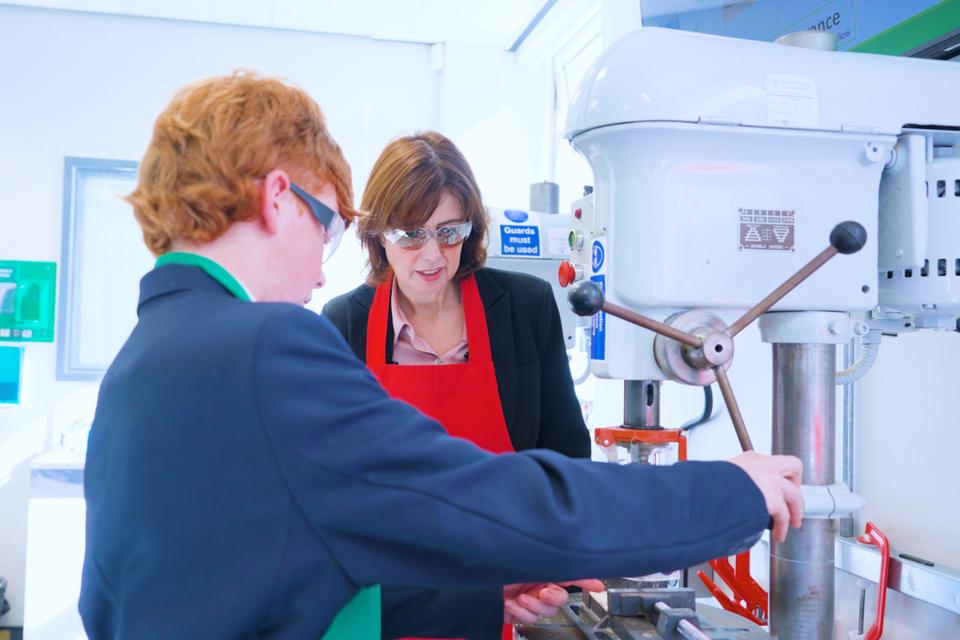
Young people are rallying behind a transformation of vocational education as the government intensifies its efforts to address youth unemployment and confront outdated perceptions of technical training. Recent surveys indicate that a significant majority of teenagers—84%—enthusiastically back the introduction of new educational options for those aged 14 and above. These options would integrate practical technical skills, such as coding, construction, and manufacturing, with essential academic subjects like English and Mathematics. This initiative was first outlined by the Prime Minister shortly after assuming office and is now progressing towards implementation.
Introduction of Vocational GCSEs
Just two weeks ago, the government unveiled its plans for Vocational GCSEs, marking a pivotal shift in the educational landscape aimed at placing hands-on learning on an equal footing with traditional academic routes from the age of 14. This reform builds upon previous efforts to establish new V Levels, which are set to be introduced in September 2027, providing high-quality vocational training for students aged 16 to 19. These new qualifications will sit alongside A Levels and T Levels and will be equivalent to one A Level, allowing students the flexibility to combine academic and vocational subjects as they consider their specialisation.
With almost a million individuals aged 16 to 24 currently disengaged from education, employment, or training, the government is committed to ensuring that the educational system caters effectively to every young person. Vocational GCSEs will adhere to nationally established standards, distinguishing them from existing Technical Awards, with grading and assessment regulated by Ofqual to guarantee full equivalence with traditional GCSEs.
Concerns Among Young People
In a recent poll of 500 participants who are at the cusp of making educational decisions at ages 14 and 16, nearly half (44%) reported that vocational and technical pathways are often undervalued by their peers. Additionally, over a third (37%) expressed feeling pressure from their parents to pursue academic options post-16. As they contemplate their futures, the primary concern for many is the prospect of ending up in unfulfilling jobs, a sentiment echoed by 69% of respondents. Furthermore, 46% voiced apprehensions that advancements in artificial intelligence might threaten employment opportunities, while 52% worry about possessing the requisite skills for future job markets.
Education Secretary Lucy Powell articulated the government’s commitment to reshaping perceptions, stating, “The message from young people is clear: they want more choices and opportunities to develop practical skills that lead to rewarding careers.” She acknowledged that while young individuals are eager for future opportunities, many still grapple with antiquated views regarding vocational education that do not align with their aspirations.
Details of the New Vocational Pathways
The forthcoming Vocational GCSEs will eventually replace the current Technical Awards, with availability in select subjects anticipated as early as September 2029. This new framework will be part of an extensive initiative to create technical pathways commencing in September 2028. Core subjects, including English, Mathematics, and Science, will remain compulsory, while elective options may encompass subjects such as Business Management, Creative Media Production, Digital Technology, Child Development, and Building and Construction. This redesign aims to facilitate progression into further education via T Levels and V Levels or through A Levels.
A consultation aimed at refining the Vocational GCSE framework is scheduled to be published by the end of the year. Starting in September 2027, the initial V Levels will be available in sectors such as Education and Early Years, Finance and Accounting, and Digital, potentially leading to university placements or apprenticeships.
Support for Students Needing Additional Help
To assist students who require support in achieving their English and Maths qualifications before advancing, two new qualifications will also be introduced in September 2027. Foundation Certificates will provide a one-year bridging programme before progression to V Levels, T Levels, or A Levels, initially focusing on Education and Early Years and Digital. Additionally, a two-year Occupational Certificate pathway will be available for those aiming to enter the workforce or pursue an apprenticeship, with initial subjects covering Catering and Hospitality as well as Education and Early Years.
Pepe Di’Iasio, General Secretary of the Association of School and College Leaders, remarked on the long-standing stigma surrounding vocational education, stating, “For too long, vocational and technical pathways have played second fiddle to academic qualifications. Schools and colleges will welcome new qualifications that help to dismantle this unfounded divide and the negative perceptions it fosters among students and families.”
Voices from the Frontline
Ryan Skitt, an 18-year-old T Level Student of the Year from Wolverhampton, shared his transformative experience, stating, “My T Level provided me with real industry experience that I believe classroom learning alone could not have offered. It has given me the confidence to pursue architecture and even start my own business while continuing my education.” He emphasised that technical education should not be viewed as a less desirable option; rather, it can be a pathway to fulfilling careers.
Oliver Coombs, a 20-year-old from Bath who completed a T Level in Engineering, echoed similar sentiments. Now engaged in a Higher Level Apprenticeship, he noted, “My T Level solidified my desire to work in the industry while continuing my education. I’m now developing the skills that employers value, which boosts my confidence about the future.”
Joe Shingler, 21, currently pursuing a Higher National Certificate in Construction at Shrewsbury College, expressed his enthusiasm for vocational education, stating, “I would have loved more opportunities to learn vocational subjects at school. Exploring various employment pathways can be daunting, especially without prior exposure to those careers.”
Elyot Harmston, a 23-year-old aviation apprentice, shared his perspective, “I knew an aviation apprenticeship was right for me because I enjoy practical work. It’s exciting to hear that more practical subjects will be available, as these opportunities build confidence and open doors to employment.”
Industry Perspectives on the Future
John Wilkinson, Chief Operating Officer at BAM UK & Ireland, highlighted the importance of aligning education with industry needs. He stated, “The UK faces an ambitious agenda of infrastructure investment, which will rely on having a workforce equipped with the right skills. We must demonstrate to young people that technical and vocational education can lead to rewarding, long-term careers in sectors like construction. By fostering closer ties between education and employers, T Levels, apprenticeships, and work placements equip young people with invaluable workplace experience, while simultaneously helping businesses cultivate the skills essential for the future.”
Wilkinson concluded by asserting that technical routes should be perceived as aspirational choices rather than alternatives to academic pathways, emphasizing the need for a cultural shift in how society views vocational education.




More Stories
Nearly 50% of Individuals with Flu-Like Symptoms Skip Work or School, New Data Reveals
Chancellor Affirms Commitment to Safeguard UK Economy Resilience with Upcoming Budget Amid Global Challenges
Tactical Power Challenge: Empowering the Future of Military Forces