
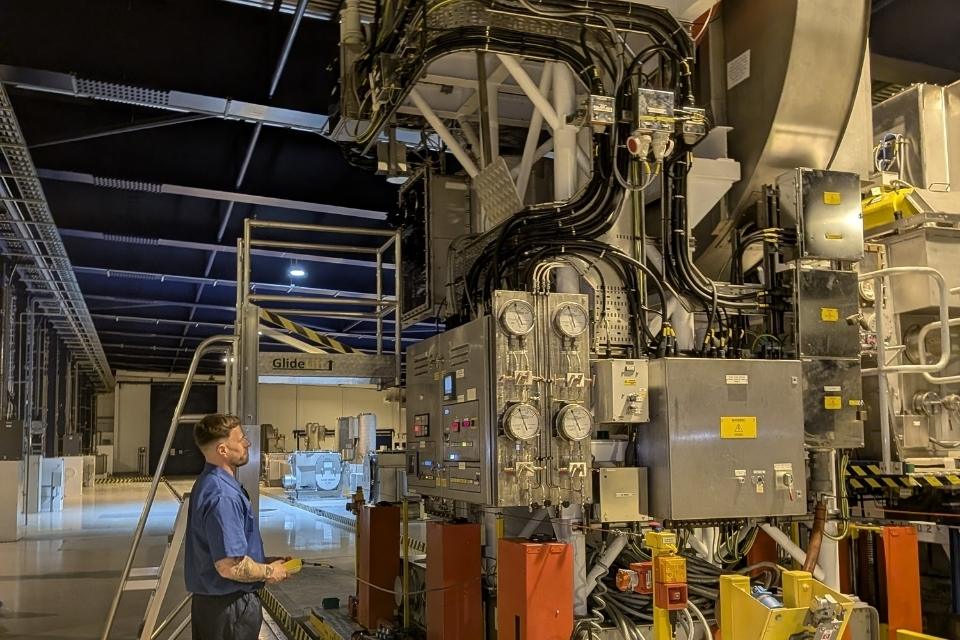
Recently, a significant operation was completed to extract radioactive material from a legacy storage tank at the Sellafield site, marking a critical step in risk reduction efforts. This undertaking is part of broader initiatives aimed at ensuring safety and environmental protection in the area.
The storage tanks in question, which date back to the 1950s, house a complex mixture of radioactive sludge referred to as flocculant. This substance was produced as a by-product during the early reprocessing of nuclear materials and has since settled and compacted over the years, complicating its safe removal and storage.
Innovative Techniques for Material Resuspension
To address the challenges posed by the compacted radioactive material, our teams devised a method to resuspend the settled solids. This innovative approach involved converting the dense material back into a sludge form, thereby facilitating its transfer to a modern storage tank designed for enhanced safety.
The new tank is integrated with Sellafield’s Enhanced Actinide Removal Plant, where the material will undergo further treatment to ensure it remains safely and stably contained. A useful analogy for understanding this challenge is that of a snow globe: when undisturbed, particles settle to the bottom, and to reintegrate them into the liquid, they must be carefully lifted and redistributed.
Our teams successfully achieved this industrial equivalent in a meticulously controlled environment, showcasing their expertise in managing complex operations.
Engineering Excellence in Action
To implement this resuspension capability, engineers and operators meticulously recommissioned specialist equipment, rebuilding and rigorously testing the system to ensure its continuous operation over extended periods. Water was introduced into the tank, and the specialist apparatus consistently mixed the contents. Over the course of approximately three weeks, the settled material at the bottom of the tank was gradually broken up and reintroduced into suspension.
This continuous process operated around the clock, and once the contents achieved a uniform mixture, they could be safely transferred. Ultimately, this operation resulted in the successful removal of 1,302 cubic metres of flocculant, a volume equivalent to more than half an Olympic-sized swimming pool.
Commitment to Safety and Environmental Stewardship
Alan Prince, Head of Operations, commented on the achievement: “Reducing legacy risk safely is central to our mission. Our teams collaborated to deliver this complex, high-hazard operation efficiently, demonstrating our expertise in executing demanding engineering and operational tasks.”
By completing this operation, radioactive materials have been safely removed from ageing infrastructure and transferred to modern containment systems, ensuring a clear route for treatment. Looking ahead, there are two remaining legacy tanks that will require emptying using a similar methodology.
This work aligns with our commitment, in partnership with the Nuclear Decommissioning Authority, to mitigate risks, safeguard the environment, and provide value to taxpayers.

More Stories
UK Urges UN Security Council to Prioritise Civilian Protection and Humanitarian Aid in El Fasher Amid Ongoing Conflict
Prime Minister’s Key Address at the King’s Trust Centre on 15 October 2026
Wes Streeting Delivers Keynote Address at the Centre for Strategic and International Studies