

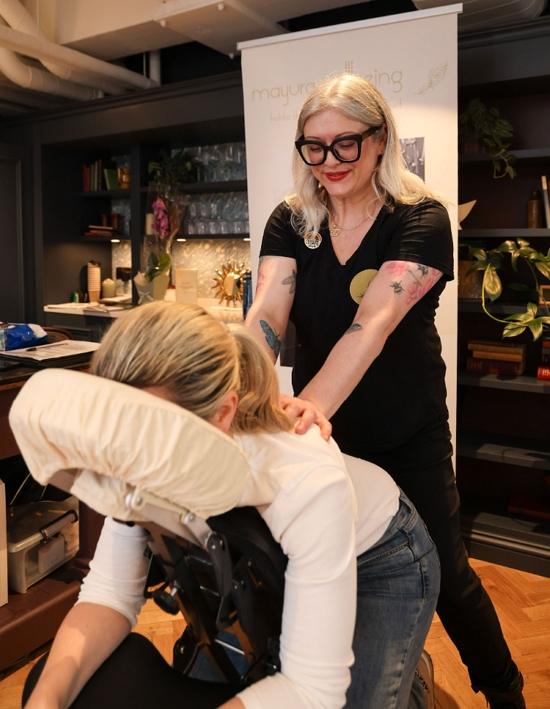
For Caz Pease, founder and owner of Mayura Wellbeing, massage and holistic therapy are about far more than following a set routine. Her approach is built around listening to each client, understanding what they need and creating an experience in which they can feel comfortable, respected and genuinely cared for.
Mayura Wellbeing provides mobile massage and holistic therapies, bringing treatments directly to clients in their own homes, as well as offering wellbeing services for workplaces, private events and other settings. Its range includes different styles of massage alongside Reiki and Sound Baths, with personalisation, inclusivity and environmental awareness forming some of the central values behind the business.
Caz’s path into the wellbeing profession came after a significant career change. Having spent years working in office and facilities management, her interest in complementary therapies developed during the lockdown period and eventually led her to build a new professional life around something she felt genuinely passionate about. Since then, she has continued expanding her training, from Sports and Deep Tissue Massage to specialist areas including Oncology Massage, while developing Mayura Wellbeing around the principle that holistic care should be adaptable to the individual rather than the other way around.
In this interview, Caz Pease discusses the experiences that led her to create Mayura Wellbeing, the importance she places on inclusive and non-judgemental care, her approach to personalising treatments, the role of sustainability in the business and how she hopes her work will develop in the years ahead.
Interview with Caz Pease, Owner and Holistic Practitioner at Mayura Wellbeing
Caz, what inspired you to leave your previous career and pursue massage therapy and holistic wellbeing professionally?
I have always enjoyed doing a job where I help people, and being an Office and Facilities Manager almost ticked that box, but it wasn’t my chosen path or passion. I had been exploring holistic therapies during lockdown and took a few classes after I was made redundant in 2021 to experience it for myself, and realised I had a passion for it. Then I was made redundant from my last job in 2023, and I decided it was the sign I needed that the universe was pushing me to follow my heart and do what I love.
You discovered your interest in complementary therapies during lockdown. What was it about that period that made you rethink the direction you wanted your life and career to take?
Lockdown was such an unprecedented time; I don’t know anyone who didn’t use the opportunity to change their lives in one way or another, whether it was to get a pet, take up a hobby or move somewhere that brought them joy. To be completely honest, at the time, I hated my job! The company culture was toxic and I knew that I had to find something that I actually wanted to do because I was so stressed out at the thought of going back. I was in my mid-40s and didn’t want to spend the next 20 years doing the same thing, so I thought hard about what I wanted my life to look like while I had the opportunity whilst I was furloughed.
Mayura Wellbeing has a very personal name, inspired by the Sanskrit word for peacock. Why was it important to you to choose a name with a personal meaning behind it?
I wanted a name that stood out and felt different from the usual options like “Serene”, “Tranquil” or “Healing”, as none of those resonated with me personally. I have a peacock tattoo that holds deep meaning for me, and I really wanted the company logo to feature a feather. When I translated peacock into other languages, the Sanskrit word Mayura stood out for me. It felt like the perfect way to blend personal significance with a unique identity for the business.
You offer mobile treatments in clients’ homes. What do you think people particularly value about receiving a treatment in their own space?
People love having massages at home as it allows them to feel more relaxed. They’re in their own surroundings, and they don’t have to battle traffic or public transport afterwards. They can just take a shower, have a nap or relax in front of the TV afterwards. I see a couple once a month and they spend the whole day in their pyjamas after their treatment: they get a takeaway, watch movies and just really enjoy doing nothing. It’s such a treat for them.
Personalisation seems to be at the heart of Mayura Wellbeing. How do you decide which techniques and approaches are best suited to each individual client?
When I was training to be a massage therapist, we were taught to follow a routine, and that always felt wrong to me because everyone has different needs, pressure preferences, etc., and I didn’t enjoy using some techniques. Now, I do a thorough consultation with clients to find out about their physical and mental health and their lifestyle. I ask about their body, specific areas of focus, preferred pressure and any areas they’d rather not be touched. Then, I discuss the different techniques that could address their needs so that they’re well informed before we start. This way, I can tailor every session to suit them perfectly and they feel confident that they’re getting the best treatment for them.
Inclusivity is one of the strongest values behind your business. What does creating a genuinely inclusive and non-judgemental wellbeing service mean to you in practice?
To me, creating a genuinely inclusive and non-judgemental wellbeing service isn’t just about ticking a box; it’s about upholding a fundamental human right. Everyone deserves to be seen, heard and respected without conditions. In practice, this means actively creating an environment where people feel safe to share their vulnerabilities, knowing they’ll be met with empathy, dignity and support. What makes this a privilege, not just a responsibility, is the trust people place in me. It’s an honour to be someone who people can truly be themselves with, free from fear of judgement.
Some people avoid massage because they feel self-conscious about their bodies. How do you help clients feel comfortable and at ease from the moment you meet them?
I completely understand that body self-consciousness can be a barrier to seeking touch-based therapies like massage, especially when the treatment is carried out in someone’s own home. I prioritise establishing a good rapport from the very first interaction with a thorough telephone consultation to discuss health history, any concerns, whether physical or emotional, and answer any questions they may have before they commit to booking. This way, clients have already had that reassurance and know that they are in safe hands.
You have trained in a wide range of techniques, from Sports and Deep Tissue Massage to Lomi Lomi, Cupping and Lymphatic Drainage. How has continuing to learn new techniques changed the way you work with clients?
The human body is incredibly complex, and techniques that work for one person might not work with another. Continuing to learn new techniques has been transformative in how I approach each client. For example, cupping is an amazing technique, but it’s not suitable for everyone, and so by expanding my skill set, I can change my approach if my initial idea doesn’t work in the first instance. I’m not limited to a one-size-fits-all approach; instead, I can adapt my methods to ensure every client receives the most effective and comfortable care possible.
Oncology Massage is one of the specialist treatments you offer. What led you to train in this area, and what particular considerations are involved when supporting people living with or recovering from cancer?
Last year, I received an enquiry from a woman with stage 4 cancer who was desperate for a massage but couldn’t find a local Oncology Massage therapist. At the time, I wasn’t qualified to perform Oncology Massage, so I tried to find someone to help her. Sadly, I was unsuccessful, but her urgency stayed with me. I realised how limited access to specialised care was, even in a place like South East London, so I took action.
I booked myself onto the next available Oncology Massage course, which was just a couple of weeks away, and told her I would be in touch as soon as I’d qualified. Knowing how much touch can mean to someone in her situation, I wanted to ensure she didn’t have to wait any longer than necessary.
Supporting people living with or recovering from cancer requires a deep understanding of their unique needs. For example, deep tissue work isn’t appropriate, so I focus on gentle, adaptive techniques that prioritise comfort and safety. My goal is always to meet clients where they are, physically and emotionally.
Alongside massage, you also practise Reiki. How would you describe Reiki to somebody who has never experienced it before, and what do you hope clients take away from a session?
Reiki is a gentle, non-invasive energy-based therapy that originated in Japan. The word Reiki combines two Japanese words: Rei, meaning ‘universal’, and Ki, which is similar to ‘life force energy’. During a session, I use my hands to channel this energy, either by lightly touching the body or holding them just above it, to promote relaxation and support the body’s natural healing processes.
For someone new to Reiki, it can feel like a deeply calming experience. Some can experience it quite profoundly, some fall asleep, but there is no right or wrong way to experience it. My hope for clients experiencing Reiki is that they feel lighter, more centred and emotionally balanced after a session.
Sound Baths are another part of your wellbeing offering. What attracts people to this type of experience, and how does it differ from the more hands-on therapies you provide?
Sound baths attract people for many reasons, and there’s a growing need for experiences that allow deep relaxation and mental reset nowadays. They are totally immersive and offer an opportunity to disconnect from external noise and reconnect with the body and mind.
Unlike hands-on therapies, sound baths are entirely non-invasive and require no physical interaction. Each instrument, such as the singing bowl, gong or chime, resonates at a different frequency. When these frequencies move through the body, they interact with our tissues, organs and energy fields and can help release tension, slow a racing mind and even encourage the brain to shift into slower, more meditative brainwave states like alpha or theta. Some people describe feeling a ‘tingling’ or warmth as the sound waves travel through them, almost like a gentle massage for the nervous system.
You also work with companies and provide massage at workplaces and corporate events. What changes have you noticed in the way employers approach staff wellbeing in recent years?
I’ve noticed in the last couple of years that companies have started pulling wellbeing services from their offerings, which is a shame because, post-COVID, they really wanted to bring these services in to help people feel less anxious about coming back to the office. The shift seems to reflect broader economic pressures, but it’s happening at a time when staff still desperately need it, especially as a lot of companies are mandating coming back to the office at least three or more days a week.
Massage can make a real difference in morale and productivity. The good news is that there are still companies offering the service and I’m still receiving bookings for corporate massage days. I always really enjoy going into offices and I would urge companies to invest at least one day a month for their teams if they can.
Mayura Wellbeing places considerable emphasis on vegan-friendly, cruelty-free and environmentally conscious products. Why was sustainability important to you when developing the business?
Sustainability was one of the most important considerations when I was developing Mayura Wellbeing because I believe our responsibility extends beyond just caring for people; it includes caring for the planet we all share. When I looked at the industry, I saw a lot of unnecessary waste: disposable table dressings, plastic-based wipes and products that didn’t align with the values I wanted to uphold.
I wanted treatments to feel truly luxurious, not just in experience, but in their respect for the environment. That’s why I prioritised vegan-friendly, cruelty-free, eco-conscious products and washable table dressings. I want clients to relax knowing their care for themselves doesn’t come at the planet’s expense.
You were named Most Inclusive Massage & Wellbeing Practitioner in London in both 2024 and 2025, followed by recognition as Best Massage Practitioner in London in 2026. What did those awards mean to you, particularly while building an independent business?
I was truly honoured to receive these awards, particularly as many industry accolades either require a fee or self-nomination and votes from the public, whereas the Global Health and Pharma Excellence Awards are judged independently and you don’t need to pay to receive recognition.
For a small business like Mayura Wellbeing, such recognition carries immense value. The awards affirmed that the values I prioritise, such as accessibility, inclusivity and sustainability, are making a meaningful difference. They have also given me even greater motivation to champion these principles and to do even better wherever I can.
Looking ahead, how would you like Mayura Wellbeing to develop over the next few years, and what would you ultimately like the business to become?
Looking ahead, I want to focus on learning, refining my skills and growing my client base so I can continue doing the work I love. The reality is that the business will need to evolve over time; I’ve just turned 50, and while mobile massage is a core part of what I do now, it may become more challenging as I get older.
So, in the background, I’m completing my hypnotherapy training, and I plan to introduce this service over the next few years. It’s an exciting next step that aligns with my passion for holistic wellbeing and will allow me to offer even more support to clients in new ways.
A personalised approach to wellbeing
Caz Pease’s journey with Mayura Wellbeing reflects both a significant personal career change and an ongoing commitment to developing the way she works. What began with an exploration of complementary therapies during lockdown has grown into an independent business shaped by her own experiences, values and belief in treating every client as an individual.
Throughout her work, the emphasis remains on adaptability. Rather than asking clients to fit into a predetermined treatment, Caz uses consultation, continued training and a growing range of techniques to shape sessions around individual circumstances, preferences and comfort levels. Inclusivity is equally central to that approach, with her aim being to create a service in which people can access massage and holistic wellbeing without feeling judged or self-conscious.
The next stage of Mayura Wellbeing is also likely to bring change. While mobile massage remains at the heart of the business today, Caz is already looking ahead, continuing her professional development and training in hypnotherapy as she considers how her services can evolve over the coming years.
For more information about Mayura Wellbeing and its treatments, visit www.mayurawellbeing.com.


More Stories
Transforming Flood Defences: Building Resilience and Confidence in a Changing Climate
Optimal Meat Consumption: How Much Should You Really Be Eating?
Understanding the New Five-Day Limit: How Long Should You Safely Use a Decongestant Nasal Spray?