
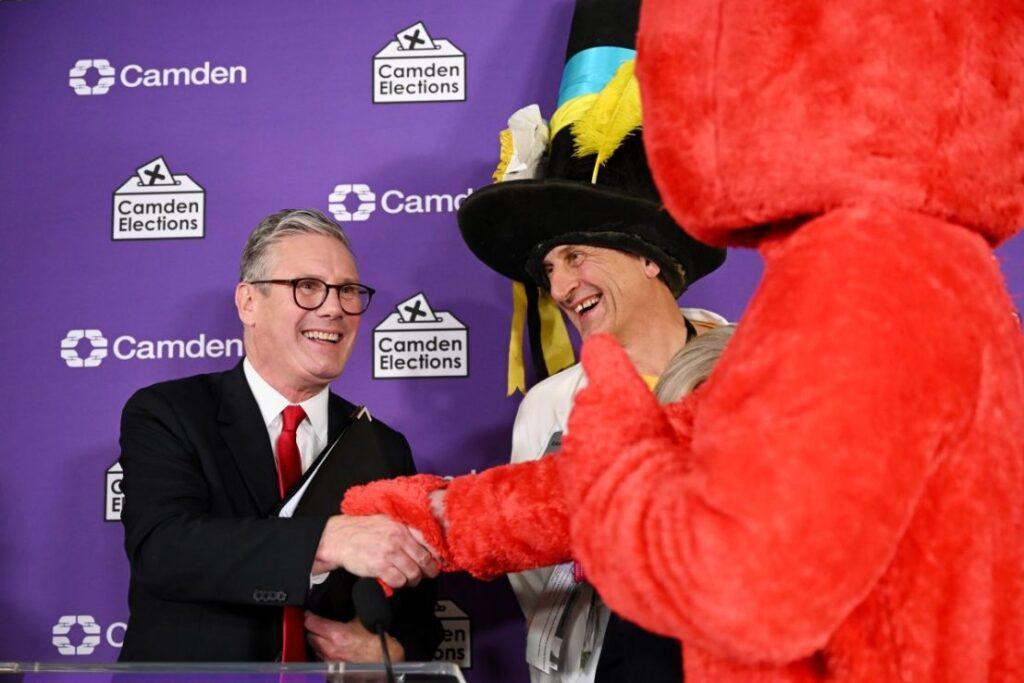
During a recent election event in Holborn and St Pancras, Keir Starmer was seen engaging with the local community in a rather unusual encounter. He shook hands with a man donned in a tall hat and a flamboyant red furry costume, an interaction that highlighted the lighter side of political campaigning. This whimsical moment comes as Labour continues to bolster its presence in the area ahead of the upcoming elections.
Engaging with the Community
Starmer’s gesture of connecting with constituents, even in the most unconventional of circumstances, underscores the Labour Party’s commitment to grassroots engagement. The event was not only about political discourse but also an opportunity for the party leader to showcase his approachable persona. By participating in such light-hearted exchanges, Starmer aims to resonate with voters and demonstrate that politics can indeed be fun.
The backdrop of this event is significant, as Holborn and St Pancras has been a key battleground for Labour over the years. With a diverse electorate, the Labour Party is keen to address local issues while also appealing to a broader audience. Starmer’s willingness to interact with various members of the community, regardless of their attire, reflects a strategy focused on inclusivity and accessibility.
The Influence of Historical Perspectives
In conjunction with the ongoing campaign efforts, Douglas Beattie, a notable figure in Labour’s historical narrative, has recently published a book entitled “Victory at the Ballot Box: The History of How Labour Built Britain.” This work delves into the evolution of the Labour Party and its pivotal role in shaping modern Britain. Beattie’s insights serve to contextualise the current political landscape, offering readers a detailed account of Labour’s journey and the challenges it has faced over the decades.
Beattie’s historical analysis may provide valuable lessons for the party as it navigates contemporary electoral challenges. Understanding past successes and failures can inform strategies that resonate with today’s electorate, especially as Labour seeks to reclaim its position in areas traditionally seen as strongholds for other parties.
Looking Ahead to the Election
As the election draws nearer, the Labour Party is focused on solidifying its platform and ensuring that its message reaches every corner of the constituency. Events like the one in Holborn and St Pancras are crucial for maintaining visibility and fostering connections with voters. Starmer’s ability to engage in both serious discussions and lighter moments reflects a balanced approach that aims to attract a wide range of supporters.
In the coming weeks, it will be interesting to observe how the Labour Party adapts its campaign strategy, particularly in light of Beattie’s historical insights. The intersection of history and contemporary politics may serve as a guiding principle for Labour as it strives for success at the ballot box, proving that acknowledging the past is essential for forging a path forward.




More Stories
Pension Savers Reclaim £188 Million After HMRC Overtaxes Withdrawals: A Shocking Oversight
How UK Tax Regulations Influenced the Recent Transfer Window
Revolutionary Inheritance Tax Changes Set to Transform Pension Utilisation in the UK