
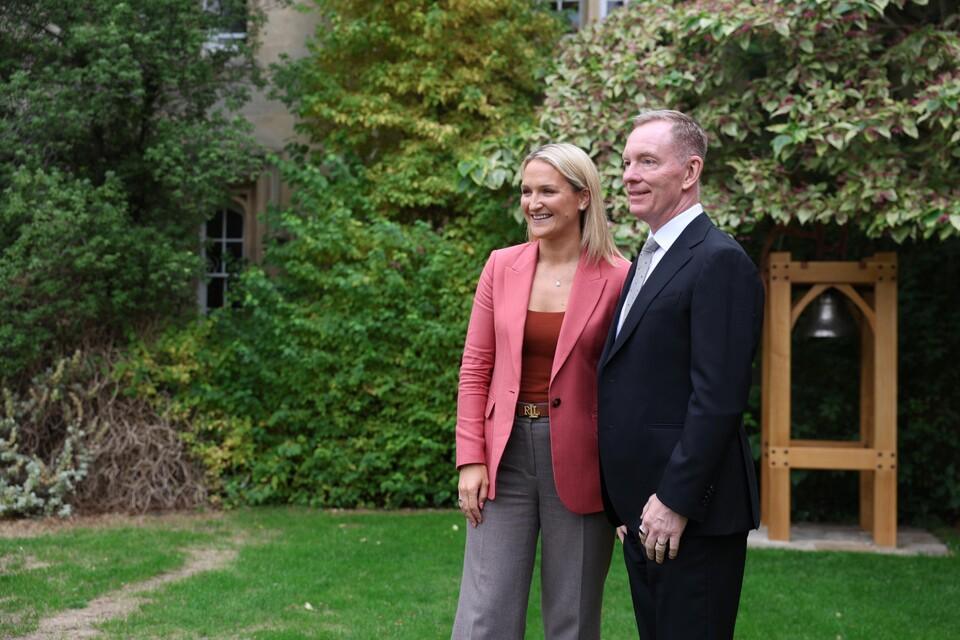
Just over a year ago, I had the privilege of being invited by the Duke of Richmond to speak at the inauguration of his new Art Foundation nestled in the beautiful forest near Goodwood. The event was splendid, showcasing a multitude of exquisite artworks harmoniously integrated into the woodland surroundings. The atmosphere was undeniably sophisticated, marked by attendees in striking purple corduroy trousers and adorned with pinky rings, signalling a rather posh affair. After my speech, an attendee approached me and expressed, “Mr Bryant, thank you for your words; I was absolutely dreading it. But you were actually adequate.”
This rather amusing remark encapsulates my aspiration as Secretary of State—to be deemed adequately effective. As Oscar Wilde, a brilliant figure born in Dublin and educated in Enniskillen, once quipped, “I am not young enough to know everything.” This resonates with me as I reflect on the responsibilities of my role. Ever since I assumed this position, I have been approached by numerous individuals in Northern Ireland, who, with a slightly pained expression, wish me “Good luck.”
It is clear that being Secretary of State for Northern Ireland presents its challenges, and I am not alone in this regard; Paul Murphy is present here today, a testament to the many who have held this role. Interestingly, my background includes serving as a priest in the Church of England, where I performed numerous baptisms, yet I have never experienced anything akin to the baptism of fire that has characterised my recent weeks in office.
Honouring the Legacy of Predecessors
This brings me to the immense respect I hold for my predecessor, Hilary Benn. Hilary exemplifies the term gentleman more than anyone else in British politics, and his significant contributions to this association cannot be overstated. He was instrumental in announcing the framework that marked a pivotal moment in diplomacy between our nations, as Helen alluded to earlier. Hilary played a crucial role in restoring the relationship between our two countries, and I feel a sense of impostor syndrome when referred to as Secretary of State, attributing much of that title to Hilary and Paul.
This week has been marked by celebrations of our closely-knit ties with other nations. I attended the ceremonial opening of the Bayeux Tapestry alongside President Macron, the King, and Andy Burnham, who made a witty remark about the historical connotations of seizing the crown in the South of England. Observing the tapestry, which, notably, is an embroidery rather than a tapestry, reinforced the notion of how history is shaped by those who narrate it and, indeed, those who stitch it together.
Significantly, the tapestry illustrates that nothing is predetermined, including war, and if agreements are to be made, they must be documented rather than merely sworn on the bones of saints. This principle holds particular relevance today, especially in the context of the politically charged environment in Ireland and Northern Ireland.
Strengthening Relationships and Embracing Change
Our two nations share a history that is, to put it mildly, complex and often contentious. There is not a decade in our shared past that has not been the subject of extensive debate regarding right and wrong. However, one fact remains indisputable: our relationship has strengthened considerably over recent years, particularly in the last two. As Helen noted, this relationship continues to mature, and I am determined to ensure its further development. We find ourselves more comfortable with one another, and with our own identities.
Outdated perceptions that once made it challenging to be Irish in Great Britain have faded into obscurity. Such notions are no longer tenable, which is a welcome transformation. The cultural, sporting, and commercial benefits of this closeness are now enjoyed by all. The recent Fleadh in Belfast serves as a prime example of this evolution; anticipated attendance figures of 800,000 were eclipsed by 1.6 million, and I suspect next year’s event will draw even greater crowds—an outcome few would have predicted two decades ago.
I am eager to capitalise on these advancements, which is why I am thankful to Helen and Jim O’Callaghan for their hospitality during my recent visit to Dublin. Our discussions were fruitful, and I firmly believe that direct communication is vital. We must engage in honest dialogue without fear of causing offence. The close association represented here today has proven invaluable in fostering a lasting relationship that is mutually beneficial.
Navigating Challenges in a Changing World
It is worth noting that I have yet to address the topic I was invited to discuss: Northern Ireland. While I will not delve deeply into that subject at present, it is important to acknowledge that Northern Ireland’s position within a changing and often crisis-ridden world is challenging to articulate, particularly now when crises appear to be a constant aspect of global geopolitics.
Every day brings new, unimaginable challenges that now seem routine: a land war in Europe, state-sponsored cyber warfare, the threat of blockades in the Straits of Hormuz. As W.B. Yeats poignantly remarked, “Things fall apart; the centre cannot hold… The best lack all conviction, while the worst are full of passionate intensity.” This sentiment rings true, particularly in Northern Ireland, where the abnormal has long since become the new normal.
While we rightfully celebrate the hard-won peace achieved through the Good Friday Agreement in 1998 and honour the political titans who made it possible, it is high time we declare, “Enough with the abnormality.” We must cease accommodating madness and seek more effective ways of functioning.
Institutional Reform and a Vision for the Future
This necessitates a degree of institutional reform. The majority of the Stormont parties acknowledge the need for change, at least in principle; however, we must translate that agreement into tangible reality. My aim is to engage with all parties to address this matter urgently. I advocate for reform not as an end in itself, but as a means to achieve improved outcomes for the people of Northern Ireland and, indeed, the entirety of Ireland.
Rather than perpetuating a vicious cycle of political instability leading to budgetary failures, we should aspire to establish a virtuous circle that facilitates transformed public services and robust economic growth. I am wholeheartedly committed to supporting the Executive as we strive to place Northern Ireland’s finances on a sustainable long-term footing. However, it is essential to recognise that governing often requires making difficult, and at times unpopular, decisions.
We need to implement a multi-year budget and a strategic plan for fiscal sustainability. Yet, this is not solely about Stormont; it is also about the nature of our political discourse. What if elected officials sought not only to deliver speeches aimed at fortifying their support but also endeavoured to persuade each other of their respective arguments and causes?
The Power of Memory and Moving Forward
The importance of history cannot be overstated; it is particularly poignant in Northern Ireland. As the saying goes, “ghosts walk amongst us.” Colm Toibin, one of my favourite authors, eloquently expressed, “memory fills my body as much as blood and bones.” Despite the significant achievements stemming from the Good Friday Agreement, many individuals still grapple with unresolved anguish, a burden they have carried in silence for three decades. The pain lingers, with many feeling anger, bitterness, disturbance, and ongoing grief.
As we approach the 30th anniversary of the Good Friday Agreement, it is imperative that we strive to complete what we began. There was a commitment to acknowledge and address the sufferings of victims and survivors, and it is essential that we fulfil this promise. Achieving this will demand equal participation from both governments, as Helen indicated, to provide answers for as many families as possible across the United Kingdom and Ireland. We must candidly acknowledge where our governments may have fallen short and allow society in Northern Ireland to focus on contemporary challenges rather than perpetually gazing in the rearview mirror.
Fostering Cooperation and Embracing Opportunities
The foundation established by the Good Friday Agreement provides the framework to accomplish this, and I am resolute in my commitment to uphold the UK Government’s obligations through the Troubles Bill. If history has imparted any lesson, it is that the UK and Ireland are at their strongest when we collaborate as equal partners, honest friends, and close allies.
In conclusion, I aim to devote at least 60% of my time and energy towards future prospects rather than merely addressing past issues. Northern Ireland is brimming with economic potential, boasting the highest growth figures in the UK, substantial US investment in cyber capabilities, agricultural output sufficient to feed ten million people, and exports to over 70 countries. It serves as a unique gateway to both the world’s sixth largest economy and the largest trading block. What is there not to celebrate?
I intend to harness these opportunities by simplifying the movement of goods from Great Britain to Northern Ireland, securing a deal with the European Union that will alleviate paperwork for most food and drink products, and establishing a one-stop shop to better assist businesses in navigating the Windsor Framework.
Lastly, I have observed a trend of politicians and commentators asserting absolute certainty in their arguments. Yet, as Oscar Wilde wisely noted, “the truth is rarely pure and never simple.” Therefore, I urge you to heed the words of Seamus Heaney: “Walk on air against your better judgement.” Rather than rehashing old arguments, let us take risks, embrace bold




More Stories
10,000 Young People to Kickstart Careers in Britain’s Tech Sector with Nationwide Work Placements
UK Drivers Set to Save £300 on Home EV Charger Installations as Government Eases Regulations
DVLA Unveils Ambitious Business Plan for 2026-2027: Key Insights and Strategies