
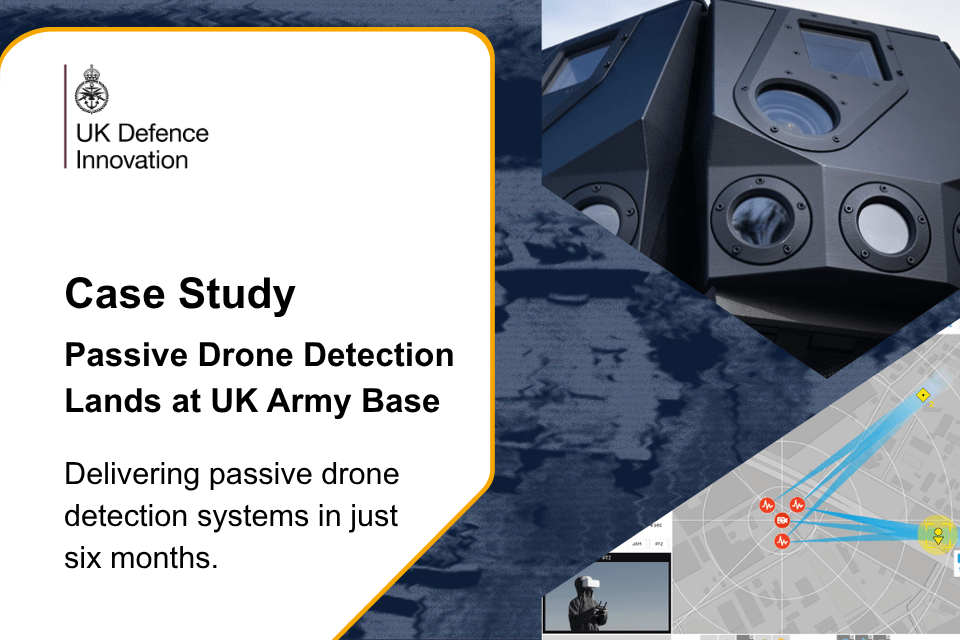
Drones are becoming increasingly compact, affordable, and difficult to detect, posing a significant challenge to military operations. An unauthorised drone can hover above a military installation, gathering visual and signal intelligence while evading detection. However, this situation has changed at a British Army base, where a new capability has been successfully deployed.
Project Halo Shield: A Rapid Deployment
In an initiative spearheaded by the British Army’s Experimentation and Trials Group (ETG) and funded by UK Defence Innovation (UKDI), Project Halo Shield has introduced a passive Counter-Unmanned Aircraft System (C-UAS) detection system at the Warminster garrison. This project has transformed a concept into an operational capability in record time, marking a significant advancement in the protection of Army bases.
Within the first 17 days of live monitoring, the system generated 29 drone position alerts, detecting activities up to five kilometres away, none of which posed a threat to the base. The system underwent rigorous testing by Army-operated drones, aimed at uncovering any vulnerabilities. The successful outcomes from these trials are already influencing how defence strategists consider drone detection, laying a robust foundation for broader implementation across other military sites in the UK.
A Collaborative Approach to Detection
UKDI’s backing facilitated collaboration between two suppliers, Dedrone and Quell, to provide a layered detection capability that enhances situational awareness for commanders. This cooperative effort was founded on prior engagements, with ETG having previously partnered with these suppliers during field demonstrations and C-UAS exercises, including Project Vanaheim and Project Flytrap, which tested the technologies against live drone operations. This established familiarity was key to the swift transition from demonstration to deployment.
Dedrone, now a part of Axon, is a recognised leader in counter-drone technology, safeguarding over 1,130 sites across 35 countries, including airports and critical national infrastructure. Their Command and Control (C2) software integrates various sensor types, including their proprietary radio frequency (RF) sensors, into a cohesive operational picture capable of detecting signals between drones and their operators, identifying both the aircraft and the pilot in real-time.
Innovative Technology in Action
The speed at which the project progressed is noteworthy, as highlighted by Nick McRobb, Dedrone’s UK defence lead and former Army Colonel. “We moved quickly. The demonstration event occurred in November 2025, and our on-site reconnaissance was completed by January 2026. We were operational by March 2026,” he explained.
The detection system employs three RF sensors to triangulate the position of drones across the garrison, with a fourth sensor dedicated to recognising and identifying both drones and their controllers. However, RF detection is just one element of the overall capability.
Quell, a British firm specialising in passive, AI-enabled surveillance and C-UAS systems, contributed their SkySpyke technology as the second layer of the Warminster deployment. This system autonomously covers the entire sky, detecting, tracking, and identifying all airborne objects. Its AI component filters alerts and provides visual confirmations, thus reducing the operator’s workload and enhancing usability.
Enhancing Capabilities Through Innovation
Bobby Hamilton, Quell’s Chief Operating Officer, emphasised the importance of simplicity and effectiveness in their system. “The drone threat is evolving, moving away from traditional RF-emitting capabilities. Our technology enables us to detect and identify drones regardless of their communication methods,” he stated.
Quell’s development of the SkySpyke system owes much to earlier funding from UKDI, which allowed the company to enhance its software platform, Deep Truth, improving detection range and redesigning hardware for a modular solution. This funding not only improved the product but also established a track record that facilitated Quell’s entry into the Warminster project.
Hamilton added, “The UKDI funding enabled us to implement lessons learned from the British Army’s Army Warfighting Experiment and pushed us towards operational testing with Taskforce RAPSTONE during their C-UAS exercises. Deploying our systems with the UK Ministry of Defence has allowed us to validate our capabilities in a real operational environment, demonstrating how it can function across the broader defence estate.”
Future Prospects for C-UAS Solutions
The technical contributions from ETG throughout the Halo Shield initiative have established a solid groundwork for future expansion. Subsequent phases may see the adoption of additional C-UAS solutions across UK garrison sites, integrating radar capabilities and acoustic sensors with existing RF and optical technologies to create a comprehensive layered detection framework.
Col James Howard of the Experimentation & Trials Group commented, “Collaborating with UKDI and industry on this dual-use capability has been mutually beneficial, enhancing the safety of the British Army from contemporary threats while allowing the ETG to further develop counter-drone capabilities.”
Nick McRobb further noted, “I encourage them to rigorously test and challenge the system. Only through such thorough evaluation will they gain the confidence to advocate for broader deployment across the estate. This project demonstrates that sensor fusion is the key; each technology contributes unique strengths, and when integrated, they provide a level of clarity and confidence unattainable by any single system.”
UKDI’s mission is to expedite the transition of cutting-edge capabilities from concept to frontline application. Project Halo Shield exemplifies this approach, showcasing a timely response to a real threat through the innovative collaboration of two pioneering companies.
If you possess technology that could enhance the UK’s protective measures, we invite you to reach out. Explore current opportunities to learn how to collaborate with us.



More Stories
UK and US to Connect Fusion Supercomputers Across the Atlantic for Groundbreaking Research
Approval Granted for Morgan and Morecambe Offshore Wind Farms Transmission Assets Development
UK and US Join Forces to Propel Fusion Energy Innovations for a Greener Future