
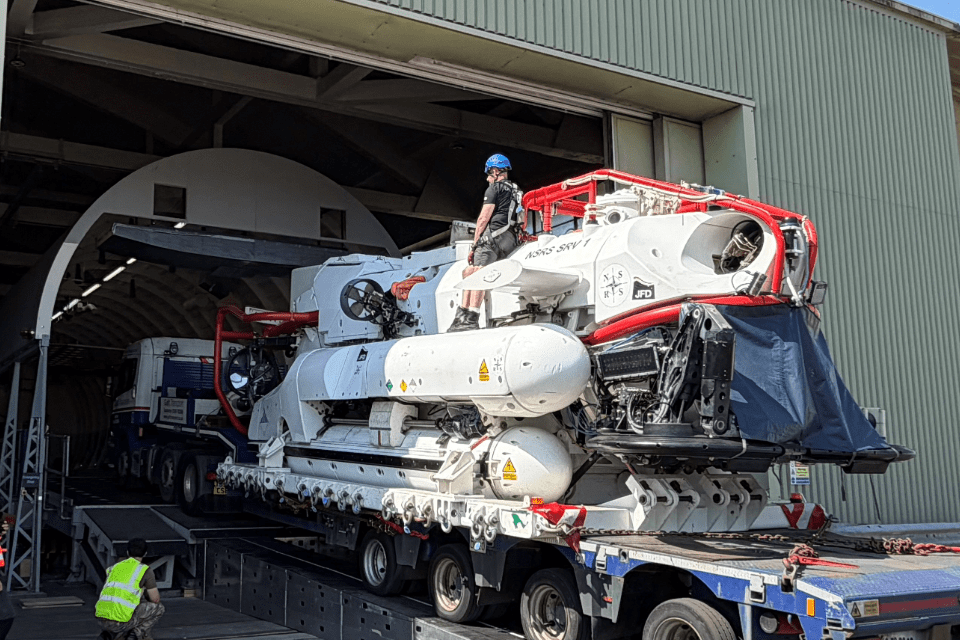
The NATO Submarine Rescue System (NSRS) has successfully participated in a recent exercise, demonstrating its capability to be rapidly deployed by the Royal Air Force (RAF) to any location across the globe.
This cutting-edge system, jointly owned by France, Norway, and the United Kingdom, stands as one of the foremost submarine rescue solutions available worldwide. Designed for full air mobility, the NSRS is equipped to evacuate submariners from vessels incapacitated at depths of up to 610 metres beneath the surface.
During the exercise, the NSRS, comprising 350 tonnes of specialised equipment, necessitated the use of 27 lorries and multiple aircraft for mobilisation. This training was crucial to validate the system’s readiness for swift deployment in emergency scenarios.
Logistical Coordination for Rapid Response
A key element of the rapid response capability for submarine emergencies involves the transportation of the system via road to an airport—in this instance, RAF Brize Norton. To enhance the safety and efficiency of the convoy, a police escort was organised, utilising forces from Glasgow to Brize Norton to maintain a consistent blue light presence throughout the journey.
Upon arrival at Brize Norton, the Submarine Rescue Vehicle—a compact submersible—was positioned on a simulator replicating the precise dimensions and deck configuration of a C-17A Globemaster. Additionally, some of the heaviest support equipment was loaded onto a similar simulator tailored for the A400M Atlas military transport aircraft.
This exercise marked the inaugural use of the A400M Atlas for NSRS transport, signifying that this aircraft can now be employed by the UK and partner nations within NATO for future mobilisations. Such enhancements are pivotal for ensuring the rapid deployment capabilities of the NSRS. The loading operations were executed by a specialised RAF team from the Joint Air Delivery Test and Evaluation Unit.
Reassurance from Defence Officials
Luke Pollard MP, Minister for Defence Readiness and Industry, remarked, “This is a piece of specialist equipment we hope never to have to use, but the ability to mobilise the NATO Submarine Rescue System at short notice to anywhere in the world is reassuring for the UK and our allies. If a submarine is in trouble, we will need to respond swiftly. Ensuring we have a tried and tested response is how we can be prepared for any eventuality.”
Captain Lyons RN, Operating Duty Holder for the NSRS, who observed the operation, commented, “The rescue of crew members from a distressed submarine demands seamless coordination among multiple agencies operating as a cohesive unit. This loading exercise onto a military aircraft is a crucial component for maintaining training and proficiency for our RAF colleagues. I was pleased to see them manage this unique vehicle with such efficiency, which is relied upon by numerous nations.”
Ongoing Commitment to Readiness
The exercise’s pace for all components of the NSRS is unwavering, as it serves to assure partner nations that the system remains in a state of readiness for rescue operations. The NSRS is administered on behalf of the Royal Navy, Marine Nationale, and Norwegian Navy by the DNE’s Submarine Delivery Group, with JFD Global serving as the service contractor.
Initiatives such as this exercise are essential to ensure that the NSRS team maintains their qualifications and provides confidence to partner nations that the system is always ready for rescue missions.




More Stories
AAIB Dispatches Investigation Team to Stirling Following Incident
Ofsted Launches Pilot Scheme for New Independent Complaints Review Service
CMA Initiates Action to Enhance Choice in Business Software Solutions