
Hello everyone,
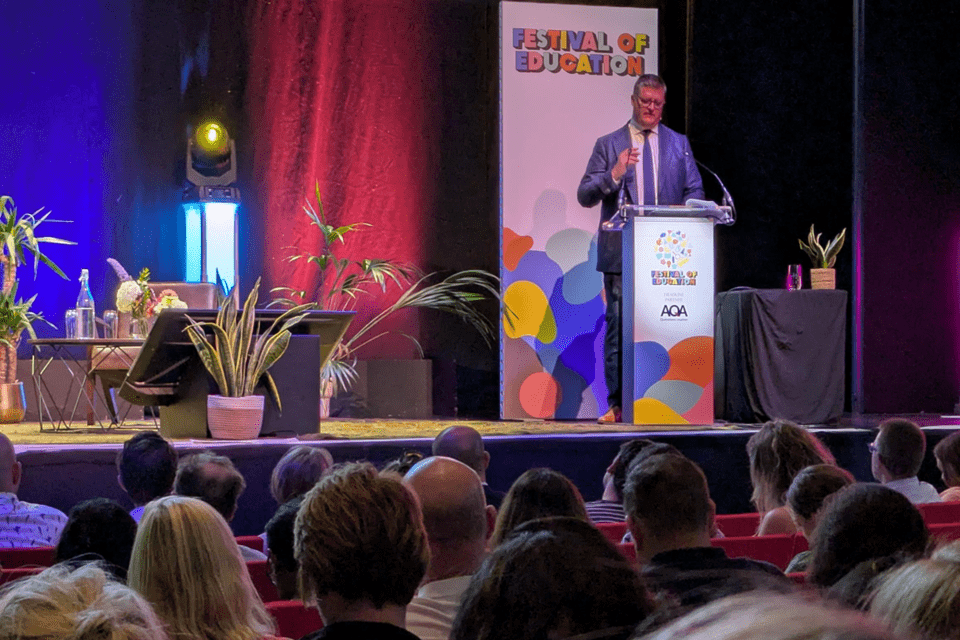
It is truly wonderful to be back at the Festival of Education. I extend my gratitude for your warm welcome, and I trust that you are enjoying the event thus far.
It is a privilege to share this platform with so many remarkable and inspiring speakers, authors, and researchers. This gathering is a celebration of education in all its forms.
At Ofsted, my responsibilities encompass the entire educational journey, beginning from early years education and care, which lays the foundation for a child’s future, through primary and secondary schooling, all the way to degree-level apprenticeships and teacher training, alongside the vital social care that interlinks these areas.
I wish to reflect on this comprehensive educational journey by discussing the developments we have undertaken over recent months as we have implemented our refreshed approach to inspections.
Additionally, I want to share some insights into what we have observed—areas of success and some statistics that substantiate these findings.
Positive Feedback on Inspections
I’m pleased to report that we have received a considerable amount of positive feedback regarding our renewed inspections.
We acknowledge that change can be challenging, and a universally favourable response is not to be expected. We will continue to listen to your feedback to ensure we can reflect and improve.
However, there is a growing sense that our published toolkits enhance transparency around inspections, allowing everyone to understand what inspectors will evaluate and how accountability is framed. We have clearly outlined the requirements for each grade across evaluation areas, and all training materials utilised by our inspectors are readily available online.
Our enhanced methodology encourages reflective practice and fosters increased dialogue. Many of you have noted that inspections now feel more collaborative, resembling a constructive conversation rather than a process imposed upon you.
This collaborative spirit is evident in our planning calls, where we have the opportunity to establish rapport before the inspection begins, ensuring we comprehend your context thoroughly.
The nominee role has also alleviated some of the pressures on leadership, particularly in smaller primary schools, contributing to improved wellbeing for both leaders and staff.
I am encouraged by the feedback we are receiving. While the process remains rigorous—ensuring high standards—it is also fairer, more humane, and more collaborative.
Emerging Positive Trends
Since implementing these changes in November, we have published nearly 6,000 inspection reports. While this represents only a small sample compared to the total number of schools and providers across the country, it is still early to draw definitive conclusions. Nevertheless, there are some encouraging trends emerging that I would like to highlight.
To begin with, let’s look at leadership and governance. Currently, 84% of schools and further education and skills providers are achieving ‘expected standard’ or above in this area. This is immensely reassuring, as it indicates that leaders are prioritising and acting upon key objectives, fostering a culture of high expectations for all pupils, and ensuring that staff receive the necessary training and knowledge to effect change.
We are also witnessing very positive outcomes in the area of inclusion, which holds particular significance for me. At present, 85% of further education and skills providers and 89% of schools are rated at or above ‘expected standard’. This suggests that inspectors are observing leaders who proactively identify pupils and learners requiring support and are committed to ensuring they receive it.
When discussing inclusion, I refer not only to those with special educational needs and disabilities (SEND) and those from disadvantaged backgrounds but also to other barriers that may impede a pupil’s chances for success. These barriers can include caring responsibilities that exhaust them, familial disruptions that create instability, or bereavement that introduces emotional challenges they may not yet know how to navigate.
It is heartening to see such positive results in this domain, affirming that children and learners are receiving the support they need to surmount both immediate and long-term obstacles.
Attendance and Behaviour: A Positive Outlook
In schools, I am also pleased to report that over 84% of establishments are graded as ‘expected standard’ or above in attendance and behaviour. I hope this positive statistic alleviates some of the concerns that have been expressed regarding this evaluation area.
During inspections, we observe schools prioritising attendance, with efforts made to support pupils and their families in this regard. The culture within these schools is conducive to learning, fostering an environment where pupils are motivated to attend regularly, which is especially beneficial for those needing the stability that consistent attendance provides.
As I have previously emphasised, we will always acknowledge and support those of you working against the odds in this area. We take context into account, using it to understand the circumstances you navigate, but we do not allow it to predetermine grades.
Furthermore, we are also seeing commendable results concerning personal development and wellbeing, with a remarkable 95% of schools achieving ‘expected standard’ or above. This indicates that pupils are being afforded opportunities to explore diverse interests, including the arts, while also being nurtured to become confident, resilient, and independent individuals. They are aware of where to seek pastoral support and can trust that they will be heard and assisted when they do so.
The Significance of Quality Teaching
I would like to emphasise the importance of genuine human connection and the profound impact that dedicated teachers make on a daily basis.
Research consistently indicates that the quality of teaching and the nature of interactions are the most significant factors influencing how pupils learn. This is particularly crucial for the most vulnerable and disadvantaged learners—those who may not experience many positive interactions at home or in their day-to-day lives. The connections they form within the educational environment can prove transformative.
This foundational aspect begins in the early years, where interactions set the stage for all future learning. The quantity of these interactions is vital, as is their quality. Opportunities for children to engage with songs, speech, and stories matter, along with the ability to turn-take, encounter new vocabulary, and partake in shared reading. Equally important is the capacity of staff to identify those children who require such interactions the most.
These enriching interactions fundamentally shape children’s language and vocabulary, bolstering their confidence and preparing them for learning ahead.
Our review of existing evidence, including collaborations with the Education Endowment Foundation, strongly supports this assertion. Effective teaching remains the single most critical factor in determining a child’s progress throughout their educational journey.
This reality may feel daunting; however, it is also an immense privilege. Being at the heart of these children’s experiences puts educators in a unique position to effect real change.
The Role of Teachers in Creating Safe Spaces
The environment we cultivate within schools is paramount, as it is the space where pupils feel secure, supported, and ready to learn. Last year, I likened schools to ‘citadels of childhood’—sanctuaries of safety, community, and connection.
Reflecting on that metaphor, I believe that it is teachers who transform these citadels into homes rather than mere fortresses. Without the dedication of teachers, staff, and leaders, a school is simply an assembly of walls, corridors, and classrooms devoid of character or culture. It is the people within that create a sense of belonging.
Teachers possess a unique ability to nurture and ensure that children feel they belong alongside their peers. You create the conditions that encourage children to attend school each day.
Throughout my three decades in education, I have encountered numerous instances of teaching assistants, reception staff, teachers, and leaders who go above and beyond. One particular case that has stayed with me involved a pupil facing immense challenges at home.
The collaboration of pastoral staff, teachers, leaders, and even the community police officer was instrumental in providing a support system. This exemplified the ‘team around the child’ approach. While I could elaborate further, the emotional weight of this case remains significant even after all these years, thus I will refrain from disclosing private details.
Ultimately, the difference made stemmed from the constancy of relationships. The same staff, the same community, being present in their lives, understanding the reasons behind difficult days, while also maintaining appropriate boundaries—this was crucial.
As I mentioned last year, it is the humanity and genuine empathy that can make a difference—though I recognise that not every situation concludes with a happy ending. Sometimes, progress may simply be achieving safety rather than a sought-after grade.
Despite any missteps along the way, we endeavoured to do our best. As I shared with the Education Select Committee last week: “Know your children, know them well, and ensure you are meeting their needs; that is the job of an educator.” While schools and teachers cannot solve every societal issue, we are grateful for all those working within the public sector.
Investing in Professional Development
If, as we know, effective teachers and support staff are the most crucial factor for children, then fostering their development must be one of the most impactful responsibilities leaders hold.
The quality of teaching, meaningful interactions, and the prevailing culture do not occur by chance; they require deliberate action. Expertise in effective teaching is cultivated through training, ongoing learning, reflection, and continuous improvement throughout one’s career.
This journey should be supported by robust and evidence-based


More Stories
SLC Disburses £5.7 Billion in Student Finance for the 2026/27 Academic Year
Prime Minister’s Key Meeting with Sultan of Oman Scheduled for 21 October 2026
Government Invests in Pothole Repairs: 7,000 Miles of Smoother Roads Following Historic Funding Boost