
Environment Agency Reveals Heatmaps of Illegal Waste Sites
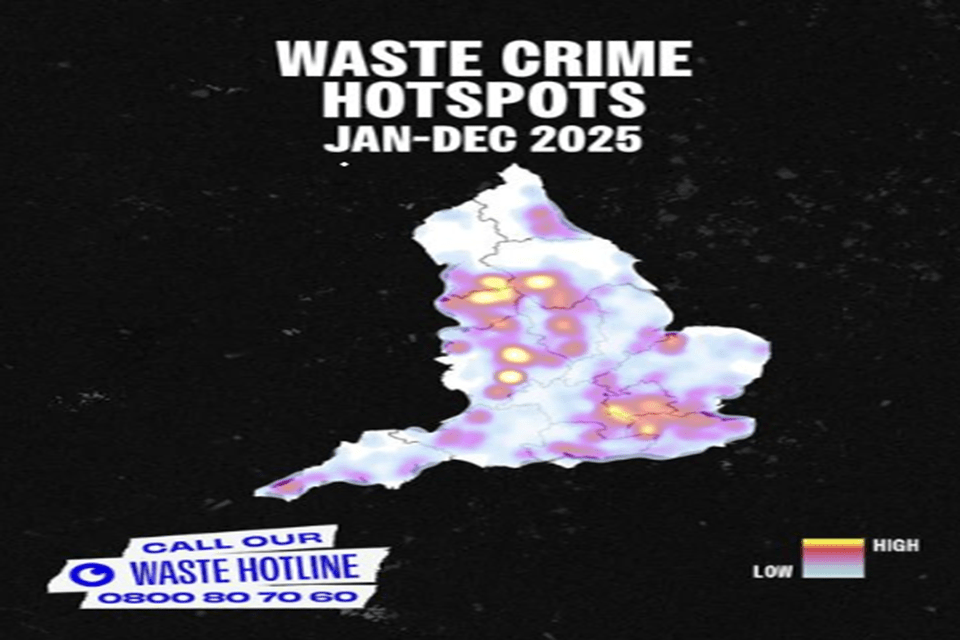
Organised crime syndicates operating illegal waste sites across England have been brought to light through the recent publication of heatmaps by the Environment Agency. These maps, unveiled on 2 September 2026, are informed by public reports and highlight areas where suspected waste crimes—including transportation, dumping, and burning—are occurring throughout the country.
First introduced in the previous year, these annual reports form a key component of the Environment Agency’s comprehensive 10-point strategy aimed at combating waste crime. The heatmaps serve as a vital tool for building intelligence, identifying hotspots, directing enforcement efforts, and disrupting illegal operations.
In 2025, the organisation recorded 10,238 allegations of suspected waste crime, with the West Midlands leading with 1,542 reports, followed closely by Yorkshire at 1,068. In response to the significant issues faced in Yorkshire, efforts are now underway to remediate one of the most notorious waste sites in Bradford. The Mayor of West Yorkshire is poised to adopt a pioneering region-led approach to address waste crime effectively.
Government Initiatives to Combat Waste Crime
As part of the Prime Minister’s initiative to tackle waste crime, the government and the Environment Agency are collaborating to ensure that waste criminals have no refuge. This partnership includes the deployment of additional Environment Agency officers to the frontline, enhancing national efforts to combat this pressing issue.
The strategy involves the increased utilisation of drones, a more prominent role for local Mayors and police forces, and a substantial increase in fines to deter and penalise illegal dumping activities. Furthermore, a newly established Waste Crime Crackdown Group, led by Environment Secretary Dame Angela Eagle, aims to unify regulators and law enforcement agencies to dismantle these criminal enterprises effectively.
Philip Duffy, Chief Executive of the Environment Agency, emphasised the importance of public intelligence, stating, “With more officers on the frontline and strengthened enforcement, we are disrupting criminal gangs and supporting legitimate operators. But intelligence from the public remains vital. If you see something suspicious, you must report it.” He urged that every piece of information contributes significantly to their ability to act swiftly and shut down operations that harm communities and the environment.
Strengthened Penalties and New Powers
Dame Angela Eagle reiterated the government’s commitment to addressing the scourge of waste crime, which has marred towns, cities, and rural areas alike. She stated, “These heatmaps illuminate the extent of the problem and how it has been allowed to persist. That’s why we are intensifying efforts against the criminals responsible and equipping the Environment Agency with the necessary tools to act decisively.”
As a part of these initiatives, the government is also empowering the Environment Agency with enhanced authority to confront waste crime. Offenders who engage in illegal dumping or fail to manage waste appropriately may face fines reaching £5,000, a significant increase from the previous maximum of £300. Those implicated in severe violations could already face more stringent penalties, including prosecution and imprisonment.
New Technologies and Tracking Systems
The Environment Agency is committed to robust enforcement measures, expanding its capabilities to track down and seize the assets—such as cash, vehicles, and properties—associated with the profits of waste crime. New provisions within the Crime and Policing Act 2026 will expedite the enforcement of confiscation orders.
Starting in October 2026, a digital waste tracking service will be introduced, simplifying the monitoring of waste movements and aiding in the identification of illegal handling. Additionally, from 2027, reforms to the waste carriers, brokers, and dealers regime will transition to a permitted system, mandating stricter compliance for waste carriers.
Spotlight on Regional Case Studies
Several specific cases exemplify the challenges and responses to waste crime across the country:
In Bradford, the Midland Road site was first reported to the Environment Agency by a concerned citizen in July 2026, prompting an investigation. The government has recently announced plans for cleanup, contingent upon feasibility assessments.
In Leicestershire, reports of foul odours led to the discovery of a concealed illegal dump at the Cave’s Inn Pits Site of Special Scientific Interest (SSSI). The Environment Agency and Natural England have initiated a significant investigation into the 30,000 tonnes of waste found there, resulting in one arrest thus far.
In Chesterfield, the Environment Agency intervened at a former industrial site in Wingerworth in May, following public reports of illegal dumping. Approximately 100 tonnes of household waste was uncovered, and action has been taken to ensure that no further dumping occurs. The landowner has since removed the waste, and a criminal investigation is ongoing to identify those responsible.
How to Report Waste Crime
The public is encouraged to take proactive measures in the fight against waste crime by following three straightforward steps:
- Dispose of household waste appropriately to prevent it from falling into the hands of criminals. For guidance, visit Dispose of household waste – GOV.UK.
- Verify that your waste carrier is registered prior to engaging a skip hire company or private waste collection service. More information can be found at Waste Carriers, Brokers and Dealers.
- Report any known or suspected illegal waste activities anonymously to Crimestoppers at Giving information anonymously or by calling 0800 555 111, or contact the Environment Agency’s 24-hour incident hotline at 0800 80 70 60.




More Stories
AAIB Dispatches Investigation Team to Stirling Following Incident
Ofsted Launches Pilot Scheme for New Independent Complaints Review Service
CMA Initiates Action to Enhance Choice in Business Software Solutions