
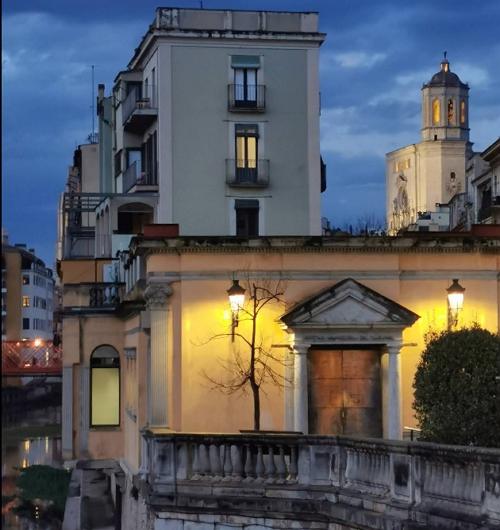
Girona is often celebrated for its medieval streets, colourful riverside houses and imposing cathedral. Visitors come expecting history, and they are rarely disappointed. Yet tucked between the city’s ancient stones lies one of Catalonia’s most ambitious cultural projects: Bòlit, Girona’s Centre for Contemporary Art, a place where the past and the present engage in an ongoing conversation.
A visit to Bòlit is unlike entering a conventional museum. There is no single monumental building or grand entrance announcing its presence. Instead, the institution unfolds across three distinct venues scattered through the historic city: Bòlit Pou Rodó, Bòlit La Rambla and Bòlit Sant Nicolau. Walking from one site to another becomes part of the experience itself, encouraging visitors to discover Girona not simply as a heritage destination but as a living cultural landscape.
Established in 2008, Bòlit has grown into one of the most significant public centres for contemporary art in Catalonia. Rather than concentrating solely on exhibitions, it functions as a platform for artistic research, production and experimentation. The emphasis is firmly on ideas as much as finished works, creating an environment where artists, audiences and researchers can engage with some of the pressing questions of our time.
What becomes immediately apparent is that Bòlit refuses to treat contemporary art as something remote or exclusive. Its programme ranges from exhibitions and artist residencies to educational initiatives, public debates and guided visits designed to engage audiences of all ages and backgrounds. The centre acts as both laboratory and meeting place, supporting local creators while maintaining an outward-looking international perspective.
The institution’s director, Oriol Fontdevila, together with a dedicated technical team, has developed a model that places collaboration at the heart of its activities. Artists are not simply invited to exhibit completed works; many are encouraged to develop new projects on site, benefiting from residency spaces, professional support and opportunities for international visibility. This commitment to production rather than mere presentation gives the centre a distinctive energy.
Even the name “Bòlit” reflects this spirit. It refers to a traditional Catalan game, similar in some respects to baseball, played with a small wooden piece struck into the air before being hit with a bat. Originating in Girona’s Sant Narcís district, where an annual world championship is still held, the game embodies movement, skill and imagination—qualities that seem entirely appropriate for an institution devoted to contemporary artistic practice.
Beyond its own walls, Bòlit occupies an important position within Catalonia’s wider cultural infrastructure. It forms part of the Public System of Visual Arts Facilities of Catalonia (SPEAVC), a network established to strengthen artistic production, improve territorial balance and ensure access to high-quality contemporary art throughout the region. Alongside leading institutions in Barcelona, Lleida, Tarragona, Vic and other Catalan cities, Bòlit contributes to a collaborative model that shares resources, supports artists and promotes innovation.
Its participation in the Transversal Network further reinforces this collaborative ethos. Bringing together cultural institutions from cities across Catalonia, the network encourages joint productions, exchanges of ideas and the development of new creative initiatives that might otherwise struggle to find institutional support.
Perhaps most impressive, however, is Bòlit’s understanding that contemporary art cannot exist in isolation. Educational programmes such as Bòlit Mentor build meaningful relationships with schools and emerging artists, while mediation projects seek to bridge the often-perceived divide between artistic practice and wider society. Documentation, publishing and public engagement are treated not as secondary activities but as essential components of the institution’s mission.
In an era when many cultural organisations compete for attention through spectacle, Bòlit offers something quieter yet arguably more enduring. Its ambition lies not in attracting crowds through blockbuster exhibitions, but in fostering sustained dialogue, critical thinking and artistic experimentation. The result is a centre that feels deeply embedded within its community while remaining connected to international contemporary art.
For visitors to Girona, Bòlit provides a compelling reminder that the city is far more than a beautifully preserved medieval jewel. Alongside its historic architecture runs a vibrant current of contemporary creativity, one that challenges assumptions, invites participation and demonstrates that culture is not merely about preserving the past but continually imagining the future.
Leaving the final venue, one has the sense that Bòlit is less a collection of exhibition spaces than an evolving conversation spread across the city itself. In doing so, it has become one of Catalonia’s most quietly influential centres for contemporary art—well worth seeking out beyond Girona’s better-known landmarks.




More Stories
Pension Savers Reclaim £188 Million After HMRC Overtaxes Withdrawals: A Shocking Oversight
How UK Tax Regulations Influenced the Recent Transfer Window
Revolutionary Inheritance Tax Changes Set to Transform Pension Utilisation in the UK