
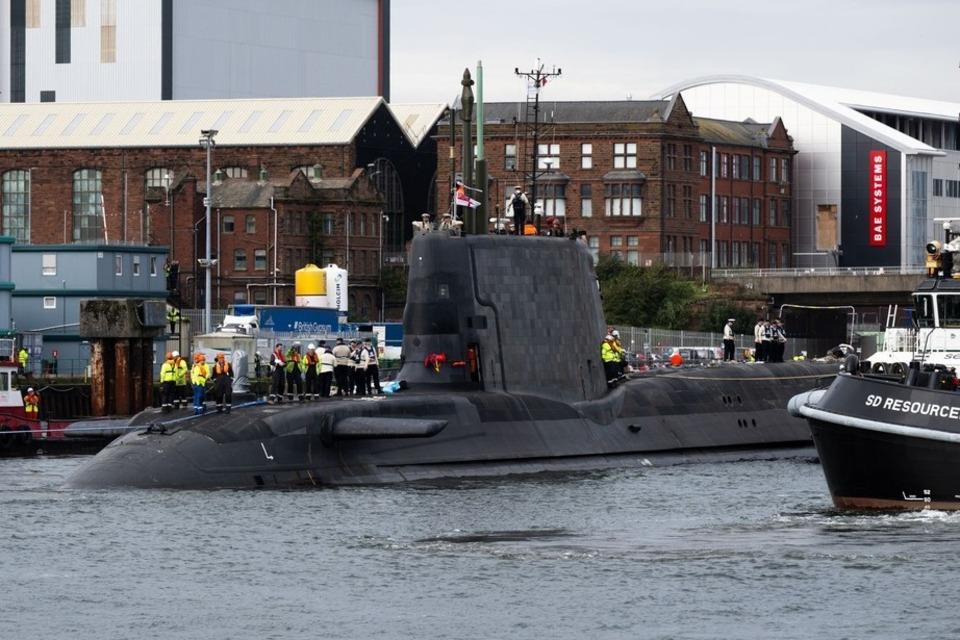
The latest addition to the Royal Navy’s fleet, HMS Agamemnon, has set sail from the BAE Systems shipyard in Barrow-in-Furness. This marks a significant milestone as the submarine embarks on its sea trials, a critical phase prior to its commissioning into active service. The introduction of HMS Agamemnon is expected to enhance the security of the UK and the wider Euro-Atlantic region.
The UK Government is investing £6 billion in the submarine industrial base during the Spending Review period, supporting thousands of jobs across the industry. The HMS Agamemnon, affectionately known as ‘Awesome Aggie’, is the latest conventionally armed nuclear-powered submarine in the Royal Navy’s arsenal and is poised to undergo rigorous testing at sea.
Advanced Features of the Astute Class Submarine
The Astute Class represents the largest, most sophisticated, and powerful attack submarines ever operated by the Royal Navy. Weighing in at 7,400 tonnes and measuring 97 metres in length, they are nearly as long as two Olympic swimming pools. Powered by a Rolls-Royce Submarines nuclear reactor manufactured in Derby, the submarine is designed to operate without the need for refuelling throughout its service life.
HMS Agamemnon boasts an impressive array of capabilities, including stealthy precision strikes, anti-submarine warfare, and intelligence gathering. The submarine is equipped with heavyweight Spearfish torpedoes and Tomahawk IV land attack missiles, which can engage targets at distances exceeding 1,000 miles.
In addition to its role in maintaining a continuous at-sea deterrent, Astute-class submarines provide essential support for maritime task groups and contribute to UK, NATO, and coalition operations.
Government Officials Acknowledge the Importance of the Milestone
Prime Minister Andy Burnham expressed his admiration for the dedication of the workforce in Barrow, stating that he understands the significance of this achievement for all those involved. He emphasised that HMS Agamemnon, as one of the most advanced submarines constructed, will substantially enhance national security both at home and within NATO.
Defence Secretary Wes Streeting MP noted that deterrence forms the foundation of national security. He remarked that the launch of another formidable attack submarine reinforces this deterrent capability and illustrates the UK’s commitment to addressing the challenges posed by an increasingly perilous global landscape. Streeting highlighted his recent visit aboard HMS Agamemnon, where he met the skilled personnel responsible for realising this engineering marvel.
The Workforce Behind HMS Agamemnon
The departure of HMS Agamemnon from Barrow-in-Furness is the culmination of years of effort by a highly skilled workforce, including engineers, technicians, and specialists from BAE Systems and the Defence Nuclear Enterprise (DNE). Their combined expertise underscores the depth of skills maintained both in Barrow and throughout the UK’s submarine sector.
Maddy McTernan, Chief of Defence Nuclear, described HMS Agamemnon’s launch as a momentous occasion for the UK’s Defence Nuclear Enterprise, showcasing the engineering excellence of the Barrow workforce and the broader supply chain. The continued production of submarines is set to bolster British industry for many years, supported by the commitments outlined in the recent Defence Investment Plan.
Strategic Importance of Sea Power
General Sir Gwyn Jenkins, First Sea Lord of the Royal Navy, highlighted the essential role of sea power in safeguarding the nation in a world fraught with danger. He expressed his delight at HMS Agamemnon commencing sea trials, anticipating her arrival at HMNB Clyde to join the fleet. Jenkins noted that the submarine exemplifies the pinnacle of British engineering and the professionalism of the Royal Navy’s submariners, reinforcing the commitment to enhancing warfighting readiness.
The completion of HMS Agamemnon aligns with the commitments made in the 2025 Strategic Defence Review and reinforced by the Defence Investment Plan (DIP). This plan allocates £298 billion over the next four years, including £47 billion specifically for investment in submarine construction, maintenance, and infrastructure, enabling the UK to produce a new submarine every 18 months as part of the SSN-AUKUS programme.
Economic Impact and Future Prospects
Recognising Barrow’s strategic significance, the DNE’s investments are driving substantial growth and development within the town. The government’s commitment to the submarine production programme provides economic certainty, underpinning the ten-year Plan for Barrow, which is supported by a £200 million Transformation Fund. Currently, over 14,000 jobs in Barrow-in-Furness are linked to defence nuclear work, with an additional 1,800 roles created under the current administration.
HMS Agamemnon is part of a national initiative involving the MOD’s DNE, along with partner organisations responsible for operating, maintaining, renewing, and sustaining the UK’s nuclear deterrent. The DNE supports more than 47,000 jobs across the country, including many highly skilled positions in submarine manufacturing.
Looking Ahead: The Future of the Astute Class
HMS Agamemnon was formally commissioned into the Royal Navy by His Majesty the King on 22 September 2025, becoming the sixth vessel to carry the name. The seventh and final submarine in this class, HMS Achilles, is currently in advanced stages of construction at Barrow. The Astute Class will eventually be succeeded by up to 12 new SSN-AUKUS nuclear-powered attack submarines, with construction of the first in class set to commence next year, ensuring Barrow’s continued prominence in the AUKUS initiative.




More Stories
Almost 50 Arrests Made in Major People Smuggling Operation at Irish Border
Government Takes Bold Steps to Strengthen Leaseholder Protections
South West Water Fined £7.8 Million for Reckless Practices: What You Need to Know