
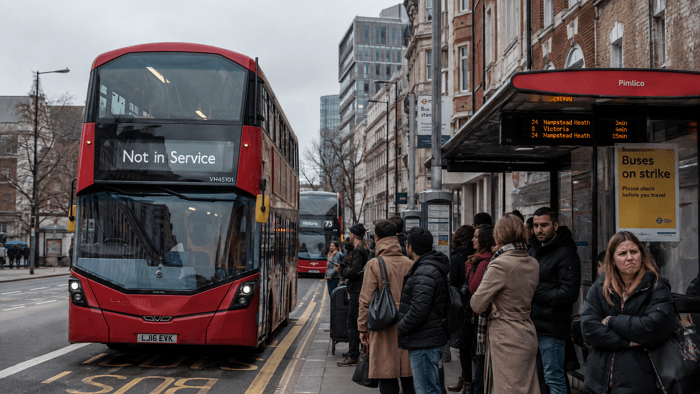
Industrial action will affect dozens of routes across North and East London after drivers rejected a new offer over working conditions during periods of extreme heat
Bus passengers in parts of London are facing a fresh round of disruption this week after more than 1,500 Arriva North London drivers voted to resume strike action.
Members of the Unite union will walk out again from Tuesday 25 August until Friday 28 August, following the rejection of a revised offer from Arriva. The dispute centres primarily on working conditions during hot weather, with drivers raising concerns about temperatures inside their cabs during this summer’s repeated heatwaves.
The latest action follows earlier strikes on 14 and 18 August. Further walkouts planned between 19 and 21 August were temporarily suspended while workers considered a new proposal from the company.
However, Unite confirmed that members did not believe the offer went far enough to address their concerns, meaning industrial action will now restart.
More than 40 London bus routes could be disrupted
The strikes involve drivers based at eight Arriva garages: Barking, Edmonton, Enfield, Grays, Palmers Green, Stamford Hill, Tottenham and Wood Green.
As a result, passengers travelling across large parts of North and East London, as well as some areas of Central London and Essex, are likely to face cancellations, reduced services and longer waiting times.
Previous industrial action affected more than 40 routes, and similar disruption is expected during the latest walkout. Routes potentially affected include major services such as the 19, 29, 34, 41, 102, 121, 123, 141, 149, 243, 259, 279, 329 and 341, alongside the SL1 and SL2 Superloop services and several night buses.
Passengers have been advised to check the latest service information before setting off and to allow additional time for journeys on strike days.
The disruption could be particularly significant because some of the industrial action coincides with planned engineering closures on the Piccadilly line, reducing the number of alternative transport options available to some passengers. (Unite the Union)
Drivers raise concerns over temperatures above 40C
At the heart of the dispute are conditions inside drivers’ cabs during periods of extreme summer heat.
Unite says most Arriva North London buses use air-cooling systems rather than full air conditioning.
According to the union, these systems have sometimes reduced temperatures by only two or three degrees during recent heatwaves, while temperatures inside some drivers’ cabs have reached 40C or higher.
The union argues that prolonged exposure to such conditions can increase the risk of fatigue, dehydration, heat exhaustion and heat stroke.
Concerns have become increasingly prominent during a summer in which London has experienced repeated spells of temperatures above 30C.
Unite has argued that the issue is not simply about comfort but also about safety, as drivers are responsible for operating large vehicles carrying hundreds of passengers during long shifts. (Unite the Union)
Offer rejected after temporary pause in strikes
The dispute appeared to move closer to a possible resolution last week when Unite and Arriva entered fresh negotiations.
Strike action scheduled for 19, 20 and 21 August was suspended to allow drivers to vote on a new proposal.
However, the ballot did not bring the dispute to an end.
Workers rejected the offer, with the union saying it did not sufficiently address the problems associated with hot-weather working.
Unite general secretary Sharon Graham said drivers were putting themselves at risk because of the conditions and called on Arriva to make further improvements.
The union has also pointed to Arriva’s financial position, saying the company has the resources required to introduce more substantial changes.
Arriva’s latest financial figures cited by Unite showed a pre-tax profit of €156 million and an operating profit of €127 million.
Further strikes planned through September and October
The four-day walkout beginning on 25 August may not be the end of the dispute.
A lengthy programme of additional strike dates has already been announced.
Unless an agreement is reached, drivers are currently expected to take further industrial action on:
- 4 and 5 September
- 7 and 8 September
- 18 and 19 September
- 21 and 22 September
- 2 and 3 October
- 5 and 6 October
- 16 and 17 October
- 19 and 20 October
The schedule means disruption could continue for almost two months if negotiations fail to produce an agreement acceptable to workers. (Unite the Union)
North London passengers likely to face the greatest impact
Areas including Tottenham, Wood Green, Edmonton, Enfield and Palmers Green are expected to be among those most heavily affected because of the concentration of Arriva-operated services in these parts of the capital.
Some routes provide important links between residential areas, railway and Underground stations, schools, shopping centres and major transport interchanges.
That means disruption could extend beyond individual bus journeys, with passengers potentially switching to other routes, the London Underground or rail services and increasing pressure on alternative networks.
Night services will also be affected, creating additional difficulties for people travelling home after late shifts or evening events.
The industrial action comes at a particularly difficult time for London’s transport network because engineering works are already affecting other parts of the system.
A wider debate over extreme heat and public transport
The dispute also highlights a growing challenge for London’s transport system: how to protect workers and passengers as periods of extreme heat become more frequent.
Older buses and driver compartments were not necessarily designed for prolonged temperatures at the levels experienced during recent summers.
Air-cooling systems work differently from traditional air conditioning and generally offer more limited temperature control.
For drivers spending many hours behind the wheel, even small differences in cabin temperature can become significant over the course of a shift.
Unite has therefore argued that long-term changes are required rather than temporary measures during individual heatwaves.
The union has also previously raised allegations concerning the treatment of some members and workplace representatives during the dispute, while Arriva has continued negotiations in an attempt to reach a settlement.
Passengers advised to plan journeys carefully
Anyone relying on Arriva services during the strike period should check live transport information before travelling.
Some routes may operate partially while others could have little or no service, depending on staffing levels.
Alternative routes are likely to become busier, particularly during the morning and evening rush hours.
With the latest strike beginning on Tuesday 25 August, passengers across North and East London now face several days of renewed disruption.
Whether the action extends into September and October will depend on whether Arriva and Unite can reach an agreement on working conditions before the next scheduled walkouts.
More Stories
Inside Nigella Lawson’s Serene £5 Million Converted Stables Home in Chelsea
Exploring Europe’s ‘Best Toddler-Friendly City’: A Parent’s Experience with a Two-Year-Old
Restoration at Buckingham Palace Reveals Hidden Treasures: Staff Betting Slips and More Uncovered