
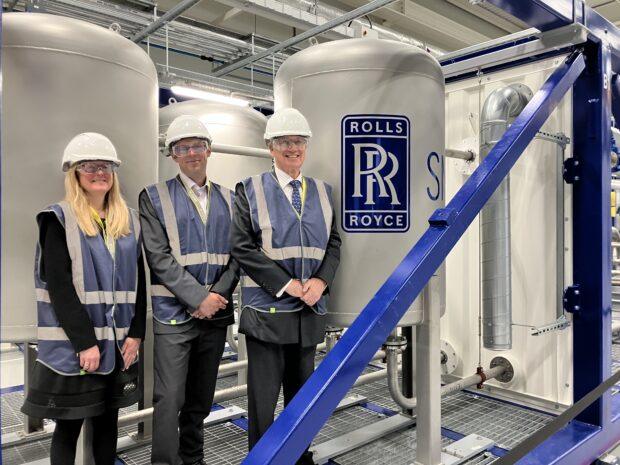
In light of Rolls-Royce SMR’s recent announcement regarding the establishment of the Pioneer Works facility in Derby, Andy Pynn, the strategic lead for nuclear new build, reflects on a visit he made to the company’s EXPERI facility at the University of Sheffield’s Advanced Manufacturing Research Centre. Accompanied by Environment Agency officials, including Chair Alan Lovell and board member Stewart Davies, Pynn aimed to explore the innovative methods being introduced for the construction of nuclear power stations.
Evolving Assessment Methods for Nuclear Reactors
As reactor designs and the construction techniques of nuclear power stations progress, the Environment Agency is also adapting its assessment processes for new reactor designs. Recently, the agency outlined its commitment to facilitating two-year reactor design assessments and providing flexible options. The agency intends to incorporate insights from international regulatory reviews to enhance its decision-making.
Understanding the Module Development Facility
The concept of manufacturing modules in a factory setting for subsequent assembly on site is not unique to the nuclear sector; similar methods have been successfully employed in industries such as oil, gas, and renewables. Rolls-Royce SMR’s ‘EXPERI’ facility, often referred to as ‘Factory 2050’, has been established to manufacture and test prototype modules for the company’s small modular reactors (RR-SMR).
In the coming years, the majority of the plant, systems, and components will be constructed in steel-framed modules within factories, subsequently transported to locations for assembly into a power station—a process commonly known as modularisation. The facilities in Sheffield, soon to be complemented by those in Derby, allow engineers at Rolls-Royce SMR to refine their approach to module manufacturing.
Insights Gained from the Visit
The visit commenced in the boardroom, where Mark Salisbury, Rolls-Royce SMR’s Head of Regulatory Affairs, alongside his engineering team, provided an in-depth overview of the reactor design, including a virtual reality tour of the reactor island. Key points discussed included:
- 121 fuel assemblies are designed to generate power for approximately 1 million people for an 18-month period.
- The design is boron-free, resulting in lower tritium production and reduced water discharge, which mitigates its environmental impact.
- The option for indirect cooling is being integrated, allowing the reactor to utilise less water and potentially be sited inland.
- Innovations in welding are being prioritised, with a shift towards more mechanical automated welds in the factory, thereby reducing hazards and leakage risks.
The engineers showcased time-lapse videos illustrating how components would be assembled within the modules, a technique anticipated for future factory operations. While modularisation is not an entirely new concept in the nuclear industry, this initiative marks the first instance of such extensive factory construction for a nuclear power station in the UK.
The Benefits of Virtual Reality in Construction Planning
The visit also featured a virtual reality tour, providing an immersive experience of an SMR site, including a walkthrough of the containment building’s interior. This advanced VR capability allows engineers to visualise the installation of components during construction and plan for maintenance and inspection access. The innovative approach to modularisation and construction is expected to significantly reduce the time required to build a power station, with animations illustrating how the individual module blocks will be assembled on-site.
On the factory floor, visitors observed the steel modules and learned about their construction process and transport logistics. Engagement with the community will be crucial for this project as well as for any new technologies. The Environment Agency is encouraging Rolls-Royce SMR and Great British Energy-Nuclear (GBE-N) to effectively communicate how this design differs from traditional ‘gigawatt’ power stations, necessitating a clear explanation of how regulatory practices will evolve at these sites.
Current Status of the RR-SMR Design Assessment
The Generic Design Assessment (GDA) process allows nuclear scientists and regulators at the Environment Agency and the Office for Nuclear Regulation to evaluate new nuclear power station designs early in the regulatory framework. During the assessment of the RR-SMR, the agency is meticulously reviewing the company’s designs and identifying potential technical issues. Regular meetings facilitate discussions and questions with the Rolls-Royce SMR engineering team, ensuring that any concerns are addressed promptly. This rigorous scrutiny aids the company in circumventing potentially costly alterations during the construction phase of the reactors.
Currently, Rolls-Royce SMR is in Step 3 of the GDA—the detailed assessment stage. The Environment Agency, along with Natural Resources Wales, is concentrating on the environmental case, which involves a public and stakeholder consultation slated to commence in February 2027.
Future Developments in Nuclear Power
In April, Rolls-Royce SMR entered into a contract with Great British Energy-Nuclear (GBE-N) to develop the UK’s first small modular reactors at the Gwyndod Power Station on Anglesey, North Wales. The company has also secured a contract with Czech to implement an SMR programme and has been selected by Videberg Kraft as a partner for delivering SMRs in Sweden.
Further Information and Contact Details
For more information, you can reach out via email at nuclear@environment-agency.gov.uk. Additional resources related to the GDA and insights into the RR-SMR can be found on the Rolls-Royce SMR website.




More Stories
Transforming Flood Defences: Building Resilience and Confidence in a Changing Climate
Optimal Meat Consumption: How Much Should You Really Be Eating?
Understanding the New Five-Day Limit: How Long Should You Safely Use a Decongestant Nasal Spray?