
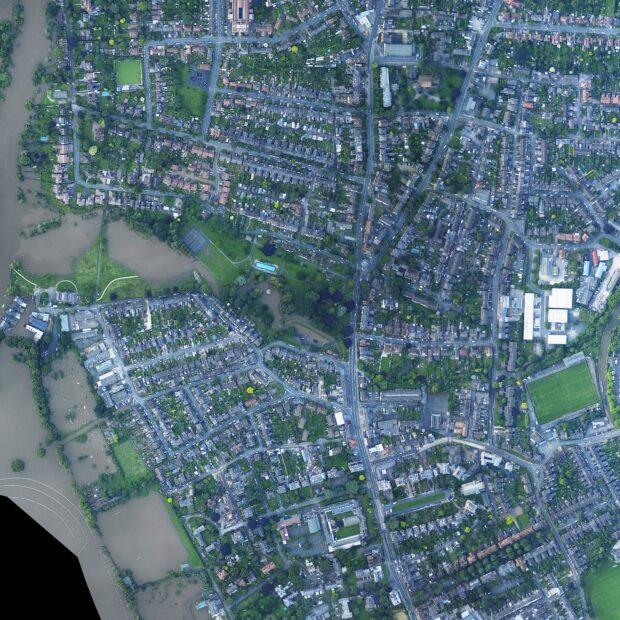
Flooding presents a significant challenge to numerous communities across England. With climate change intensifying the frequency and severity of extreme weather events, recent research conducted by the Environment Agency underscores the pressing need for an effective and equitable approach to flood risk management.
Understanding the Distribution of Flood Risk
For over twenty years, research from the Environment Agency has revealed a correlation between flood risk and socio-economic deprivation. The latest analysis reaffirms that these disparities remain prevalent today.
The National Flood Risk Assessment indicates that approximately 6.3 million properties in England are situated in areas vulnerable to flooding from rivers, the sea, surface water, or a combination of these sources. Notably, around 4.6 million properties are specifically at risk from surface water flooding alone.
By integrating property-level flood risk data with population estimates from the Office for National Statistics, it is estimated that roughly 11.3 million individuals in England reside in regions at risk of flooding.
Furthermore, our findings reveal that over 2.5 million people who are susceptible to flooding from rivers, the sea, or surface water also inhabit the 20% most deprived neighbourhoods in the country.
Approximately 9.3 million individuals in England are increasingly exposed to the threat of surface water flooding, which occurs when heavy rainfall overwhelms drainage systems, resulting in water accumulation on the ground and leading to flash flooding. Of this group, 2.1 million live in the most disadvantaged towns and cities, indicating that nearly one in four people at risk of surface water flooding are situated in the nation’s most vulnerable urban communities.
Coastal areas exhibit some of the starkest inequalities, with around one-third of residents living in flood-prone coastal regions also residing in the most deprived areas of England.
The Importance of Addressing Inequality
The analyses conducted clearly demonstrate that flood risk is a significant issue impacting a considerable portion of the population across every region of the country. The uneven distribution of risk is critical, as flooding does not affect all communities equally.
Communities experiencing deprivation often face numerous challenges, including:
- Limited resources to prepare for potential flooding
- Increased disruption during flooding events
- Extended recovery periods following such incidents
The Environment Agency acknowledges these challenges in its revised flood and coastal erosion risk management (FCERM) funding policy. A central aspect of this policy is a heightened emphasis on fairness and prioritising investment in areas where it is most urgently required.
The policy outlines specific commitments:
- At least 20% of FCERM investment will be allocated to the most deprived communities
- At least 40% will be directed towards the two most deprived groups combined
Collaborative Efforts to Build Resilience
In partnership with the British Red Cross, efforts are underway to support those at risk of flooding. Initiatives such as the Building Resilience Together programme aim to establish local centres or ‘hubs’ designed to enhance community preparedness and resilience. Additionally, collaboration with Communities Prepared facilitates training and resources for local volunteers wishing to assist their communities during emergencies.
The Environment Agency is also engaged in the Action Group on Communications and Community Engagement for the Floods Resilience Taskforce. This group unites experts and decision-makers from various sectors, including government and industry, to address all stages of flooding resilience—encompassing preparedness, response, and recovery—with a particular focus on vulnerable communities.
Moreover, the agency is exploring innovative approaches to enhance the resilience of homes against future flooding. For instance, the Resilient Roch project in Rochdale is conducting household surveys to evaluate flood risk, heating, and insulation. This initiative merges flood management with energy efficiency while providing a platform for discussing these critical issues with those most at risk from future flooding and climate change.
Further information regarding this research can be found on the official government website.




More Stories
Essential New Guidance for Farmers to Enhance Flood Resilience
Collaborative Efforts: How the Environment Agency and the Netherlands Unite to Safeguard Communities Against Rising Tides
Do Blue Light Filters Really Work? Unveiling the Truth Behind Eye Protection