
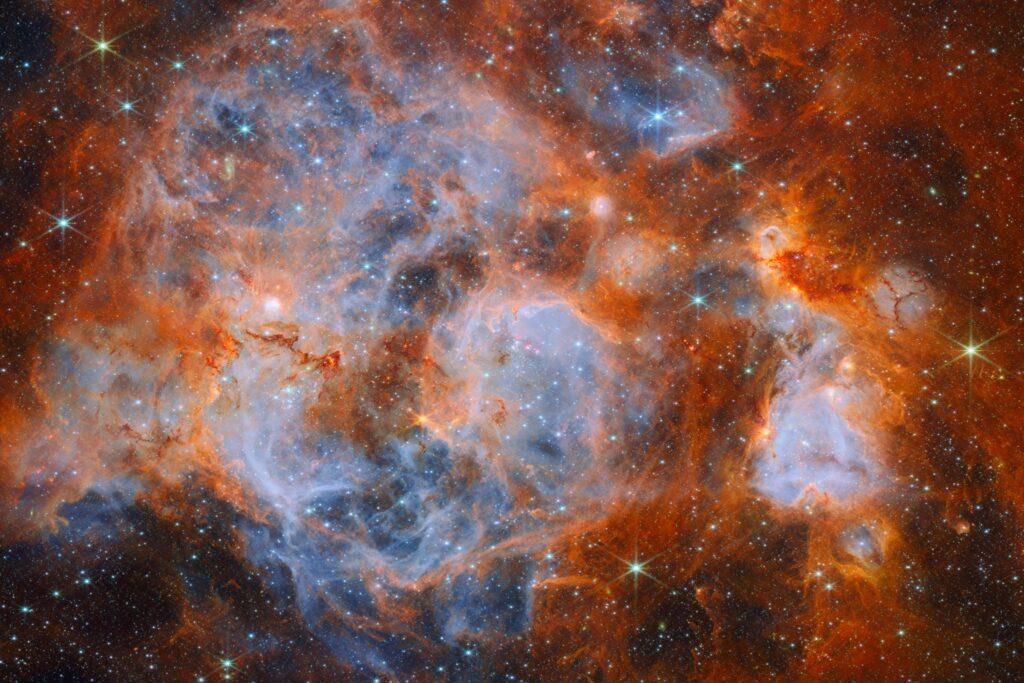
The latest image captured by the James Webb Space Telescope, unveiled on 22nd October 2026, reveals a dynamic and chaotic environment of star formation. This captivating region, known as N159, is situated approximately 161,000 light-years away within the Large Magellanic Cloud, a satellite galaxy that orbits our own Milky Way.
Unveiling the Secrets of N159
N159 is characterised by its dense clusters of gas, which play a crucial role in the ongoing process of star formation. Interestingly, this area exhibits a lower metallicity compared to the Milky Way. Metallicity refers to the abundance of elements heavier than helium and hydrogen. This unique attribute provides astronomers with a valuable opportunity to explore the conditions prevalent in the early universe, as well as the mechanisms that contributed to star formation during that era.
Insights into Early Cosmic Conditions
The exploration of regions like N159 is pivotal for enhancing our understanding of the universe’s evolution. By studying the lower metallicity found in N159, researchers can glean insights into the primordial conditions that existed shortly after the Big Bang, offering a glimpse into the formative stages of cosmic history. Such investigations not only enrich our knowledge of star formation but also illuminate the pathways through which galaxies have evolved over billions of years.
Continued Exploration and Discoveries
As the James Webb Space Telescope continues its mission, it promises to uncover further mysteries of the cosmos. With each image and observation, we edge closer to deciphering the complex processes that govern star and galaxy formation. The findings from N159 are just one example of how our understanding of the universe is being revolutionised by advanced astronomical technologies and methodologies.
For those interested in delving deeper into the wonders of N159 and its significance in the grand tapestry of cosmic evolution, additional resources are available to explore the intricacies of this fascinating region.




More Stories
Explore November’s Night Sky: Your Guide to Celestial Wonders and Shorter Days
Discover the Stunning Colours of the Moon: APOD for 1st November 2026
NASA Investigates Commercial Opportunities for Hubble Telescope Servicing