
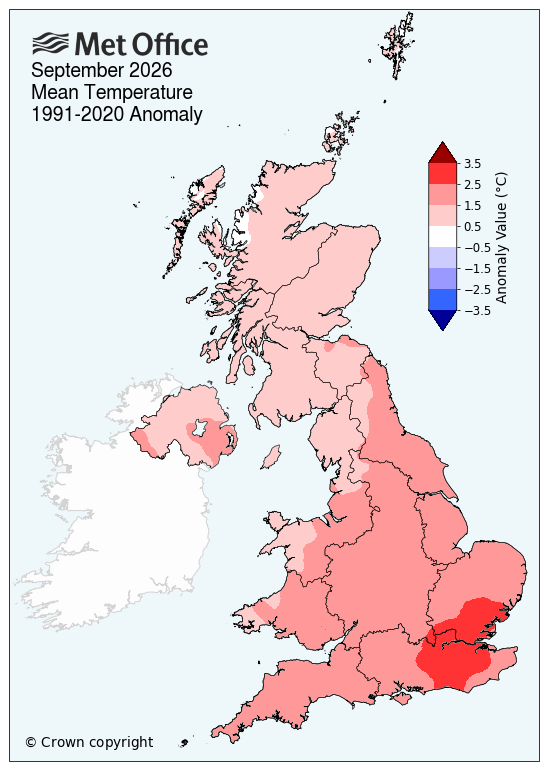
Record-Breaking Warmth in September for the UK
September 2026 has been marked as the joint-fourth warmest on record in the UK, according to provisional data collected by the Met Office, with records dating back to 1884. The month experienced a surge in temperatures, peaking at a remarkable 28.1°C on 29 September, leading to an overall mean temperature of 14.6°C, equalling the figures reported in both 1949 and 2016.
Despite rainfall levels being close to the average for the month, substantial regional disparities were evident, particularly in southern and eastern England, which saw significantly less precipitation.
Continuation of Above-Average Temperatures
Following what has been provisionally identified as the hottest summer on record, September has continued this trend of elevated mean temperatures throughout much of 2026. Mike Kendon, a Climate Information Scientist at the Met Office, noted, “The persistent warmth has characterised recent months, and September is no exception. With high-pressure systems dominating southern regions late in the month, September 2026 stands out as the joint-fourth warmest on record for the UK.”
While the month may not seem extraordinary in isolation, it fits into a broader context of increasingly frequent above-average temperatures as climate change impacts the region. Variations in temperature were noted across the UK, with Wales reporting its joint-sixth warmest September, England its third, and Northern Ireland its fourth warmest. Scotland, while warmer than the norm, fell just outside the top ten warmest months.
Precipitation Patterns and Regional Disparities
The overall near-average rainfall for September obscured significant variations across the UK. While Scotland experienced over a third more rain than its typical average, southern England remained relatively parched, notwithstanding some recent rainfall. Philip Duffy, Chief Executive of the Environment Agency, commented, “Although the rainfall in September is welcome, it alone is insufficient to address the significant water deficits resulting from a dry spring and an exceptionally hot summer.”
Duffy highlighted that true recovery from drought conditions will require months of consistent and substantial rainfall to restore groundwater, rivers, and reservoir levels to normal. “Currently, the situation remains serious, with drought-affected areas of England experiencing the least rainfall this month. Water supplies are limited, and many reservoirs are alarmingly low. It’s crucial for everyone to conserve water to expedite drought recovery and safeguard supplies for local rivers, agriculture, and wildlife,” he added.
Sunshine Levels Across the Regions
Sunshine levels throughout the UK were generally average for September; however, Northern Ireland experienced a notably dull month, albeit without setting any records. The following table outlines the provisional statistics for September 2026:
Provisional September 2026 Statistics
| Region | Mean Temp (°C) | Rainfall (mm/% of average) | Sunshine (hours/% of average) |
|---|---|---|---|
| UK | 14.6 | 94.7 | 124.6 |
| England | 16.0 | 44.8 | 142.7 |
| Wales | 14.6 | 112.5 | 114.8 |
| Scotland | 12.3 | 169.0 | 102.7 |
| Northern Ireland | 14.0 | 118.4 | 92.0 |
Understanding Monthly Climate Data
The monthly climate statistics compiled by the Met Office draw upon HadUK-Grid data to calculate county, regional, and UK-wide averages. This dataset aggregates weather observations from across the nation and interpolates them onto a 1km x 1km grid, ensuring comprehensive coverage of the UK. Some records within this dataset extend back to as early as 1836, providing nearly 200 years of valuable weather data.




More Stories
Mild and Rainy Conditions Ahead, But Expect More Settled Weather Later This Week
Brace for Wet and Windy Weather Next Week: What to Expect
Milder Temperatures Ahead, But Expect Wet and Windy Conditions Next Week