
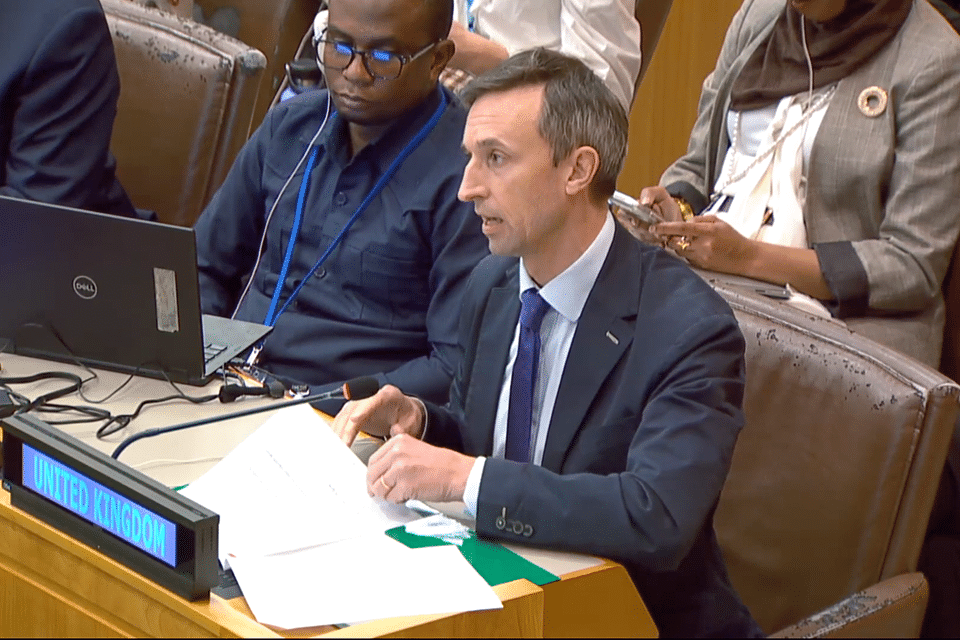
The United Kingdom is poised to support this resolution. Our decision is grounded in a fundamental and universal principle: occupation does not extinguish the rights of those who live under it, and the passage of time cannot legitimise the acquisition of territory through force.
Crimea is an integral part of Ukraine. For over a decade, the people residing there have endured an occupation imposed upon them, coupled with severe restrictions on their fundamental freedoms and their capacity to maintain their language, culture, religion, and identity.
Addressing Human Rights Violations
This resolution confronts these stark realities: arbitrary detention and enforced disappearances; torture and mistreatment; restrictions on freedom of expression and belief; repression of Ukrainian and Crimean Tatar identities; as well as the militarisation, indoctrination, and forced assimilation of Ukrainian children.
These are not mere differing narratives for this Assembly to deliberate upon. They are documented violations, corroborated by independent international monitoring mechanisms. These same bodies have identified analogous patterns in all other areas of Ukraine currently under Russian occupation.
The United Kingdom reaffirms its steadfast and unwavering support for the International Criminal Court and its essential role in combating impunity for the gravest international crimes.
Ukraine’s Sovereignty and Global Implications
Ukraine must not be viewed as a proxy in the decisions of others. It is a sovereign Member State, and its citizens possess the right to determine their own destiny. They have chosen to defend their sovereignty, identity, and homeland.
This matter extends far beyond the borders of Ukraine. Should borders be altered through force and occupation progressively normalised, the protections guaranteed by the Charter would be undermined for every Member State.
Recently, I have heard esteemed colleagues contesting this resolution, claiming that it fosters confrontation and contradicts the principles of friendly relations among nations. However, the true challenge to these aspirations lies in illegal aggression and occupation.
Defending Sovereignty and Human Rights
This resolution urges us to defend a principle that transcends any individual political stance: that sovereignty is paramount, that Ukrainians maintain their rights even under occupation, and that the United Nations must persist in documenting violations wherever they arise.
For these reasons, we will cast our vote in favour, and we encourage all delegations to do likewise.
As the occupying power, Russia bears responsibility for the civilians under its control.
We once again call upon the Russian Federation to grant independent monitors access to Ukraine’s occupied territories and to provide information regarding all civilians who have been arbitrarily detained, forcibly transferred, or deported.
We will continue to ensure that the world is made aware of what Russia seeks to conceal.



More Stories
PM Holds Key Meeting with Dutch Prime Minister Jetten on 21 November 2026
UK’s Ambitious NATO Space Launch Initiative Aims for the Stars
UK Condemns Damage to Diplomatic Premises Amid Russian Assaults on Ukraine: Key OSCE Statement