
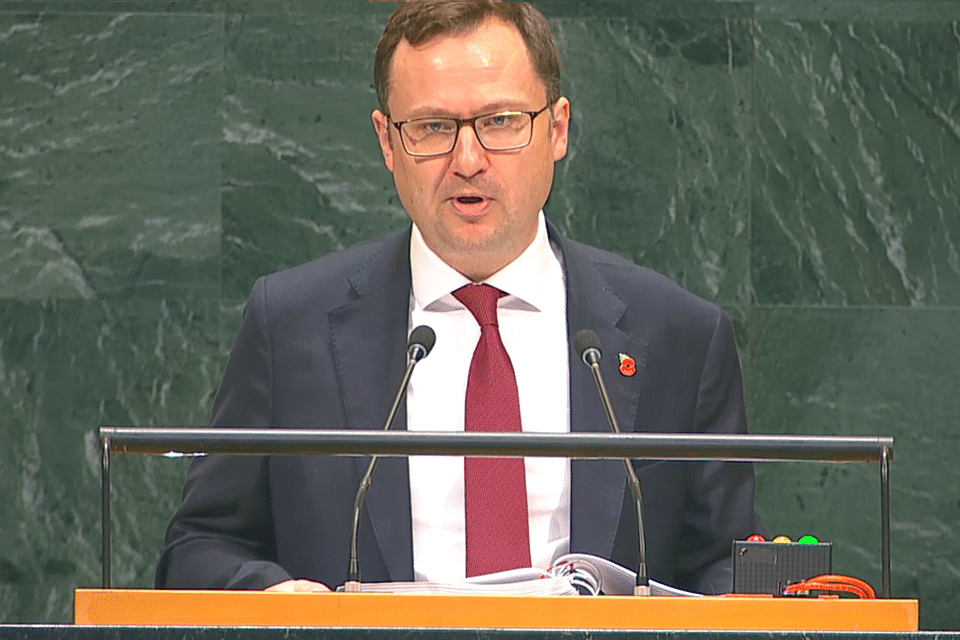
I have the honour of delivering this statement on behalf of the United Kingdom in response to the presentation of the Annual Report of the International Court of Justice.
I would like to express my gratitude to President Iwasawa for his insightful address and commend his leadership of the Court. Furthermore, I extend my appreciation to the judges and the Registry for their unwavering dedication to the cause of international justice.
Celebrating Eight Years of the Court’s Inaugural Sitting
This year marks the eighth anniversary of the Court’s inaugural sitting, a pivotal establishment born from the ashes of devastating conflict. The Court stands as a testament to the belief that law must offer States an alternative to coercion and the use of force. Eight decades later, this conviction is more critical than ever, particularly in an era fraught with conflict, instability, and escalating pressures on the international legal framework.
The Court’s role in the peaceful resolution of disputes has seldom been more vital. It provides a platform for States to present their disagreements to an independent judicial body, ensuring that they are heard on an equal footing and receive a resolution rooted in law rather than power.
The Growing Importance of the Court’s Work
The increasing demands placed on the Court underscore its significance and impact. Over recent years, a growing number of States have sought the Court’s assistance, resulting in heightened participation in its proceedings. Consequently, it is imperative that the Court is adequately resourced and equipped to manage its workload effectively while upholding the quality and rigor that underpin its authority.
The United Kingdom’s support for the Court is both practical and principled. We have advocated for additional resources to address the Court’s staffing requirements and contributed to the trust fund for its Judicial Fellowship Programme, which aids young jurists from developing nations in gaining invaluable professional experience while furthering the Court’s overarching mission.
Investing in the Future of the Court
Investing in the Court’s future necessitates ensuring it continues to benefit from judges of exceptional calibre, drawn from diverse legal traditions and capable of tackling the complex issues it faces. In this regard, the United Kingdom is proud to endorse Professor Dapo Akande for election to the Court on 3 November. His extensive national group nominations and robust support from every United Nations region reflect the deep respect he commands within the international legal community.
At a time when international law confronts significant challenges, Professor Akande embodies the independence, legal acumen, judgement, and breadth of perspective essential for the Court. His contributions would undoubtedly enhance its work.
Commitment to International Justice
The United Kingdom has consistently been a staunch supporter of the Court, having accepted its compulsory jurisdiction. We encourage other States yet to do so to contemplate accepting the Court’s jurisdiction in accordance with its Statute. However, our commitment to international justice extends beyond this Court alone.
While my focus today is on the International Court of Justice, I must stress that it is vital for international institutions to operate independently, impartially, and with integrity. This is why the UK does not endorse sanctions against the International Criminal Court. Such attempts to obstruct its work undermine the broader international legal order upon which all States depend.
The Enduring Significance of the Court
Returning to the ICJ, for eighty years, it has played a crucial role in transforming the Charter’s pledge for peaceful settlement into a legal reality. Its lasting significance lies not only in the disputes it has resolved but also in the fundamental principle it upholds: that relations between States must be governed by law, rather than merely by power.
The United Kingdom remains committed to defending this principle and will continue to support the Court in fulfilling its essential mandate.




More Stories
Celebrating 10 Years of ‘See it. Say it. Sorted.’ – A Decade of Enhancing Safety on Britain’s Railways
Welsh Rugby Union Commits to Supporting Armed Forces Community
Lifelong Learning Entitlement (LLE) Applications Now Open: Unlock Your Future Today!