
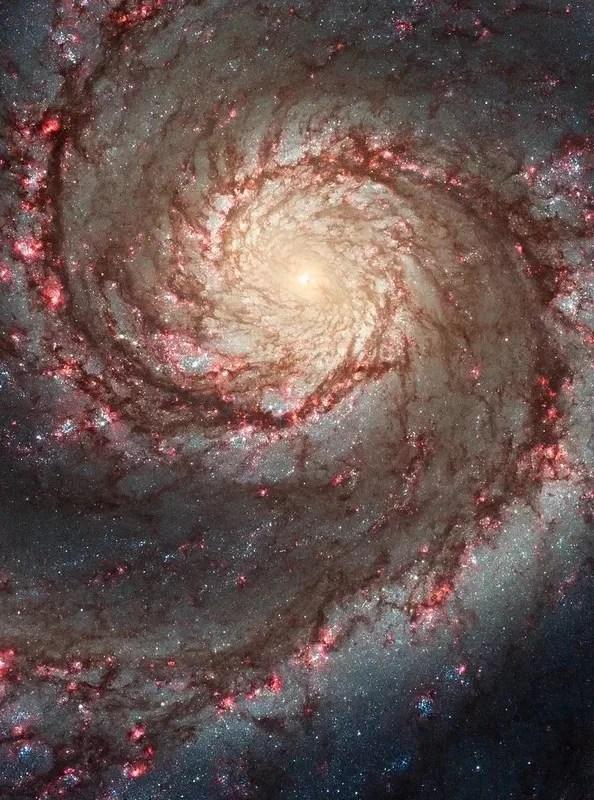
An extraordinary view of the universe presents itself in the form of the edge-on spiral galaxy NGC 1827, which is situated approximately 37 million light-years from Earth. Captured in a stunning image, this galaxy reveals intricate details that tell a story of cosmic beauty and complexity.
Distinctive Features of NGC 1827
The most striking aspect of NGC 1827 is its rusty-brown dust lanes that elegantly bisect the galaxy lengthwise. These dust lanes, rich in cosmic material, create a stark contrast against the vibrant blue star clusters scattered throughout the galaxy. Notably, the left side of NGC 1827 appears to host a higher concentration of these bright-blue points, suggesting active star formation in that region.
Adding to the celestial drama, a luminous foreground star can be seen shining prominently just to the left of the galaxy’s centre. This star, with its distinct diffraction spikes, serves as an anchor for the viewer’s eye amidst the vastness of space.
A Cosmic Canvas of Distant Galaxies
The backdrop of this image is a rich tapestry of black, dotted with countless distant galaxies and a sprinkling of other foreground stars. Each of these distant celestial bodies contributes to the grandeur of the cosmos, highlighting the scale and diversity of the universe. The presence of these stars, easily identifiable by their unique diffraction patterns, adds an additional layer of intrigue to the scene.
As we marvel at NGC 1827 and its surroundings, it becomes evident that the cosmos is an ever-expanding frontier, filled with wonders waiting to be explored. This image not only showcases the beauty of NGC 1827 but also invites us to ponder the mysteries that lie beyond our own galaxy.



More Stories
Experience the Sonification of the Eagle Nebula’s Pillars – 18th October 2026 Astro Visualisation
Artemis II Heat Shield Successfully Recovered After Splashdown
Explore the Stunning 3D Imagery of Comet 67P on 17th October 2026