
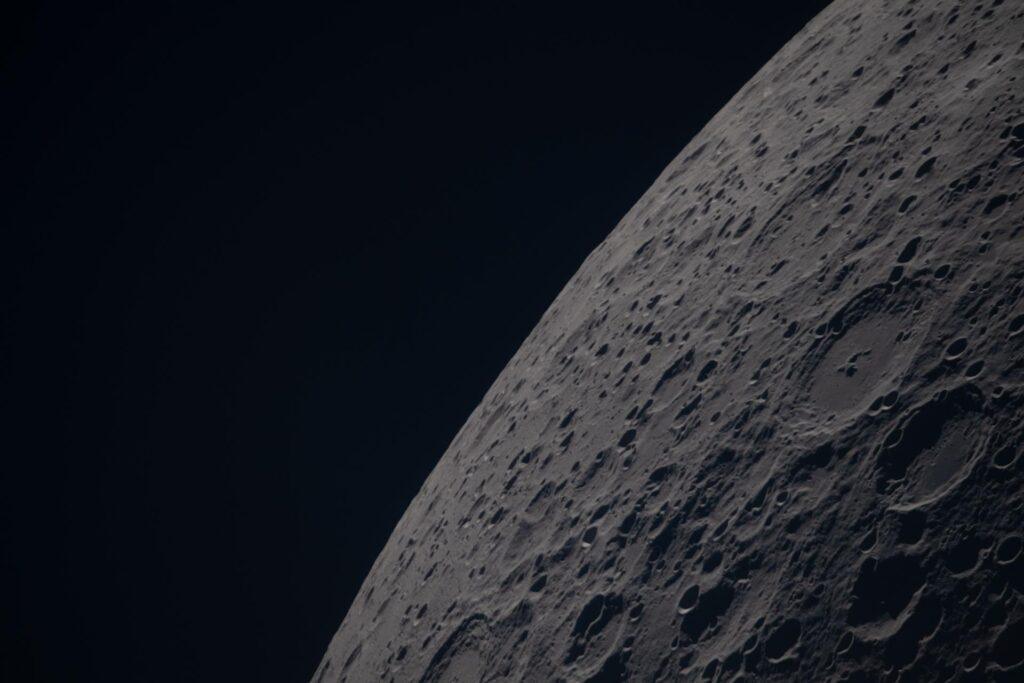
In a stunning depiction of the Moon’s far side highlands, the Poynting and Keeler craters are prominently displayed side by side in the lower right portion of the image. Poynting crater, located above, is a substantial impact feature characterised by its well-defined rim and relatively smooth interior. This smoothness suggests that the material within the crater has settled over time following the initial impact event.
Directly beneath Poynting, the slightly smaller Keeler crater presents a sharply defined rim and a more textured interior. This texture is a testament to the history of subsequent impacts and the ejecta that have influenced its surface. Both craters are situated within the densely cratered highlands of the Moon’s far side, which serve as a geological archive, preserving evidence of the ancient impacts that have sculpted the lunar landscape over billions of years.
Insights from Lunar Exploration
The scientific knowledge gained from each lunar rock sample, along with the extensive datasets produced through NASA’s Artemis programme, is set to be shared with the international community. This initiative underscores a commitment to collaborative research and the dissemination of information that could enhance our understanding of the Moon and its geological history.
The Artemis programme aims not only to explore the Moon but also to pave the way for future missions to Mars and beyond. By studying the Moon’s surface and its composition, scientists hope to unlock secrets about the origins of our planetary system and the processes that have shaped it over time. The ongoing research and exploration will undoubtedly enrich our knowledge and inspire future generations of scientists and explorers alike.
Collaborative Global Efforts
NASA’s dedication to international collaboration is evident in its plans to share findings from the Artemis missions. Such partnerships are crucial for fostering a global scientific community that can work together to unravel the mysteries of the cosmos. By making lunar samples and data accessible, researchers from around the world can contribute their expertise, leading to a more comprehensive understanding of lunar geology and its implications for planetary science.
As the exploration of the Moon continues, the insights gained will not only inform our knowledge of Earth’s nearest celestial neighbour but also provide valuable lessons for future space exploration initiatives. The interplay of local geological processes and broader cosmic events will continue to be a focal point of study, bridging the gap between Earth-based and extraterrestrial science.



More Stories
Comet NEOWISE Illuminates the Adriatic Sea: A Spectacular View on 13th September 2026
NASA’s Chandra Observes Stunning Galactic Treasure
Enhance Space Telescope Data Analysis with the Innovative Artifact InSPECtor Tool