
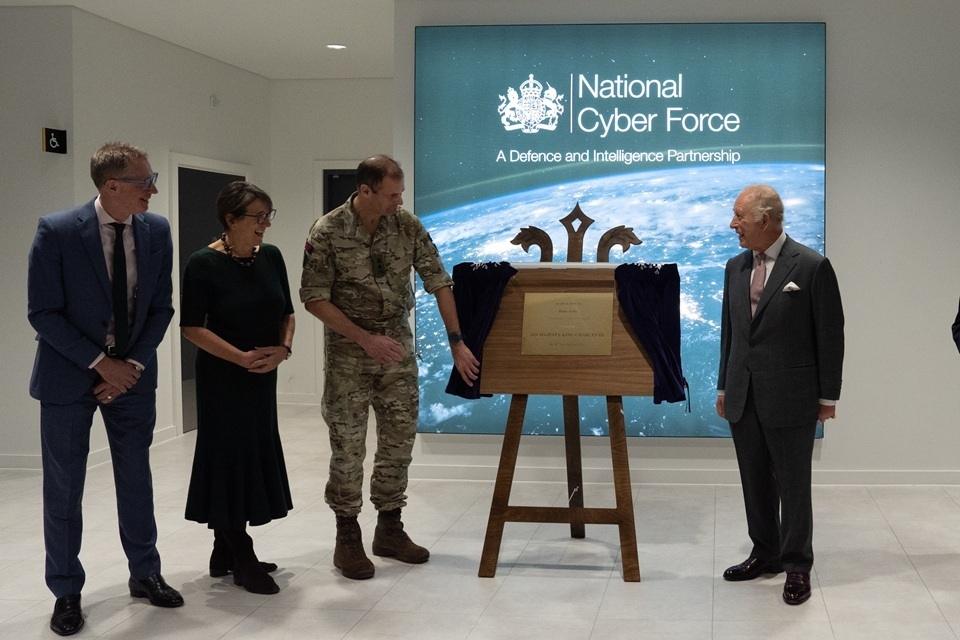
The King has acknowledged the crucial role of the National Cyber Force (NCF) in enhancing the UK’s cyber capabilities, essential for safeguarding the nation as adversaries exploit the rapidly evolving technological landscape.
The NCF is a collaboration between GCHQ and the Ministry of Defence, tasked with conducting cyber operations that support military objectives, mitigate state threats, and disrupt criminal and terrorist activities.
His Majesty the King officially inaugurated the new headquarters of the National Cyber Force in Samlesbury, Lancashire. This facility is set to bolster the nation’s cyber capabilities while simultaneously promoting job creation, skills development, and economic growth in the North West of England.
Uniting GCHQ, the Ministry of Defence, the Secret Intelligence Service (SIS), and the Defence Science and Technology Laboratory (Dstl), the NCF engages in cyber operations aimed at addressing threats and safeguarding the UK’s interests both domestically and internationally.
Prior to the opening of Ribble House, notable investments were made by the Defence and its partners to enhance local skills and cultivate specialised capabilities within the region. The Digital and Cyber Bursary, established in 2025, currently supports 500 students across regional colleges, offering youngsters in Lancashire valuable training and qualifications in cyber and digital skills.
Engagement with NCF Leadership
The King met with senior figures from NCF partner organisations, including the Director of GCHQ and the Commander of Cyber & Specialist Operations Command. The NCF’s initiatives encompass countering state threats, combating terrorism, and disrupting online child exploitation and other criminal activities. Due to the sensitive nature of its operations, the NCF typically refrains from disclosing operational details, as this could undermine their effectiveness and allow adversaries to enhance their defences.
During the visit, His Majesty also engaged with personnel already stationed at the facility. This included discussions with local recruits and entrants from the Armed Forces Cyber Direct Entry Scheme regarding their contributions to national security and the protection of the UK’s interests. The discussions also encompassed briefings on the NCF’s mission, capabilities, and efforts to counter threats faced by the UK and its allies.
Statements from Leadership
The Director of GCHQ remarked that, in an era marked by radical uncertainty and rapidly evolving technology, the NCF plays a pivotal role in ensuring the nation’s safety through high-impact cyber operations executed on a daily basis against those who pose threats to national interests.
As Defence and Intelligence capabilities increasingly merge to prepare for future crises or conflicts, the new headquarters in the North West stands as a powerful representation of partnership, speed, and innovation. The NCF is strategically positioned to enhance the North West Cyber Corridor, fostering job creation, skills development, and innovation within the region.
The Commander of Cyber & Specialist Operations Command noted that the opening of the NCF’s headquarters signifies a major leap forward in fortifying the UK’s capacity to address threats in an increasingly contested environment. He emphasised the necessity of readiness to confront, deter, and succeed in the cyber domain, reinforcing the National Cyber Force’s critical role in providing the UK with a competitive advantage.
A government representative highlighted that as hostile entities engage in cyberattacks to disrupt daily life, the nation’s premier intelligence agencies are essential in tackling these threats directly. The National Cyber Force stands at the forefront of British technological prowess and expertise, ensuring the safety of the country against adversarial actions.
The Defence Secretary remarked on the evolution of the threat landscape, which is markedly different from that of previous decades. Modern threats necessitate contemporary responses, particularly in cyberspace. He affirmed the government’s commitment to enhancing capabilities across all domains, with the National Cyber Force leading the charge by integrating top-tier expertise and advanced technology to deter and disrupt adversaries.
Community Engagement and Future Workforce Development
The King was introduced to local dignitaries, including members of the Lancashire Cyber Partnership, who have significantly contributed to the growth of the county’s cyber economy and have highlighted opportunities for individuals to develop skills and embark on careers in national security.
The inauguration of Ribble House marks a significant advancement in strengthening the UK’s offensive cyber capabilities, representing a long-term investment in regional development and the future workforce in cybersecurity.
The NCF amalgamates GCHQ’s global intelligence capabilities with the operational planning expertise of the MOD, the scientific and technological resources of Dstl, and the clandestine operational technologies from the SIS. This unique partnership continuously evolves to develop sophisticated cyber capabilities in response to real-world challenges, thereby securing advantages for the nation.
GCHQ operates as a key intelligence and cyber agency dedicated to maintaining the safety of the UK. By leveraging advanced technology, technical ingenuity, and world-class collaborations, GCHQ identifies, analyses, and neutralises threats in an increasingly complex global environment. Collaboration with MI5, the SIS, law enforcement, military, and international partners is essential in countering threats posed by nation-states, criminal organisations, terrorists, and individuals.
The Cyber & Specialist Operations Command coordinates joint capabilities for UK Defence, encompassing medical services, intelligence, cyber warfare, special forces, training, and overseas bases. Furthermore, it manages military operations conducted abroad through the Permanent Joint Headquarters, working closely with the Defence Cyber & Electromagnetic Force to align resources for offensive cyber operations.
The SIS provides vital expertise in managing agents, clandestine technology, and extensive experience in undercover operations and intelligence, ensuring that the NCF remains ahead of potential adversaries.
Dstl, as an Executive Agency of the MOD, delivers impactful science and technology solutions for the UK’s defence, security, and prosperity. As a core partner of the NCF, Dstl collaborates with various entities to enhance the UK’s capacity for designing and executing cyber operations.




More Stories
PM Holds Key Meeting with Dutch Prime Minister Jetten on 21 November 2026
UK’s Ambitious NATO Space Launch Initiative Aims for the Stars
UK Condemns Damage to Diplomatic Premises Amid Russian Assaults on Ukraine: Key OSCE Statement