

Why walking away from a painful family is rarely the end of the story
By a London Globe correspondent, with psychodynamic psychotherapist, Kate Nicholls
Christmas is coming, and for many people that means dread. The group chat is pinging, a relative is asking “who’s coming?”, and an old, familiar knot is tightening in the stomach.
For some, the question isn’t what to wear or what to cook. It’s whether to go at all.
Family estrangement is far more common than we tend to admit, yet it is rarely spoken about with any nuance. It is often portrayed as a dramatic rupture, a door slammed for good. Psychodynamic psychotherapist Kate Nicholls sees something quieter and far more complicated: people who have spent years trying to keep the peace and who arrive at distance not out of coldness, but out of exhaustion.
When “family” get-togethers feel threatening and dangerous
Our families are where we first learn what love looks like, and what we must do to earn it. When that early education involves criticism, control, guilt, or emotional manipulation, we can carry its lessons into adulthood without realising.
You might recognise some of this. You feel responsible for everyone else’s moods. Saying no leaves you with a guilt that seems out of proportion. After a conversation with a relative, you find yourself wondering whether you remember it correctly, or have done something ‘wrong’.
In many families, people also settle into roles. One person keeps the peace. Another becomes the scapegoat. Someone is the golden child. Someone else the one who always gives way. These roles can feel so natural that we mistake them for personality.
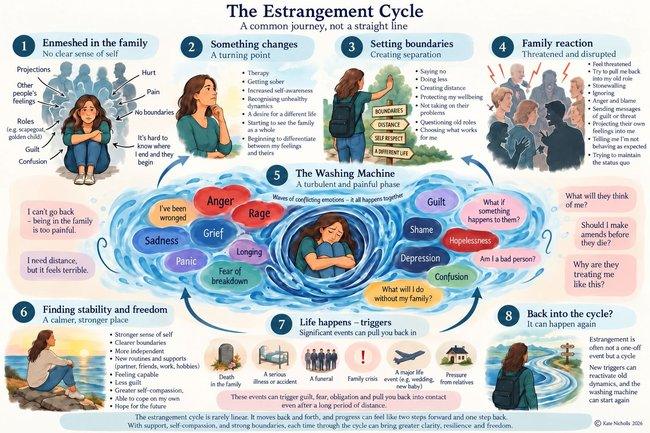
The Estrangement Cycle
Estrangement doesn’t tend to happen all at once. Kate Nicholls uses a framework she has developed called The Estrangement Cycle, which maps the emotional stages many people move through. It begins with enmeshment, a family in which boundaries are blurred and it’s hard to tell where your feelings end, and everyone else’s begin.
Then something shifts.
It might be therapy, a milestone, a painful incident, or a slow dawning that things can’t carry on as they are. For the first time, you question the role you’ve always played.
Next come boundaries. Learning to say a simple ‘no’, creating some distance, reinforcing a decision to no longer be the family’s emotional shock absorber. Here is the part few people expect. When one person changes the rules, the rest of the family often pushes back. That can mean anger, blame, guilt-laden messages, silence, or pressure to restore the old order.
What follows is what Kate calls the Washing Machine. Anger, grief, shame, relief, longing, and panic, all churn together. You may feel certain on Monday and doubtful by Wednesday. You may wonder what others will think, whether you should reconcile, or what happens if a parent dies with things unresolved. You may even ask whether you are a bad person.
In Kate’s work, she helps people recognise that this doesn’t point to you being in the wrong. It reflects how much these relationships matter and how hard it is to change patterns laid down over a lifetime.
With time, many people find steadier ground: a stronger sense of self, healthier relationships, new sources of belonging, and less guilt. But it is rarely a straight line. A wedding, a new baby, an illness, or a bereavement can stir everything up again, and people sometimes find themselves pulled back into old dynamics years after the initial realisations had begun.
That is the crucial point. Estrangement isn’t simply a question of whether you’re in contact with your family. It is an ongoing psychological process of understanding, separating from, and making sense, of those relationships.

The grief nobody talks about
One of the hardest parts of estrangement isn’t the absence of contact. It is the grief. People mourn the family they had, and the family they hoped for. Many carry a longing for the acknowledgement or apology that never comes.
It can also be isolating. Friends may mean well, but offer well-worn lines such as “but they’re your family” and “life’s too short.” Such comments, however kindly meant, can leave people feeling more alone, and invalidated, with the decision they’re agonising over.
What psychodynamic therapy offers
Psychodynamic psychotherapy looks at how early relationships shape the way we think, feel, and relate to others now. Rather than handing out quick fixes or a script for managing difficult relatives, it asks deeper questions. Why did these patterns develop? How have they shaped my sense of self? Why do certain feelings still hit so hard?
The aim, Kate stresses, is for therapy not to push anyone towards reconciliation or towards staying estranged. It is a space without agenda, where conflicting feelings can sit side by side without judgement, a space to find out what is right for each person, given everyone is unique. Together, Kate and her clients look at recurring patterns, and at how they may also show up in friendships, partnerships, and parenting, so that choices come from self-awareness rather than fear, obligation, or guilt.
Ultimately, the work is about building a more secure, independent sense of who you are, one that doesn’t depend on other people’s approval or reactions.
If this sounds familiar
If you’re navigating family conflict, estrangement, or the lingering effects of emotional manipulation, you’re far from alone, and you don’t have to untangle it by yourself.
Kate Nicholls holds an MSc with Distinction from Birkbeck, University of London, and her practice is based in Fitzrovia. She works exclusively online, with clients across the UK and beyond, supporting people with family conflict, relationship difficulties, anxiety, guilt, shame, low self-esteem, and uncertainty about their own boundaries and identity.
Address: 4th Floor, Silverstream House, 45 Fitzroy Street, London W1T 6EB




More Stories
Canning Town Residents Evacuate as Housing Developer CEO Sells £720k Penthouse in Condemned Building
James Cleverly: The Conservatives’ Strongest Contender for London Since Boris Johnson
Russell Brand’s Prison Statement Under Investigation Following Wife’s ‘Not Guilty’ Assertion