
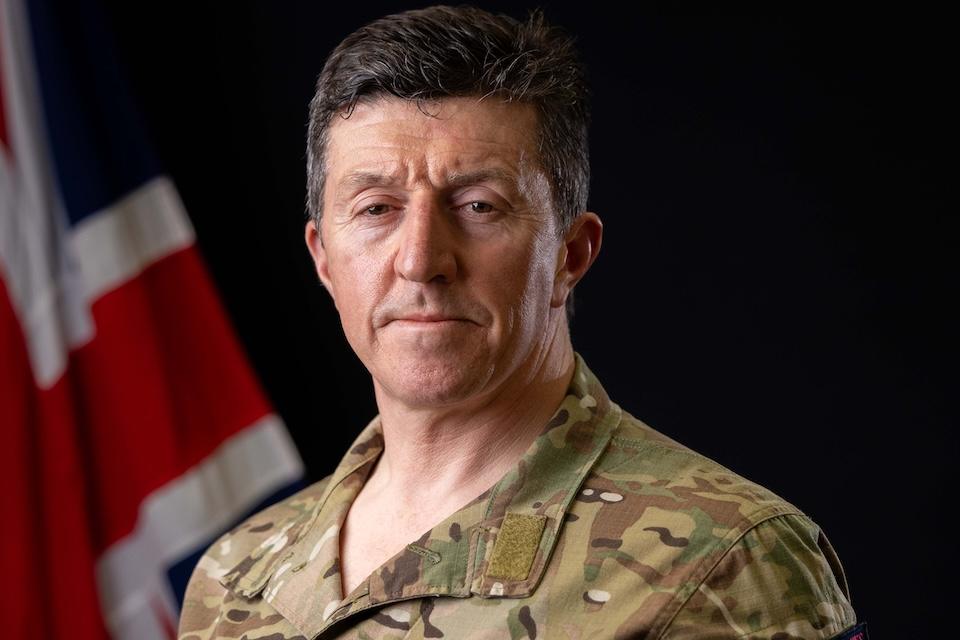
Thank you, Kyrre, and my sincere gratitude to my fellow JEF chiefs for gathering here today to sign this Agreement.
After nine months of dedicated effort, I am thrilled to announce that the JEF Northern Navies Initiative has reached a significant milestone today.
Together, we have demonstrated what can be achieved when nations with a shared vision unite towards a common goal.
This conference has unequivocally highlighted that the global landscape has evolved—the threats we face are growing in number, and we must rise to meet the challenges ahead.
In recent years, there has been an important acknowledgment—rightly so—that the United Kingdom, alongside our European allies, must enhance our efforts to defend our core values.
Through this Agreement, I believe we have illustrated our commitment to this cause.
I would also like to express my appreciation to everyone present for your honesty, challenges, and the innovative ideas shared during this conference.
At times, the discussions held within these walls have been quite sobering.
I have previously remarked that we find ourselves in an era of state-on-state competition, a reality that is somewhat unfamiliar to many of us, even those with extensive military careers.
This situation can feel unsettling, and we should not shy away from acknowledging that fact.
However, I depart today with a sense of hope.
The recent years have taught us that we are not powerless. Each one of us here—ministers, military strategists, industry leaders—has a role to play.
What matters is our readiness to take action and our ability to adapt swiftly.
Listening to the Ukrainian ambassador earlier truly emphasised this point. Five years ago, when Russian tanks invaded, few believed Ukraine stood a chance.
Yet today, the Ukrainian people continue to fight.
They have shown remarkable adaptability, combining extraordinary bravery with technological innovation, refusing to accept the fate that others had predetermined for them.
Above all, they still possess hope.
And so do I.
I am fully aware of the challenges that lie ahead.
The risk of conflict is increasing.
Russia will persist in testing our resolve and seeking signs of weakness. Yet, war is not inevitable—if our adversaries believe that we are serious.
“Prepare for war if you want peace.” This 1,600-year-old adage remains relevant today.
This means we must continue to strengthen our capabilities, adapt swiftly, stand united, and demonstrate that we are prepared to engage if necessary.
We have outlined our vision for the revitalisation of the Royal Navy—now is the time for decisive action.
Eighteen months ago, I assumed the role of First Sea Lord, a position that has been, and will remain, the greatest privilege of my professional career.
From the moment I took office, my primary mission has been clear: to rebuild the Royal Navy and refocus it on its fundamental purpose—to lead, fight, and win.
The Defence Secretary has recently articulated the task ahead: we must be prepared to fulfil this mission within 1,000 days.
This is why every action undertaken by the Royal Navy is now aimed at the end of the decade, ensuring we are ready to safeguard our nation alongside NATO and our allies.
The path we are on presents challenges, and there remains much to accomplish. However, with each passing month, we are making progress.
What drives me each day is the understanding that we have turned a corner. The Royal Navy is now in a phase of renewal.
You can see this renewal reflected in the steel of our ships.
We are embarking on the most extensive recapitalisation of the Royal Navy since the Second World War.
Thirteen new frigates are already under construction, including the Type 26s, which we will operate alongside Norway.
Following these, we will introduce six Common Combat Vessels designed to command our uncrewed systems.
Under the sea, we are renewing our nuclear deterrent with the addition of four Dreadnought submarines, completing the Astute programme, and, through AUKUS, preparing for the next generation of up to a dozen attack submarines.
Furthermore, four new amphibious ships will enhance the reach of our Commandos, while four Fleet Solid Support ships will sustain our Fleet worldwide.
In total, our existing programme accounts for 280,000 tonnes of new steel, which will increase to approximately 450,000 tonnes when planned projects are included.
Indeed, we face challenges in the present.
We are all aware of what these challenges entail.
Nevertheless, the Royal Navy remains a world leader, and we are unwaveringly focused on improving the availability of our fleet and getting more of our ships operational.
The future is undeniably promising.
We are engaged in a comprehensive renewal of our fighting Fleet, our nuclear deterrent, and the support required to maintain both at sea.
This should convey a clear message to our allies and adversaries alike.
As a nation, we are wholeheartedly committed to bolstering our maritime power. Yet, this is merely one aspect of our journey.
If we are to overcome the threats and challenges discussed today, the Royal Navy must be capable of fighting and generating combat power in a new manner.
This is why we are implementing the Hybrid Navy.
A year ago, when I addressed this conference, the Hybrid Navy was largely a concept on paper.
Today, twelve months later, that is no longer the case.
The Hybrid Navy is operational, and our progress is evident to all.
In response to the situation in the Strait of Hormuz, we mobilised swiftly and collaborated with many of you present to establish a multinational coalition.
We converted RFA Lyme Bay into a mothership for autonomous mine-hunting systems, and secured a fleet of several dozen Kraken USVs in just a few months.
Last week, we commissioned the Royal Navy’s 1st Autonomous Squadron in Portsmouth—a truly historic achievement for the Hybrid Navy.
For the first time, autonomy has a permanent operational presence within the Fleet. At its core will be our fleet of Kraken scouts.
The first task of the Squadron will be coastal defence, deploying uncrewed vessels to monitor our approaches, safeguard critical infrastructure, and respond more swiftly to hostile activities.
The Kraken fleet will not remain static.
Today, I am pleased to announce that we will integrate a counter-drone capability onto our Kraken scouts in the new year.
This will provide us with a cost-effective and adaptable means to counter airborne threats, preserving our advanced missiles for genuine threats that require them.
This represents a clear advantage afforded by the Hybrid Navy.
By integrating these interceptors onto Kraken, we are learning from the experiences in Ukraine and demonstrating that a sledgehammer is no longer required to crack a nut.
Alongside the new Squadron, we also inaugurated the Royal Navy Capability Accelerator Hub in Portsmouth last week.
This serves as a delivery engine for the Hybrid Navy, bringing together operators, capability teams, engineers, and industry under one roof.
Its purpose is to identify the Fleet’s needs, rapidly test proven or near-ready technology, integrate it safely, and deliver capabilities to the front line at the necessary pace.
The Squadron and the Accelerator are two interconnected elements of the same system. One enhances the Hybrid capability, while the other ensures its deployment in operational contexts.
It has been a year of decisive action.
Yet, we remain on a journey—and next year promises to bring even more advancements.
As the Minister announced this morning, phase one of Atlantic Bastion, Atlantic Net, will become operational within months.
In collaboration with Ocean Infinity, this initiative will enable us to detect hostile underwater activities earlier and strengthen our protection of critical infrastructure.
The advantages we gain from this extend beyond the Royal Navy, benefiting our NATO and JEF allies, who will also gain a clearer understanding of undersea activities.
Moreover, we are expanding our contributions in the air domain.
Typically, this hangar houses our F-35Bs, Merlins, and Wildcats. However, in the future, they will be joined by uncrewed partners, thereby incorporating the ‘Hybrid’ element into our Hybrid Air Wing.
Among these will be our first jet-powered drones, known as Collaborative Combat Aircraft, or CCA.
Last year, I expressed my desire for the first of these CCAs to be launched from the carrier flight deck by next year.
At the time, there may have been some scepticism in the room.
However, today, here in Oslo, I can confirm we are making significant progress.
In just two days, aboard this carrier, I will sign a statement of intent with our partners at Northrop Grumman to prepare their TALON demonstrator for trials with the Royal Navy under Project VANQUISH.</p




More Stories
PM Holds Key Meeting with Dutch Prime Minister Jetten on 21 November 2026
UK’s Ambitious NATO Space Launch Initiative Aims for the Stars
UK Condemns Damage to Diplomatic Premises Amid Russian Assaults on Ukraine: Key OSCE Statement