
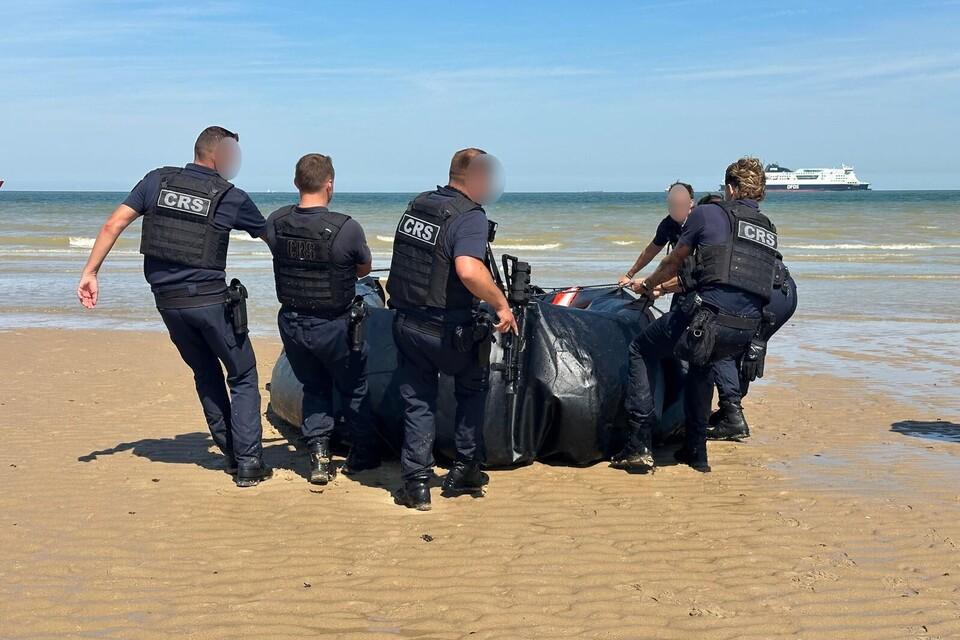
French units, newly funded as part of a significant UK-France agreement, have swiftly commenced operations with notable success in their initial three months. Recent data from French authorities reveals that between 27 April and 2 August, officers successfully intervened in 185 small boat incidents.
This proactive approach included measures to halt boat launches, seize equipment such as boats, engines, and lifejackets, and apprehend individuals involved in smuggling activities. Impressively, this led to the prevention of 61% of all small boat events during this period, reflecting nearly a 5% increase in the event prevention rate compared to the same timeframe in 2025.
Effective Interception Techniques
Reports indicate that during the three months following the signing of the agreement, there were four weeks when French authorities managed to intercept every potential crossing event, achieving a remarkable prevention rate of 100%. The actions taken resulted in over 4,300 thwarted crossing attempts, significantly safeguarding against migrants reaching UK shores, with many more likely deterred before even approaching the French coastline.
Throughout May, June, and July, French officers employed a variety of tactics to combat the nefarious smuggling networks and disrupt migrant crossings. These strategies included direct interceptions on beaches, preventing boats from departing, and stopping migrants from boarding taxi boats.
For instance, in May, French units successfully intervened to halt a potential small boat launch south of Calais, identifying three groups of nearly 100 migrants along with a concealed boat, four fuel cans, and an engine, effectively neutralising the crossing attempt.
Additionally, during the same month, police dispersed a large group of migrants and apprehended a suspected smuggler three kilometres from the French coast. In July, officers utilised surveillance technology to monitor another group of migrants heading towards Dunkirk, leading to the interception of a boat intended for crossing.
Seizing Smuggler Resources
French authorities have also focused on seizing boats and engines from vehicles heading towards the coast, alongside uncovering hidden equipment along the shoreline. In May, security officers intercepted a vehicle containing a boat with an engine, three fuel jerry cans, and a fuel tank, resulting in the arrest of a suspected smuggler.
In June, two suspected traffickers were apprehended for transporting nautical equipment, including a boat and three jerry cans of fuel. Furthermore, in July, a Gendarmerie drone detected a group of migrants carrying a boat engine, prompting a successful operation that resulted in the seizure of the vessel.
French officers have expanded their efforts to intercept boats at sea, employing innovative maritime tactics designed specifically to target migrant taxi boats. Since these new methods were introduced on 3 March, there have been 12 interceptions of taxi boats on the water, with three occurring in the past fortnight alone, effectively preventing these vessels from loading additional migrants.
Commitment to Disrupting Smuggling Operations
The Home Secretary, Shabana Mahmood, commented on the impact of the UK-France deal, stating, “Our new agreement is already making a tangible difference, halting crossings before they take place and undermining the criminal networks behind them.” She further emphasised the government’s determination to dismantle smuggling operations and seize their equipment while disrupting their business model.
Charlie Eastaugh, Director of Maritime and Small Boats at Border Security Command, affirmed the strength of the partnership with France, noting, “Together, we are intensifying the pressure on criminal gangs and halting these illegal and hazardous crossings.” He praised the bold actions taken by French officers to prevent launches where safe and lawful, commending their efforts in challenging conditions to save lives at sea.
Broader Measures Against Illegal Migration
Beyond merely preventing launches, French authorities have initiated a trial designed to remove migrants from French beaches, which commenced on 1 May under the new agreement. Statistics reveal that a total of 119 migrants have been detained, with 76 currently in detention, 32 released, and 40 deported, comprising over 33% of those detained thus far.
This trial is being conducted alongside the ongoing construction of a permanent Immigration Removal Centre in Dunkirk. Since the agreement was established, two additional police units have been activated on French beaches, including a new riot police unit equipped to manage and disperse groups of illegal migrants.
Moreover, France is investing millions in drone surveillance, introducing two new helicopters and a comprehensive camera system aimed at intercepting people smugglers and illegal migrants.
Strengthening Immigration Enforcement
This month, the Home Secretary announced the deployment of a record number of National Crime Agency officers to combat people smuggling, with the total doubling since the start of 2025, rising from 276 to nearly 800. These officers are collaborating closely with international partners, having seized over 1,100 small boats and engines since the election.
The Home Secretary is also enacting comprehensive reforms to the immigration system, seeking to eliminate the incentives that draw migrants to the UK and increasing the removal of individuals without the right to remain. This initiative builds on the successful return of over 80,000 individuals since taking office.




More Stories
Decommissioning Calder Hall: The Historic Journey of the World’s First Commercial Nuclear Power Station
Unveiling the UK’s Arctic Policy Framework: Minister Kumaran’s Keynote Address
UK Champions Two-State Solution for Lasting Peace and Security for Israelis and Palestinians