
Every day, enthusiasts of astronomy are treated to a captivating glimpse of the universe through a carefully curated image or photograph. Each feature is accompanied by a succinct explanation crafted by a professional astronomer, inviting viewers to delve deeper into the wonders of our cosmos.
Exploring Stickney Crater
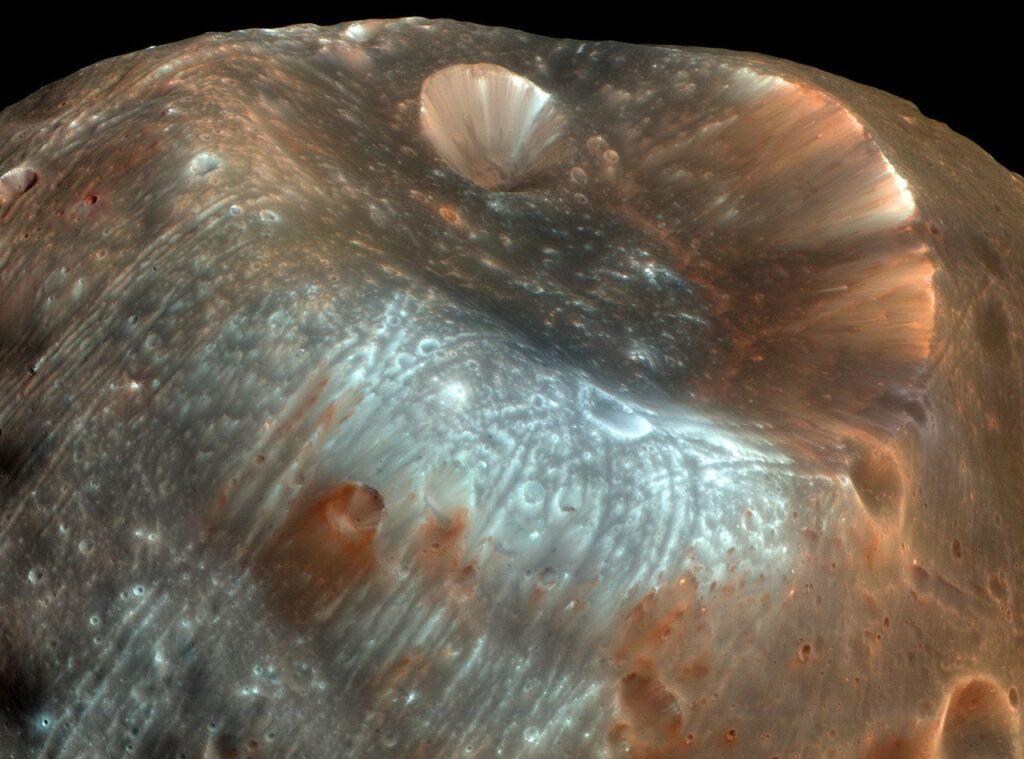
Among the many intriguing celestial formations, Stickney Crater stands out as the largest crater on Phobos, one of Mars’ two moons. Named after Chloe Angeline Stickney Hall, a mathematician and the spouse of the esteemed astronomer Asaph Hall, this remarkable feature boasts a diameter of over 9 kilometres, making it almost half the size of Phobos itself. The crater’s formation was the result of a significant impact, so powerful that it likely brought the tiny moon to the brink of destruction.
This enhanced-colour image of Stickney, along with its surrounding terrain, was captured by the High-Resolution Imaging Science Experiment (HiRISE) camera aboard the Mars Reconnaissance Orbiter during a close flyby of Phobos in March 2008, at an altitude of approximately 6,000 kilometres. Despite Phobos’ surface gravity being less than one-thousandth that of Earth, evidence of geological activity is apparent. Notably, streaks along the crater walls suggest that loose material has gradually slipped down over time.
Additionally, the light bluish areas at the crater’s rim may signify a relatively newly exposed surface, hinting at ongoing geological processes. The origin of the peculiar grooves marking the moon’s surface remains an enigma; however, they could be attributed to tidal stresses from Phobos’ proximity to Mars, or possibly linked to the impact event that created Stickney Crater.
Looking Ahead: Tomorrow’s Feature
The excitement continues as tomorrow’s image promises to showcase the fascinating features of the moon’s far side. Each day’s revelation enriches our understanding of the cosmos and the celestial bodies within it.
As we anticipate further insights, it’s essential to recognise the dedicated efforts of the teams behind these discoveries. The remarkable image of Stickney Crater, along with the ongoing exploration of Mars and its moons, is made possible through the collaboration of NASA’s Mars Reconnaissance Orbiter team and the broader scientific community.
This initiative is an integral part of NASA’s Science Activation programme, which strives to enhance public engagement with space science and exploration. With each new photograph, the mysteries of the universe are unveiled, sparking curiosity and inspiring future generations of astronomers and enthusiasts alike.




More Stories
Exciting NICER Status Updates: Stay Informed on the Latest Developments!
Stunning Showdown: Milky Way Galaxy vs. Mesmerising Auroras on 17 November 2026
Thunderbirds Soar in Spectacular Formation Display