
Every day presents an opportunity to explore the wonders of the universe through the Astronomy Picture of the Day (APOD). This initiative showcases a unique image or photograph of the cosmos, accompanied by a succinct explanation crafted by a professional astronomer, allowing enthusiasts and the curious alike to delve deeper into the mysteries of space.
Exploring the Cocoon Nebula
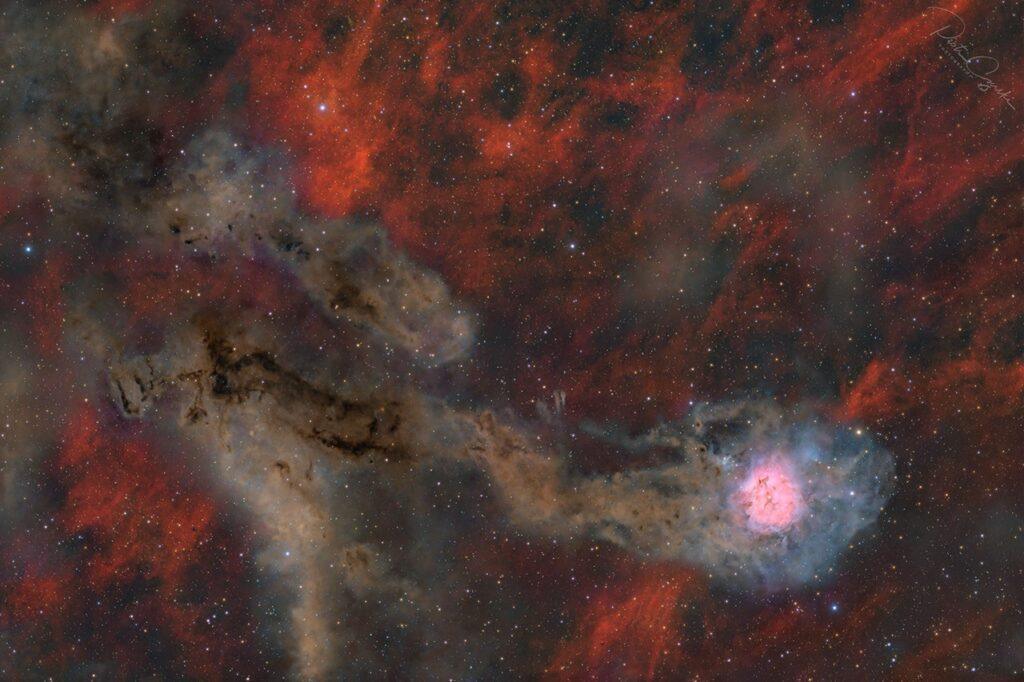
One of the captivating images featured is that of the Cocoon Nebula, a stunning cosmic formation located within the constellation of Cygnus, also known as the Swan. This nebula, catalogued as IC 5146, captivates the observer with its resemblance to a comet. The image reveals a dense starfield that extends over two degrees, and within this expanse, the Cocoon Nebula stands out prominently.
The Cocoon Nebula is a compact region where new stars are forming, characterised by its bright emissions and reflections. On the lower right of the image, the nebula emits a vibrant glow, while to the left, a long trail of interstellar dust clouds stretches out, enhancing the comet-like appearance of this celestial body. The central bright section of the nebula spans approximately 10 light years, while the dark, dusty tail extends nearly 100 light years, with both being situated about 2,500 light years from Earth.
A bright star positioned near the nebula’s centre plays a crucial role in its development, likely providing the energy necessary for star formation and helping to sculpt a cavity within the surrounding material. Although the tail appears dark in this visible light image, it conceals nascent stars that are in the process of coming to life. This spectacular image was captured in July from the stunning vistas of Death Valley in California, USA.
Updates and Future Images
The main portal for APOD, previously located at apod.nasa.gov, is transitioning to a new address at science.nasa.gov/apod, ensuring continued access to the stellar images and insights that have captivated audiences worldwide. Looking ahead, tomorrow will feature an intriguing image showcasing a triple eclipse, promising yet another stunning visual journey through our universe.
The latest image, shared on September 20, 2026, depicted an analemma over the Callanish Stones, highlighting the diversity and richness of astronomical phenomena that APOD endeavours to present. The project is supported by the Astrophysics Science Division at NASA’s Goddard Space Flight Center, along with contributions from Michigan Technological University, ensuring a steady stream of educational and visually striking content for astronomy enthusiasts.



More Stories
NASA and JAXA’s XRISM Mission Captures Pulsar Interacting with Companion Star’s Stellar Wind
Discover the Enigmatic Analemma Above the Callanish Stones: September 20, 2026
NASA Welcomes Media to the Signing Ceremony of Artemis Accords in Albania