
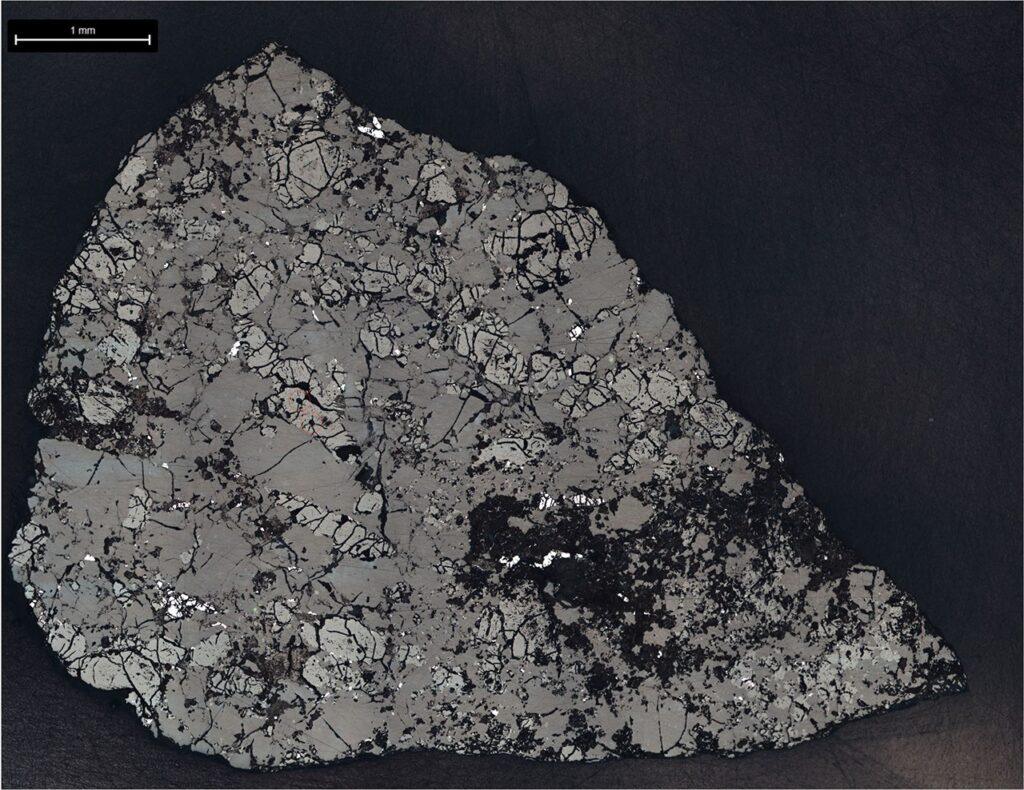
A striking microscopic view of a rock specimen is presented against a stark black background, showcasing a heavily fractured, mosaic-like mineral texture. The intricate patterns are rendered in various shades of grey and black, providing a captivating insight into the rock’s composition. A scale bar, measuring one millimetre, is conveniently positioned in the top-left corner for reference.
Insights into Ancient Martian Geology
This particular slice belongs to Teghaza 001, recognised as one of the most ancient Martian meteorites ever discovered on Earth. Its significance extends beyond mere aesthetics, as this specimen has been instrumental in determining the age of the rock and shedding light on the geological history of Mars. The analysis of such meteorites not only enhances our understanding of the Martian surface but also provides crucial information regarding the planet’s past conditions and potential for life.
The reflected light images reveal a complex interplay of minerals and textures that characterise this meteorite. The fractures seen in the sample may provide clues about the forces that shaped the Martian landscape, offering a window into a time long before humanity existed. Each detail captured in the microscopic view contributes to a larger narrative about the evolution of our neighbouring planet.
Significance of Teghaza 001
Teghaza 001’s age determination is a pivotal aspect of its study. By analysing isotopes and mineral compositions, scientists can piece together a timeline that not only marks the formation of the meteorite but also aligns it with critical events in the Martian geological record. Such research is essential for understanding the broader context of planetary formation and evolution within our solar system.
The findings from the Teghaza 001 meteorite have implications that extend beyond Mars. They resonate with ongoing studies of meteorites originating from other celestial bodies, enhancing our comprehension of the processes that govern planetary landscapes. As researchers continue to delve into the data presented by this ancient rock, the mysteries of Mars and its history slowly begin to unfold, revealing the planet’s potential to host life in its distant past.
Future Explorations and Research
As technology advances, so too does the ability to analyse meteorites like Teghaza 001 with greater precision. Future explorations to Mars may provide opportunities to gather more samples, which could further enrich our understanding of Martian geology. These studies will not only focus on the mineral composition but also on the environmental conditions that have prevailed over millions of years.
The ongoing research into ancient meteorites stands as a vital component of planetary science. Each sample collected from space serves as a testament to the history of our solar system, allowing scientists to piece together the intricate tapestry of planetary formation and evolution. With each discovery, the allure of Mars continues to captivate, driving the quest for knowledge about our cosmic neighbourhood.




More Stories
Discover the Stunning Colours of the Moon: APOD for 1st November 2026
NASA Investigates Commercial Opportunities for Hubble Telescope Servicing
Explore the Haunting Beauty of a Spooky Planet: Night Sky Wonders for Halloween 2026