
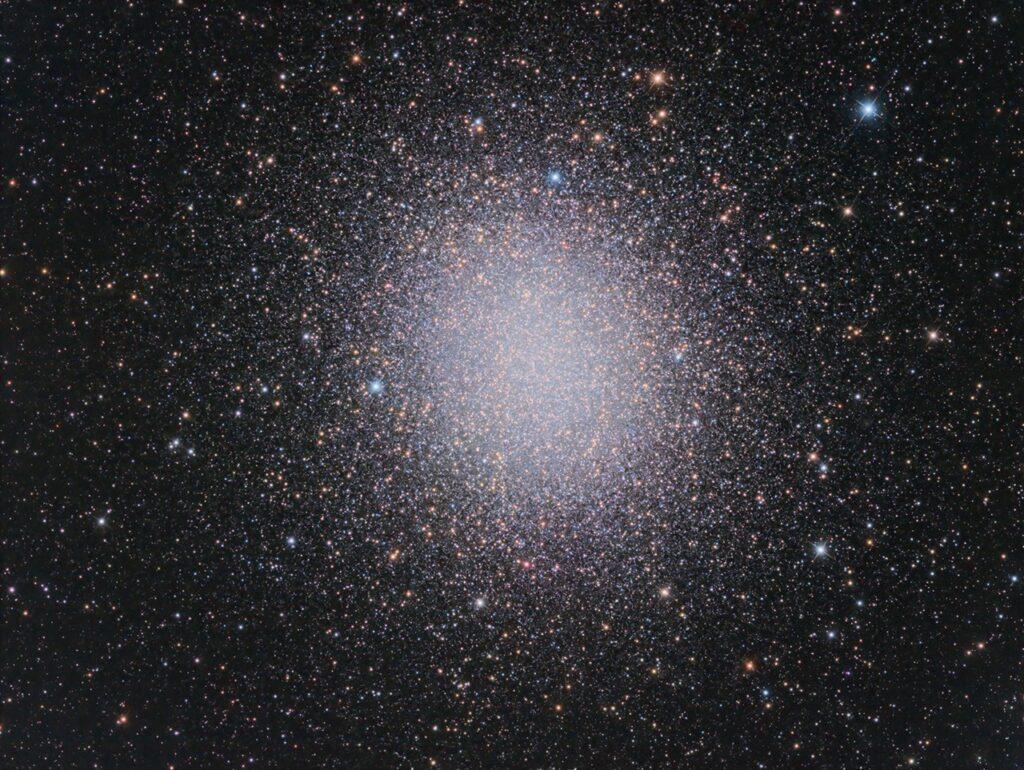
Every day offers a new glimpse into the cosmos, showcasing a captivating image or photograph that highlights the wonders of our universe, complemented by an insightful explanation provided by a professional astronomer.
Exploring Omega Centauri
Among the celestial treasures is the globular star cluster known as Omega Centauri, which contains approximately 10 million stars, all significantly older than our Sun. This remarkable cluster, identified as NGC 5139, spans a diameter of about 150 light-years and is situated approximately 15,000 light-years away from Earth. It stands out as the largest and brightest of roughly 200 known globular clusters that inhabit the halo of the Milky Way galaxy.
Distinct from typical star clusters, which usually consist of stars that share similar ages and compositions, Omega Centauri is intriguing due to its diverse stellar populations, which vary in age and chemical make-up. This diversity suggests that Omega Centauri may be the remnant core of a smaller galaxy that has merged with our Milky Way. The cluster’s red giant stars, characterised by a yellowish hue, are particularly prominent in detailed telescopic observations, making them easily identifiable.
Over the past two decades, extensive studies of Omega Centauri using the Hubble Space Telescope have uncovered compelling evidence of a massive black hole residing at its centre, adding yet another layer of fascination to this stellar phenomenon.
Updates and Future Discoveries
For those keen on contributing images to the Astronomy Picture of the Day (APOD), please note that submission details have changed. More information can be found on the updated APOD submissions page. Additionally, the main APOD site, previously located at apod.nasa.gov, is transitioning to a new address: science.nasa.gov/apod, ensuring continued access to awe-inspiring astronomical content.
As we look forward to tomorrow’s feature, which promises to reflect upon a starry night, the celestial narrative continues to unfold, inviting us all to explore the vast and intriguing universe that lies beyond our planet.
The featured image today, dated September 25, 2026, is credited to Javier O. Cadenas Parra, with contributions from a dedicated team of authors and editors including Jerry Bonnell, Cecilia Chirenti, Robert Nemiroff, and Keighley Rockcliffe. This initiative is supported by the ASD at NASA/GSFC, NASA Science Activation, and Michigan Technological University.
Yesterday’s Highlight
For those wishing to catch up, yesterday’s featured image was titled “The Ghosts of Five Supernovas,” offering another glimpse into the dramatic events that shape our universe. Each image serves as a reminder of the ever-evolving nature of astronomical exploration and discovery.




More Stories
Discover the Stunning Sh2-188: The Shrimp Nebula – September 29, 2026 Astronomy Highlight
NASA Celebrates Milestone: Artemis Accords Now Boasts Over 75 Signatories
Exploring the Secret Valleys Beneath Greenland’s Ice Cap