
The Astronomy Picture of the Day (APOD) invites enthusiasts to explore the wonders of the cosmos. Each day, a captivating image or photograph of our intriguing universe is showcased, accompanied by a concise explanation authored by a professional astronomer.
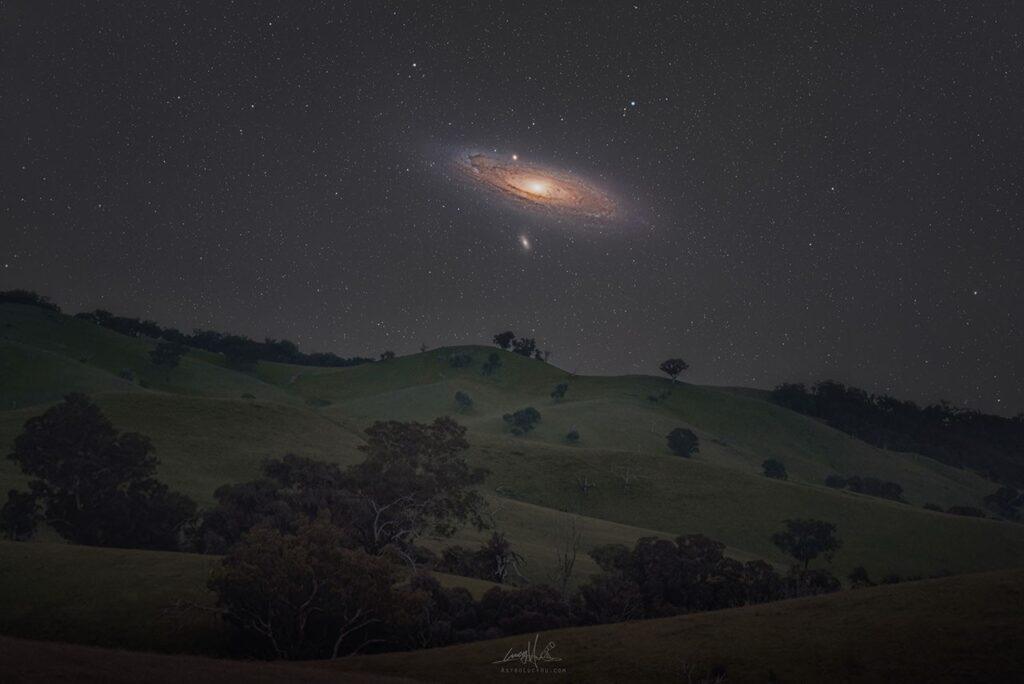
Andromeda Galaxy in the Southern Hemisphere Spring
Taking a northern gaze from Mullion in New South Wales, Australia, the Andromeda Galaxy appears just a few degrees above the horizon. However, during the spring season in the southern hemisphere, this magnificent galaxy reaches its highest point in the sky around midnight. Captured through a telephoto lens on the nights of October 10 and 11, this stunning image utilises multiple exposures to unveil the intricate details of the spiral galaxy as it ascends above the undulating Australian landscape.
Known scientifically as M31, the Andromeda Galaxy ranks among the brightest celestial bodies listed in the Messier catalogue. Despite its prominence, it is visible to the naked eye merely as a small, faint, and fuzzy patch. The composite image skilfully combines digitally tracked and stacked frames with a foreground shot, allowing for a more extensive view of the galaxy during Earth’s night. In the enchanting springtime sky, the closest large spiral galaxy stretches across nearly six full moons, offering a breathtaking spectacle for stargazers.
Anticipating Tomorrow’s Cosmic Image
As we look ahead, tomorrow’s image promises to be equally captivating, offering a glimpse into the realm of pixels in space. Enthusiasts can eagerly await this new addition to the daily astronomical showcase.
Date: October 23, 2026
Credit & Copyright: Lucy Yunxi Hu
Contributors to this fascinating feature include Jerry Bonnell, Cecilia Chirenti, Robert Nemiroff, and Keighley Rockcliffe, all of whom play vital roles in bringing the wonders of astronomy to the public.
This initiative is supported by the ASD at NASA/GSFC, NASA Science Activation, and Michigan Technological University, ensuring a continuous flow of inspiration for astronomy aficionados.
Reflecting on Yesterday’s Image
Looking back, yesterday’s image showcased the first green star, WD J1330+6435, adding another layer of intrigue to the rich tapestry of celestial phenomena. Each day, APOD serves as a reminder of the vastness and beauty of our universe, encouraging exploration and appreciation of the night sky.



More Stories
NASA Welcomes Media to the 2026 von Braun Space Exploration Symposium: Join the Future of Space Discovery
Discover the First Green Star: WD J1330+6435 Unveiled on 22nd October 2026
Accelerating Scientific Progress: An Open Letter to the Research Community