
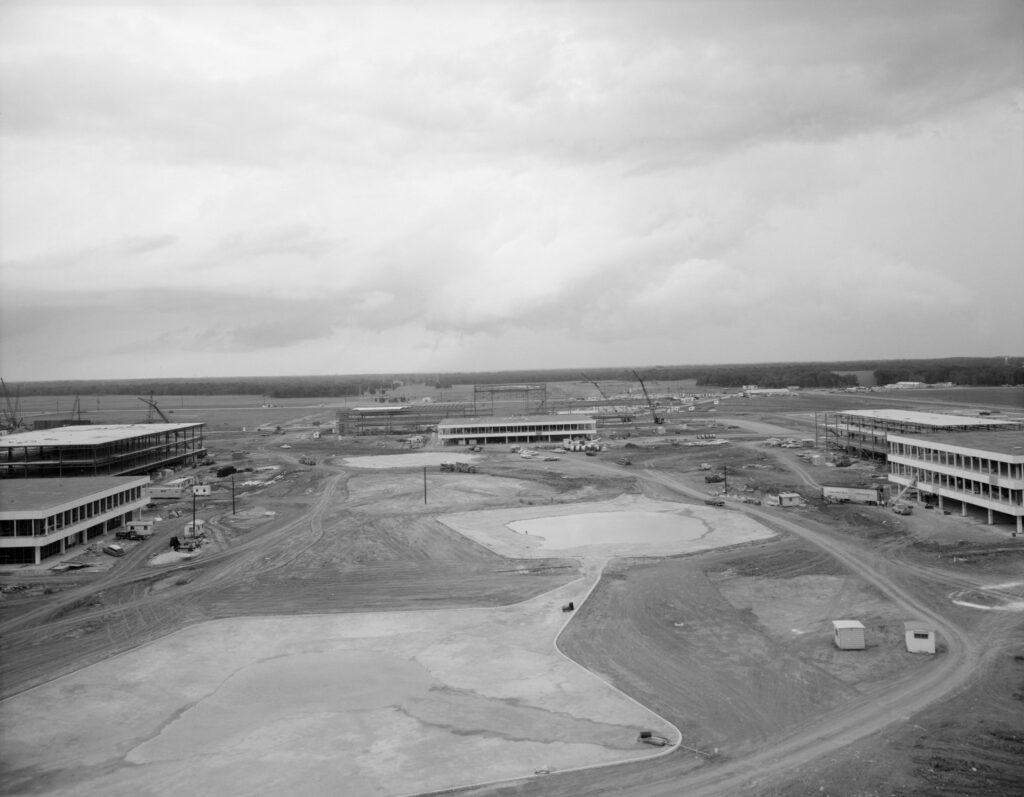
A wide, high-angle view of a large construction site reveals numerous partially constructed rectangular buildings scattered across a flat, open landscape.
The Visionary Beginnings
Sixty-five years ago, a daring concept emerged in Houston: the establishment of a NASA centre focused on human space exploration. Since its inception, NASA’s Johnson Space Center has played a pivotal role in advancing space travel and research.
Milestones in Space Exploration
Over the decades, the centre has been at the forefront of numerous significant milestones. It has served as the primary hub for astronaut training, mission operations, and spacecraft development. With each passing decade, the centre has adapted to the evolving demands of space exploration, contributing to iconic missions such as the Apollo moon landings and the Space Shuttle programme.
Innovations and Technological Advancements
The Johnson Space Center is not only a site for training astronauts but also a cradle for innovation. It has facilitated groundbreaking research in various fields, including engineering, robotics, and life sciences. The technologies developed here have often found applications beyond space, benefiting various sectors on Earth.
Community and Educational Outreach
In addition to its technical achievements, the centre has actively engaged with the community and educational institutions. It has developed numerous outreach programmes aimed at inspiring the next generation of scientists, engineers, and explorers. By fostering interest in STEM (Science, Technology, Engineering, and Mathematics), the Johnson Space Center continues to cultivate a pool of talent essential for future advancements in space exploration.
The Future of Space Travel
As the centre looks ahead, it remains committed to pushing the boundaries of human spaceflight. With ambitious projects such as the Artemis programme, which aims to return humans to the Moon and eventually send astronauts to Mars, the Johnson Space Center is poised to remain a central player in the realm of space exploration for years to come. Its legacy of innovation and dedication to human exploration continues to inspire and shape the future of space travel.



More Stories
NASA’s Hubble Space Telescope Discovers Missing Oxygen in Nearby Dwarf Galaxies
Explore November’s Night Sky: Your Guide to Celestial Wonders and Shorter Days
Discover the Stunning Colours of the Moon: APOD for 1st November 2026