
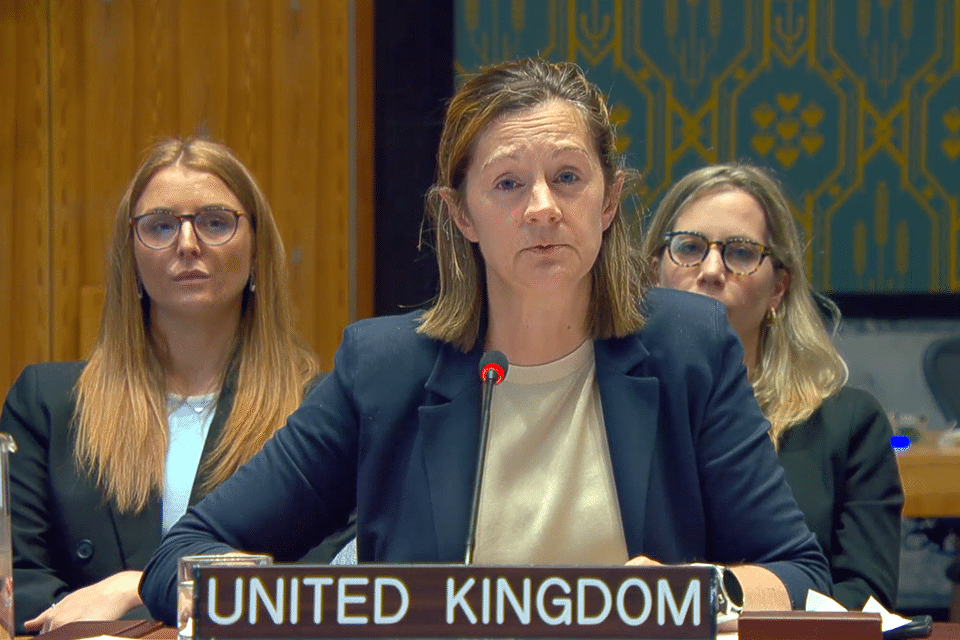
Today marks twenty-six years since the adoption of Security Council Resolution 1325, yet a significant disparity remains between the commitments made in this Council and the harsh realities faced by women and girls in conflict zones.
This issue is evident across various situations on our agenda.
In Gaza, nearly 50,000 women and girls have lost their lives or sustained severe injuries since October 2023.
In Ukraine, the ongoing aggression from Russia continues to displace women and girls, exposing them to violence and increased protection risks.
Meanwhile, in Myanmar, the Secretary-General has reported extensive sexual violence coupled with severely restricted access to essential support services.
Addressing the Ineffectiveness of Commitments
President, the challenge we face is no longer a lack of understanding of effective measures; rather, it is our frequent failure to implement them.
I wish to emphasise three critical areas where we must enact change.
Firstly, participation must equate to genuine influence. We acknowledge the insightful contributions made by today’s civil society briefer. The Council must not only listen to women, peacebuilders, and civil society but also take action based on their analyses and safeguard those who engage with us from potential reprisals.
Moreover, participation cannot merely involve integrating women into discussions after vital decisions have already been finalised. In Afghanistan, for instance, women and girls have been systematically excluded from public life and decision-making processes. Their voices must be at the forefront of discussions regarding the nation’s future. Sustainable peace cannot be achieved while half of the population is sidelined from its formulation.
The United Kingdom is committed to supporting this principle through tangible actions. In March, we pledged that by 2030, at least 90 per cent of our bilateral overseas development assistance would focus on promoting equality for women and girls, either as a core principle or a significant goal.
Last year, we allocated approximately $4.6 million to women peacebuilders and women’s rights organisations operating in fragile and conflict-affected contexts. We intend to maintain this commitment in the current financial year.
Ensuring Protection and Accountability
Secondly, the protection of women must be accompanied by accountability. Survivors of conflict-related sexual violence require comprehensive, survivor-centred support, but they equally deserve justice.
Yesterday, the United Kingdom announced over $6 million in funding to assist survivors of sexual and gender-based violence in Sudan, alongside support for human rights defenders documenting atrocities for future prosecutions. We must not condemn these crimes year after year while perpetrators continue to operate with impunity.
Accountability is crucial not only for survivors but also for prevention efforts.
Confronting the Exclusion of Women from Public Life
Thirdly, we must address the various ways in which women are being pushed out of public life. This exclusion increasingly occurs in both physical and digital spaces.
Online threats and abuse are employed to intimidate and silence women, creating additional barriers to their involvement in political and public spheres. The United Kingdom has initiated an international programme specifically designed to combat this type of abuse.
We must ensure that technology enhances women’s ability to participate rather than providing new instruments for their exclusion from important debates.
President, the issue of women, peace, and security is not a mere optional addition to the work of this Council; it is fundamental to the sustainability of the peace we strive to establish.
Twenty-six years after the adoption of Resolution 1325, we no longer need to reiterate the case for action.
Our obligation now is to bridge the gap between the promises made by this Council and the realities faced by women in conflict situations. This entails ensuring true influence, adequate funding, protection with accountability, and a safe space for women to participate as the threats they encounter evolve.



More Stories
UK and Australia Forge Stronger Ties Ahead of Commonwealth Heads of Government Meeting 2026
UK Judge Champions International Law at the International Court of Justice
Rogue Skip Hire Operator Receives Suspended Prison Sentence for Misconduct