
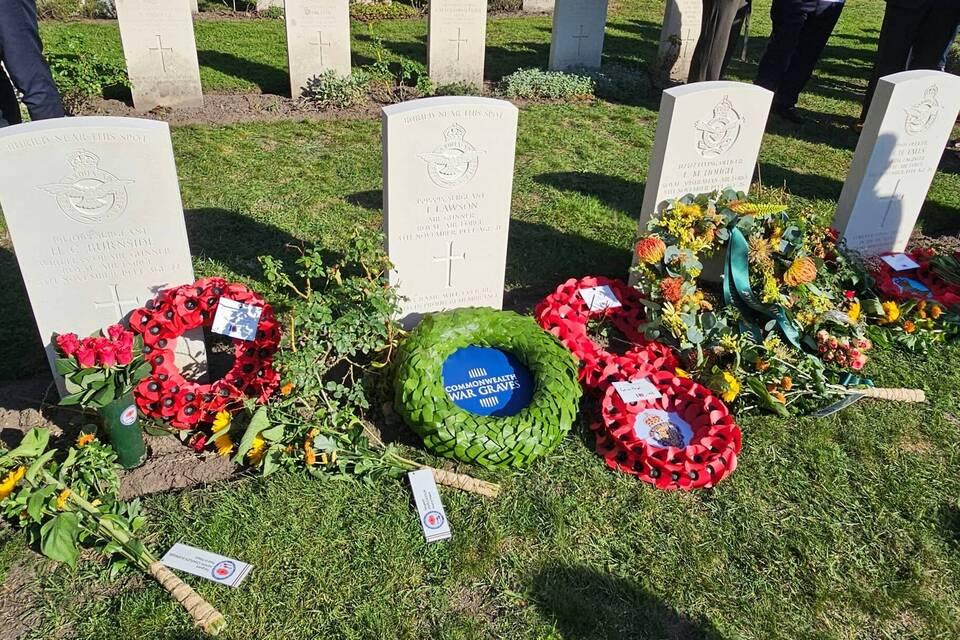
Four airmen who tragically lost their lives when their Lancaster bomber crashed in Germany in December 1944 were finally honoured by name, following an extensive 82-year search that unveiled the truth behind one of Bomber Command’s enduring mysteries.
Memorial Service in the Netherlands
Earlier today, a poignant service was held at the Commonwealth War Graves Commission’s Venray War Cemetery in the Netherlands for Flying Officer Leslie Markland Hough of the Royal Australian Air Force, Pilot Officer John Henry Tales, and Sergeants Henry Charles Burnside and John Lawson, all of the Royal Air Force Volunteer Reserve. For decades, their remains had rested in graves marked ‘unknown’ due to a series of post-war administrative errors.
On the morning of 8 December 1944, the Lancaster PD374 from No. 218 Squadron RAF took off from RAF Methwold in Norfolk, as part of a larger force of over 130 aircraft tasked with targeting the Neerbeck oil plant in Homberg, located in Germany’s Ruhr region. Of the seven-man crew, three were able to parachute to safety and were captured as Prisoners of War, while the other four perished.
Paying Tribute to Brave Airmen
Tracey Bowers, a caseworker from the Joint Casualty and Compassionate Centre (JCCC), expressed her sentiments during the service, stating, “Today we honour the British and Australian airmen who served and died together during World War II. To have so many families present here today has made this occasion especially poignant, and witnessing their interactions with the local community, who have adopted these graves, has been incredibly moving.”
Pilot Officer Tales, born on 31 December 1917 in Attercliffe, Sheffield, was the youngest of eleven children. He worked as a poster writer before enlisting in the RAF in September 1939, where he built an exemplary service record. After completing a full operational tour, he voluntarily returned to frontline operations, joining No. 218 Squadron in August 1944.
Family Reflections on a Significant Day
John Tales, the nephew of Pilot Officer Tales, attended the service alongside other family members. He remarked, “It has been an extremely poignant occasion and we are honoured and quite overwhelmed to have been here. It has been wonderful to learn more about our Uncle John, and we would like to thank all those who have made this possible.”
The Captain of Lancaster PD374 was Flying Officer Hough, who was reported to have remained at the controls of the burning aircraft to allow others the chance to escape. The two other crew members honoured were Sergeants Burnside and Lawson. Burnside was noted for his professionalism and immaculate appearance, while Lawson, affectionately nicknamed “Geordie,” hailed from a mining family in County Durham.
Community Support and Remembering the Fallen
Thurston Lawson, nephew of Sergeant Lawson, attended the service with his cousin John Lawson. He stated, “It has been a fantastic day and incredibly memorable. It is so moving to see so many people here, and everyone has been so kind, representing their organisations brilliantly.”
The rededication service was conducted by Reverend (Group Captain) Ruth Hake, who remarked, “It is my immense privilege to conduct the ceremony for Flying Officer Hough, Pilot Officer Tales, Sergeant Burnside, and Sergeant Lawson today. They gave their lives in defence of our nation, and in dedicating their graves today with their names rightfully in place, we are finally able to honour the debt we all owe to them and their loved ones.”
A Long-Awaited Commemoration
Today’s service, occurring more than eighty years after these men made the ultimate sacrifice, marks a significant moment in which the crew of Lancaster PD374 will finally be commemorated under their own names, rather than as unknown servicemen. Dr Daniel Seaton, Commemorations Case Officer at the Commonwealth War Graves Commission, expressed his satisfaction, stating, “I am delighted that, after so many years, the final resting place of these brave airmen has finally been identified. Their family members, many of whom were present today, can now visit their known graves in perpetuity. The Commission is pleased to have assisted with this process and will continue to maintain their graves with the utmost care and respect.”


More Stories
COP31 Outcomes: Answers to Your Key Questions Explained
Kent Communities Encouraged to Trust Their Instincts and Report Waste Crime
Sovereign AI Partners with National Security Strategic Investment Fund to Support UK Autonomous Defence Systems Company