
Each day, enthusiasts of the cosmos are treated to a stunning visual representation of our universe through the Astronomy Picture of the Day (APOD). This platform showcases a unique image or photograph daily, accompanied by an insightful explanation authored by a professional astronomer.
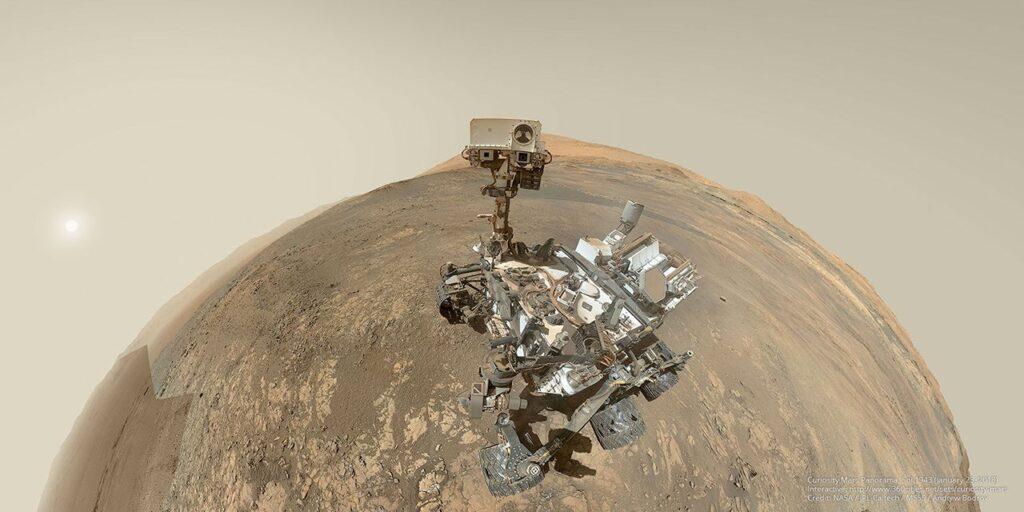
Curiosity’s Martian Selfie
On the 1943rd sol of its exploration journey across Mars, the Curiosity Rover captured a remarkable selfie at the southern rim of Vera Rubin Ridge. A sol refers to a Martian solar day, which is approximately 40 minutes longer than a day on Earth. Therefore, sol 1943 translates to 23 January 2018 in Earth time. This captivating image has also been presented as an interactive 360-degree virtual reality experience, providing an immersive view of the Martian landscape.
The selfie is a composite panorama created from 61 separate exposures taken by the rover’s Mars Hand Lens Imager (MAHLI). Notably, frames that included the imager’s arm were omitted from the final image, allowing for a clearer view of the surrounding terrain. The extended background featured in the panorama was captured by the rover’s Mastcam on sol 1903. Dominating the scene is the ChemCam housing, positioned atop the rover’s mast, which obscures the impressive peak of Mount Sharp, standing 5 kilometres high.
As of 26 August 2026, Curiosity has achieved a total elevation gain of 1 kilometre in its ascent from the base of Gale Crater up the slopes of Mount Sharp, marking a significant milestone in its ongoing exploration.
Updates and Future Features
For those interested in contributing to this captivating collection, please note that APOD’s email address for image submissions has changed. Further details can be found on the APOD submissions page. The anticipation builds for the next image to be featured tomorrow, titled “Sunday’s Childe,” showcasing yet another extraordinary aspect of our universe.
Today’s date is 3 October 2026, and the stunning images are brought to life thanks to the collaborative efforts of NASA, JPL-Caltech, and MSSS, with contributions from Andrew Bodrov for the panorama. The APOD team, including Jerry Bonnell, Cecilia Chirenti, Robert Nemiroff, and Keighley Rockcliffe, continues to inspire and educate through this remarkable service of NASA’s Science Activation and Michigan Tech University.
A Look Back at Yesterday’s Imagery
For those who missed it, yesterday’s APOD featured a detailed exploration of the complete Sharpless Catalog, showcasing 313 nebulas. This serves as a reminder of the vast and diverse wonders that the universe holds, encouraging ongoing curiosity and exploration.




More Stories
NASA Invites Applications for Upcoming Flight Director Positions
Discover the Complete Sharpless Catalogue: Explore 313 Stunning Nebulae on 2nd October 2026
NASA’s SpaceX Crew-13 Successfully Launches to the International Space Station