
Every day presents a new opportunity to explore the cosmos through stunning imagery and insightful explanations. The Astronomy Picture of the Day (APOD) showcases a different image or photograph of our captivating universe, accompanied by a succinct description crafted by a professional astronomer.
Illuminating the Night Sky
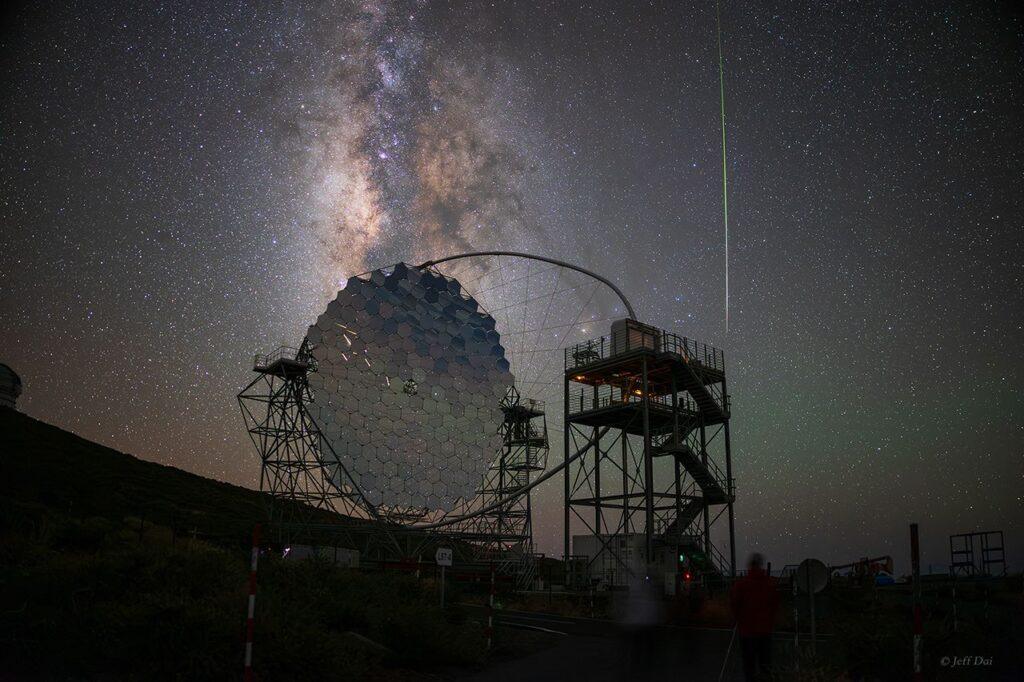
On August 15, a Perseid meteor blazed through the night sky above the Observatorio del Roque de los Muchachos, located on La Palma in the Canary Islands, Spain. This vibrant and colourful meteor trail was beautifully juxtaposed with the central Milky Way, where dark interstellar dust clouds contrasted with the radiant starlight that stretched across the horizon. In the foreground of this breathtaking celestial tableau lies the 23-metre diameter mirror of the prototype Large-Sized Telescope (LST-1).
LST-1 represents a significant advancement in astronomical observation, being the first telescope built at the northern hemisphere site of the pioneering Cherenkov Telescope Array Observatory. This remarkable instrument is composed of 198 hexagonal mirror segments, complemented by a large, high-efficiency pixelised camera. Its primary function is to detect extremely brief flashes of visible light that occur in the atmosphere. These fleeting bursts, lasting only about a billionth of a second, are initiated by high-energy gamma-rays originating from cosmic entities, including distant active galaxies and gamma-ray bursts. Notably, on that night, some of LST-1’s individual mirror segments also reflected the atmospheric flash generated by the bright Perseid meteor.
Updates and Future Engagements
APOD has recently updated its email address for submissions of images, which can be found on their official website. Additionally, the main site for APOD is transitioning from its former domain to a new one, aimed at enhancing user experience and accessibility. Visitors can now access APOD at science.nasa.gov/apod.
Looking ahead, anticipation builds for tomorrow’s image, which promises to deliver yet another captivating glimpse into the wonders of the universe. To stay engaged with the latest astronomical discoveries and visuals, enthusiasts are encouraged to explore the previous day’s image, showcasing the Globular Star Cluster Omega Centauri, which was highlighted on September 25, 2026.
APOD continues to serve as an invaluable resource for both amateur and professional astronomers, fostering a deeper appreciation for the intricacies of our universe.




More Stories
Discover the Stunning Sh2-188: The Shrimp Nebula – September 29, 2026 Astronomy Highlight
NASA Celebrates Milestone: Artemis Accords Now Boasts Over 75 Signatories
Exploring the Secret Valleys Beneath Greenland’s Ice Cap