
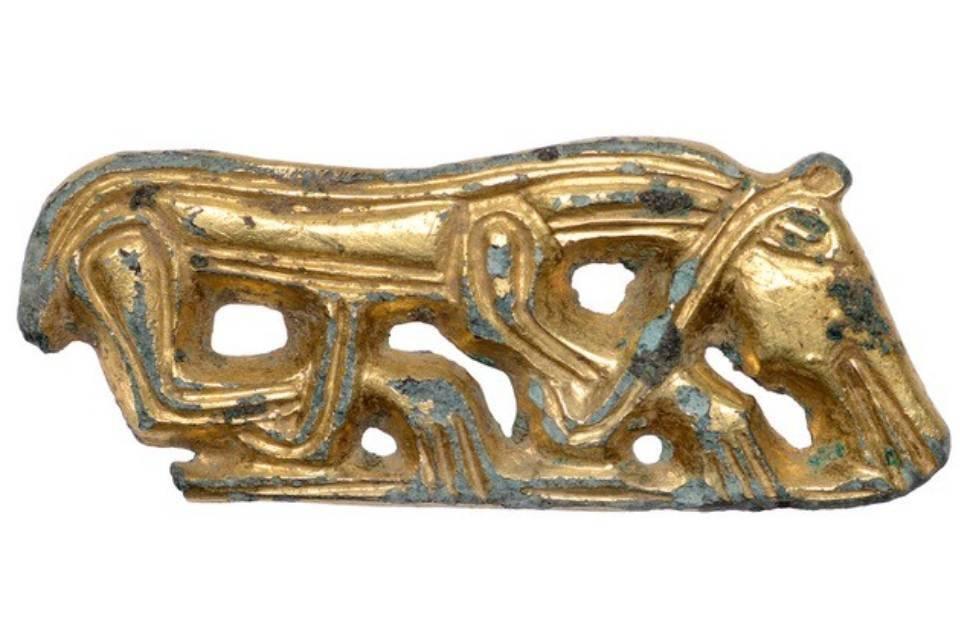
The UK Government has implemented a temporary export ban on a remarkable Anglo-Saxon artefact, aiming to secure its future within the country. This decision arises from the desire for a British gallery or institution to preserve this unique national treasure for public benefit.
The artefact, believed to date back over 1,400 years, features a finely crafted depiction of a four-legged animal. Such representations are thought to have held significant cultural and religious value, providing an invaluable opportunity to explore the cultural exchanges prevalent in Anglo-Saxon East Anglia.
Significance of the Artefact
Experts have determined that this artefact satisfies all three of the Waverley Criteria, which assess whether an item qualifies as a national treasure. These criteria evaluate the object’s historical relevance to the nation, its aesthetic merit, and its significance for the study of art, history, or learning. This classification underscores the artefact’s deep connection to British heritage and its potential to enhance understanding of early British culture.
The temporary ban on exporting the artefact allows museums and galleries the necessary time to gather funds for its acquisition, with the ultimate objective being to retain this vital piece of history within the UK, accessible to the general public.
Discovered by a metal detectorist in Holme Hale, Norfolk, in 2024, the artefact includes attachments on its reverse, indicating it was likely intended to be mounted on another object. This mount is particularly rare due to its clear depiction of a four-legged animal, while most surviving examples from this period are highly stylised. Crafted from copper-alloy and adorned with gilding, it measures just over 3cm in length and weighs a mere 5 grams. Scholars believe it was produced during the late 5th or early 6th century.
The Call for Preservation
Arts Minister Ruth Mackenzie has emphasised the artefact’s importance, stating, “This piece is undeniably a national treasure. It offers researchers an important window into our Anglo-Saxon past. I hope this mount can remain in the UK where researchers and the public will have the best access to it.”
Helen Jacobsen, a member of the Reviewing Committee on the Export of Works of Art and Objects of Cultural Interest (RCEWA), highlighted the importance of physical artefacts in studying early medieval life and culture. She remarked, “This object is of particular significance for research into the early Anglo-Saxon kingdoms because of its unique form and very rare imagery. Further study will shed light on its function and on the transmission of artistic styles, materials, and iconography in southern Scandinavia and eastern and south-eastern England during the late 5th and 6th centuries. It will be a huge loss if it cannot be saved for the nation, and I hope very much that a home can be found for it in a national museum.”
Next Steps for Acquisition
The RCEWA has recommended deferring the export licence application for the mount until 3 November 2026, during which time expressions of interest from potential buyers are welcomed. Following this initial deferral period, the current owners will have a 15-business-day window to consider any offers to purchase the mount at the suggested price of £1,054 (plus VAT). A further deferral period will follow the signing of an Option Agreement, lasting three months.
When a request is made to permanently export a culturally significant object from the UK, the Government can intervene to halt the export process if it is deemed a national treasure. This pause allows museums or collectors time to secure the necessary funding to retain the artefact in the country.
Contact for Interested Buyers
Individuals or organisations interested in acquiring the mount are encouraged to reach out to the RCEWA at 02072680534 or via email at rcewa@artscouncil.org.uk.
Details of the artefact are as follows: A late 5th to early 6th century Anglo-Saxon copper-alloy gilded chip-carved mount, the maker of which remains unknown. The sub-rectangular piece features a depiction of a slender-bodied quadruped. The reverse side is ungilded and exhibits the stubs of two lugs, suggesting it was designed to be affixed to another object. The mount is incomplete, with visible breaks to the tail and baseline from the perspective of the depicted creature. The gilding is predominantly intact on the decorated surface but shows signs of wear in several areas. It measures 33.7mm in length, 15.1mm in width, with a thickness of 2.1mm, and weighs 5g. It was found in Holme Hale, Norfolk, and is recorded with the Portable Antiquities Scheme (PAS) database reference NMS-15F391.
The RCEWA is an independent body supported by Arts Council England (ACE), which advises the Secretary of State for Culture, Media and Sport on the national importance of cultural objects intended for export.




More Stories
Free Rail Travel for Bereaved Veteran Families This Remembrance Weekend: A Tribute to Their Sacrifice
Funding Acquired to Uncover Hidden Treasures of Bronze Age Flag Fen Excavation
Suffragan Bishop of Warwick Appointment Set for 11th September 2026