
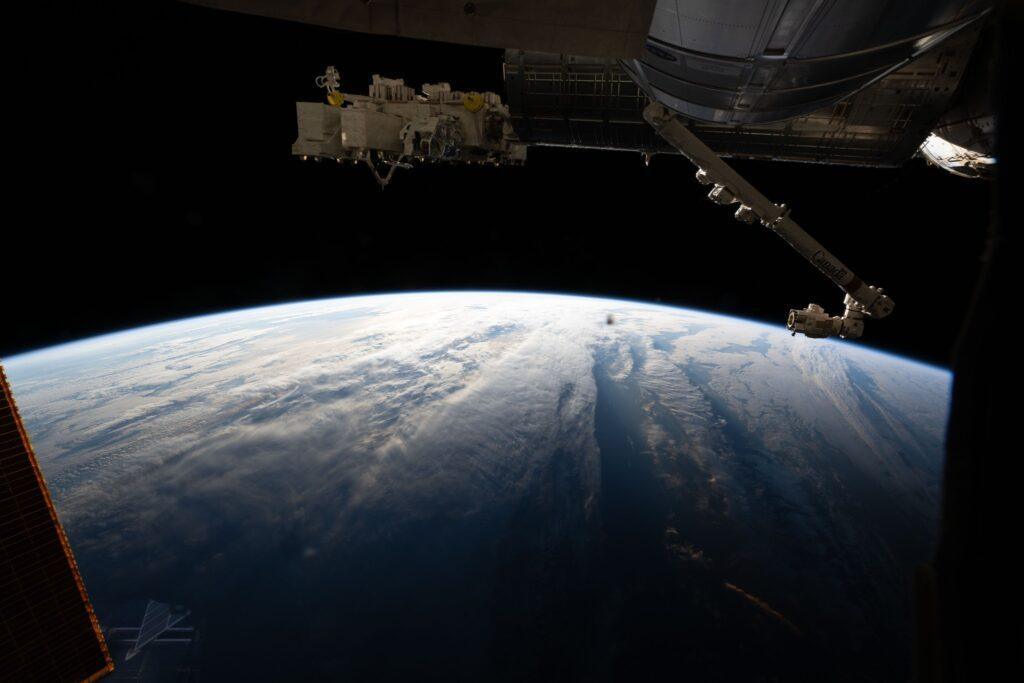
(March 15, 2026) — The International Space Station orbits 267 miles above a cloudy Atlantic Ocean, southwest of Cape Town, South Africa. The Kibo laboratory module’s External Platform and the Canadarm2 robotic arm prominently feature in the foreground above Earth’s terminator—the line that separates night from day—in this photograph captured at approximately 6:36 a.m. local time.
Return of Expedition 74 Crew
The Expedition 74 crew will be welcomed back during a public event at Space Center Houston following their extended mission aboard the International Space Station. NASA astronauts Jessica Meir, Jack Hathaway, and Chris Williams; ESA (European Space Agency) astronaut Sophie Adenot; along with Roscosmos cosmonauts Sergey Kud-Sverchkov and Sergei Mikaev, will share highlights from their mission at 6 p.m. CST on Tuesday, 17th November, at the visitor centre of NASA Johnson Space Center. An awards ceremony honouring key contributors to the mission will take place after the presentation.
Prior to the event, the astronauts will be available for media interviews. Requests for in-person interviews must be submitted by 5 p.m. on Monday, 16th November.
Mission Overview
Williams, Kud-Sverchkov, and Mikaev launched aboard the Soyuz MS-28 spacecraft from the Baikonur Cosmodrome in Kazakhstan on 27th November 2025. They returned to Earth on 26th July, successfully landing with parachutes southeast of Dzhezkazgan, Kazakhstan. The crew spent 241 days in space, completing 3,856 orbits and travelling over 102 million miles. This was the inaugural mission for both Williams and Mikaev, while it marked the second mission for Kud-Sverchkov.
Meir, Hathaway, and Adenot launched aboard a Dragon spacecraft on 13th February as part of NASA’s SpaceX Crew-12 mission from Space Launch Complex 40 at Cape Canaveral Space Force Station in Florida. After more than seven months on the space station, they safely returned to Earth, splashing down in the Pacific Ocean off the coast of Los Angeles on 8th October.
Throughout their 237-day mission, the four crew members collectively travelled over 100 million miles and completed more than 3,792 orbits around Earth. This mission represented the second for Meir, while it was the first for both Hathaway and Adenot. Roscosmos cosmonaut Andrey Fedyaev participated in Crew-12 but will not attend the event.
Scientific Contributions
The Expedition 74 crew dedicated over 1,400 hours to scientific research and technology demonstrations aboard the International Space Station. Their work advanced in-space manufacturing by testing metal and tissue 3D-printing technologies, and supported studies on human health, particularly the effects of long-duration spaceflight. Research efforts included investigations into blood flow, assessments of piloting capabilities under varying gravitational conditions, and the activation of a new compact exercise system. Additionally, the crew evaluated life-support and environmental systems crucial for future exploration missions under NASA’s Artemis programme.
Furthermore, the crew conducted pharmaceutical research focused on crystallising proteins for cancer treatments, enhancing tumour-targeting therapies, and cultivating stem cells for therapeutic applications. They managed the first set of plants studied outside of controlled systems, upgraded instruments to further our understanding of matter and develop new quantum technologies, coordinated visiting spacecraft, and performed essential maintenance to ensure the ongoing operation of the orbiting laboratory.
Engagement and Future Prospects
Apart from their research and operational successes, Expedition 74 actively engaged students and audiences worldwide through live educational events, outreach activities, and the sharing of remarkable imagery that underscores the significance of scientific discovery and international collaboration in space.
For over 26 years, individuals have continuously lived and worked aboard the International Space Station, pushing the boundaries of scientific knowledge and achieving breakthroughs that are not feasible on Earth. The space station plays a pivotal role in helping NASA understand and address the challenges of human spaceflight, expand commercial opportunities in low Earth orbit, and establish a foundation for long-duration missions to the Moon as part of the Artemis programme, and eventually to Mars.
For further information on International Space Station research and operations, please consult the relevant resources.




More Stories
Stunning Swirls and Vibrant Colours of Jupiter Captured by Juno – 22 November 2026
Voyager’s Stunning Neptune Encounter: A Deep Dive into the Cosmos on 21 November 2026
Curiosity Mars Rover Successfully Gathers Valuable Samples for Scientific Research